Menu & categories

White chocolate

Sweet chocolate with high sugar and fat content made from cocoa butter

Wiki about white chocolate Nutri-Score E Vegan No Gluten-free Yes Lactose-free No Nut-free No
NUTRITION / 100 g
560 kcal 6.0 g Protein 57.0 g Kohlenhydrate 34.0 g Fett

Introduction

Bar of white chocolate broken into pieces
I still remember clearly the first moment I consciously tasted white chocolate: a colleague had brought it from a travel souvenir pack and secretly handed me a piece while we sat late at the desk. It wasn't the classic chocolate I had known before; it tasted velvety, almost vanilla-like, and left a warm, buttery feeling on my tongue. Since then this seemingly simple ingredient hasn't let me go.

White chocolate is made from cocoa butter, sugar and milk components, but no cocoa powder, which gives it its light color and soft, creamy character. To me it is the elegant exception in the chocolate world: not as bitter as dark chocolate, not as clumsily sweet as some milk chocolates. Instead it offers a velvety canvas on which flavors like vanilla, citrus or roasted nuts come into particularly good relief.

In my kitchen I like to use white chocolate in surprising ways. Once I used it in a salted caramel sauce — the balance between sweet and salty was so enticing that my partner was raving about it the next day. Another time I refined a raspberry dessert with a delicate white chocolate mousse; the fruitiness of the berries stood out wonderfully against the creamy sweetness.

Anyone working with white chocolate should keep a few things in mind:

  • Temperature control: Cocoa butter melts quickly and is sensitive to heat; chocolate that is too hot tends to separate.
  • Quality: High-quality white chocolate contains real cocoa butter instead of vegetable fats and has a rounded, long-lasting aroma.
  • Seasoning and pairing: Lemon zest, sea salt, exotic spices or roasted almonds enhance the complexity.
Some critics say white chocolate is not "real" chocolate. I find those debates evaporate as soon as you taste a good piece of white chocolate — it has its place and its own charming rules. Whether as a glaze, in pralines or in fine desserts: it requires a delicate touch, but rewards with velvety depth. And honestly, when I dissolve a spoonful of white chocolate in hot milk on cold winter evenings, I immediately feel a bit like that colleague at the desk: warm, happy and ready for the next delicious idea.

Availability & types

Availability and types

White chocolate is a popular sweet that you can find in many shops. Unlike regular chocolate, which is made from cocoa mass, white chocolate is mainly composed of cocoa butter, sugar and milk. Because it contains little or no cocoa mass, it has a light, almost creamy color and a mild, creamy taste.

Origin and growing regions
The most important ingredient of white chocolate is cocoa butter, which is obtained from the seeds of the cacao tree. Cacao trees grow in warm regions near the equator. The best-known growing regions are countries in West and Central Africa (such as the Ivory Coast and Ghana), South America (for example Ecuador and Brazil) and some countries in Southeast Asia (for example Indonesia). You can think of it this way: cacao trees need lots of warmth and rain — similar to banana plants — and therefore only grow in certain parts of the world.

How easy is white chocolate to find?
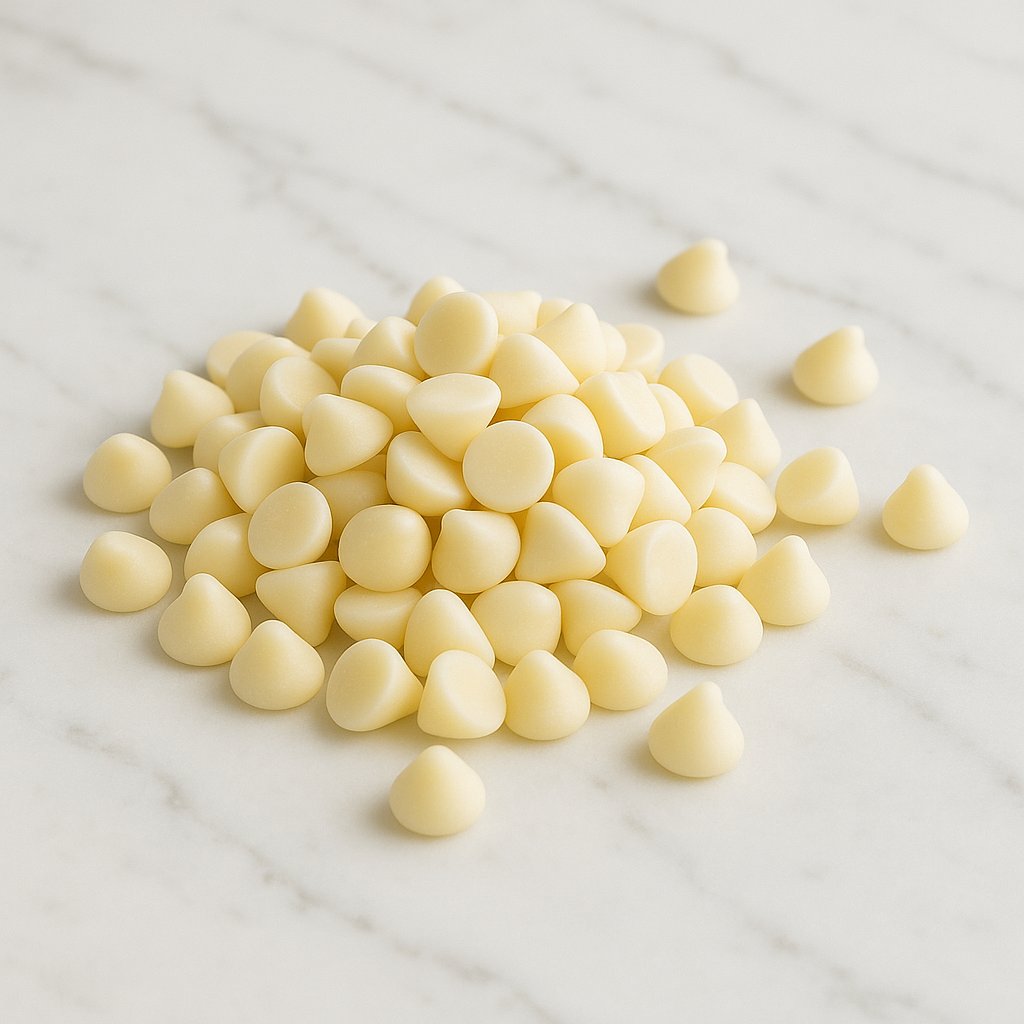
White chocolate is very widely available. You can find it in almost every supermarket, in delicatessens, in patisseries and also online. It is available as bars, shavings, couverture for melting, chocolate chips for cookies and even as drinking chocolate. In bakeries and cafés white chocolate is often used for desserts, glazes and hot chocolate.

Available types and variants
There are different kinds of white chocolate depending on how much cocoa butter, milk and sugar are used. Here are some common variants, explained simply:

  • Standard white chocolate: The normal variety you find in the supermarket. It contains cocoa butter, milk powder and sugar and is creamy and sweet.
  • White couverture: Specifically made for melting. It often contains slightly more fats so it melts smoothly — good for pralines or coatings.
  • Milky-light variants: Some types are less sweet or slightly lower in fat so they taste lighter. They are a blend of white chocolate and elements of milk chocolate.
  • Flavored white chocolate: Additional flavors are added here, e.g. vanilla, raspberry or lemon. It's similar to ice cream with different flavors.
  • Vegan or lactose-free variants: For people who cannot or do not want to consume milk, there are plant-based white chocolates. Instead of milk powder, ingredients like coconut milk, almond drink or soy powder are used.
  • Praline and baking quality: Depending on whether the chocolate is intended for direct snacking or for baking, the processing differs. Baking chocolate can be more heat-stable so that cookies or cakes do not change.
Tips for recognizing and choosing
When selecting white chocolate, check the ingredient list: good white chocolate contains a real proportion of cocoa butter and not just cheap fats. Also look at the amounts of milk and sugar — some varieties are sweeter than others. For baking, specially formulated couverture is practical because it melts well and is easy to work with.

In summary: white chocolate is widely available worldwide, is made from cocoa butter whose raw material grows in tropical countries, and comes in many variants — from ordinary bars to meltable couverture to vegan alternatives. That way almost everyone can find a suitable type for snacking or baking.
Details & nutrition

Property Value
Unit g
Calories per 100 560
Protein per 100 6.0
Carbohydrates per 100 57.0
Sugar per 100 57.0
Fat per 100 34.0
Saturated fat per 100 21.0
Monounsaturated fat 10.0
Polyunsaturated fat 1.0
Fiber per 100 0.0
Vitamin C (mg) per 100 0.0
Vitamin D (IU) per 100 0.0
Calcium (mg) per 100 200
Iron (mg) per 100 0.2
Nutri-Score E
CO₂ footprint 5.0
Origin Varies by manufacturer; typically Europe
Gluten-free Yes
Lactose-free No
Nut-free No
Vegan No
Note Nutritional values are average values for commercially available white chocolate; exact values may vary depending on manufacturer and recipe.

Technical & scientific information

White chocolate is a cocoa-based confectionery raw material that differs from dark and milk chocolate by the absence of cocoa mass. Technically, white chocolate consists primarily of cocoa butter, milk components, sugar and, if applicable, emulsifiers and flavorings. It contains no significant amounts of cocoa solids, which are responsible for the color and typical cocoa-related flavor notes of darker chocolates.

Chemical composition
The main components are cocoa butter (triglycerides of fatty acids such as palmitic, stearic and oleic acids), milk proteins (casein and whey proteins), lactose, sucrose as well as small amounts of emulsifiers such as lecithin (usually soy lecithin) and flavoring agents such as vanillin. Cocoa butter is composed mainly of saturated and monounsaturated fatty acids; its melting point is close to human body temperature, which explains the characteristic melting sensation in the mouth. Minerals and volatile aroma compounds are present in much smaller amounts than in chocolate containing cocoa mass.

Nutritional value and macronutrients
White chocolate is energy-dense. Typical nutritional values per 100 g are roughly 500–600 kcal, with the calorie share coming mainly from fat (approx. 30–40 g/100 g, primarily from cocoa butter) and sugar (approx. 40–55 g/100 g). Protein content is moderate (typically 6–10 g/100 g) and derives mainly from milk proteins. Fiber content is very low, and micronutrients like iron or magnesium are present only in traces, unlike dark chocolate, which contains higher amounts due to the cocoa solid content.

Manufacturing process
Production begins with preparing a homogeneous mass of cocoa butter, milk powder, sugar and emulsifiers. These components are milled and conched at controlled temperatures to optimize particle size and texture and to remove unwanted volatile aromas. A decisive step is tempering, during which the crystal structure of the cocoa butter is deliberately set to achieve a glossy surface, a clean snap and stability against fat bloom. Due to the high milk content, hygiene conditions and moisture control during processing are particularly important to minimize lumping and microbial risks.

Sensorial and physical properties
White chocolate is characterized by a light, ivory to yellowish-white color determined by the amount and refinement degree of the cocoa butter as well as milk components. The texture is buttery and melts quickly in the mouth because cocoa butter crystallizes and melts at body temperature. Flavor-wise, sweet, milky and vanillic notes dominate; the typical bitter or astringent components of cocoa solids are absent.

Health aspects
From a nutritional perspective, white chocolate provides a high energy density, mainly from saturated and monounsaturated fatty acids as well as sugar. Excessive consumption can contribute to a positive energy balance and thus weight gain, and increase risks for cardiometabolic diseases if sustained over time. Positive aspects include the proteins and calcium from the milk components as well as the pleasant sensory experience that can support moderate consumption. Conventional white chocolate is unsuitable for people with milk allergy or lactose intolerance; additionally, traces of soy or nuts may be relevant depending on the manufacturing environment.

Regulatory and quality aspects
In many jurisdictions there are defined minimum and maximum percentages for cocoa butter, milk components and fat content that classify a product as "white chocolate." Alternatives using vegetable fats instead of cocoa butter are often not allowed to be labeled as "chocolate." Quality features include a stable fat content, low moisture, a correctly tempered crystal structure and the absence of fat bloom or gray discoloration.

In summary, white chocolate is a technically specialized product made from cocoa butter, milk components, sugar and additives and is characterized by its physical and sensorial properties as well as by specific processing steps such as conching and tempering. Its nutritional properties make it a pleasure-oriented but calorie-dense food, whose production and labeling are determined by chemical composition and regulatory requirements.

Wiki entry for: white chocolate
Active now: 18 visitors of which 2 logged-in members in the last 5 minutes