Menu & categories

Wheat Flour Type 405

Fine wheat flour for cakes, cookies and light baked goods

Wiki about wheat flour type 405 Nutri-Score B Vegan Yes Gluten-free No Lactose-free Yes Nut-free Yes
NUTRITION / 100 g
344 kcal 10 g Protein 72 g Kohlenhydrate 1 g Fett

Introduction

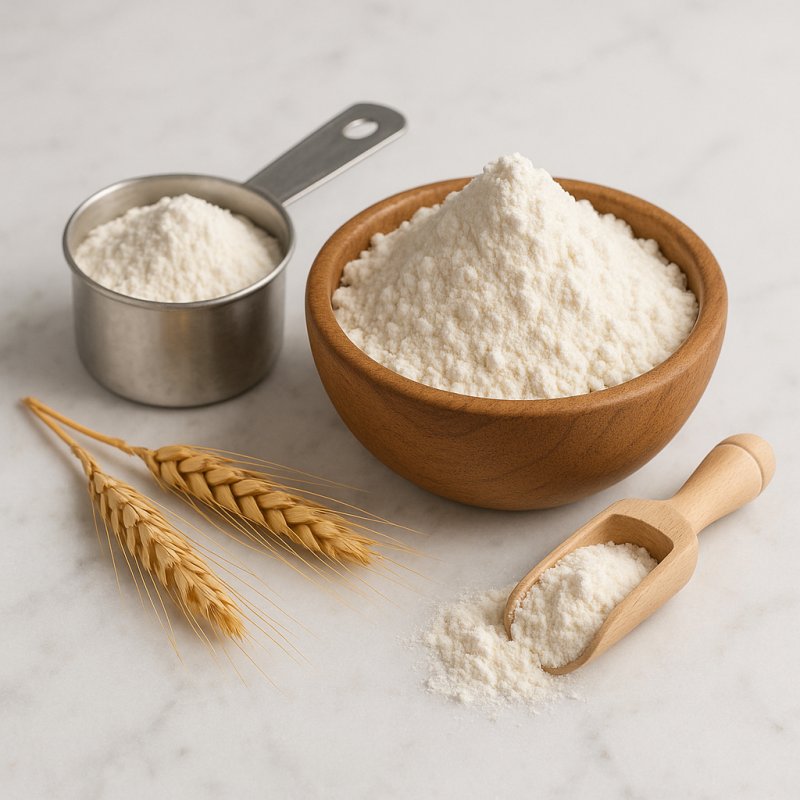
Wheat Flour Type 405 in a bowl with small heaps of flour
I still remember the day I first experimented with wheat flour Type 405 for a family recipe: it was meant to be a simple batter cake, and the flour was so fine that the batter lay almost silky in my mixing bowl. A colleague jokingly called it “the little miracle flour” because it so reliably produces tender baked goods. Since then Type 405 has been a constant companion in my kitchen.

Type 405 is the classic everyday flour in many European households. It has a comparatively low mineral content of about 405 mg per 100 g and a moderate protein content, which gives it a light, fine-pored structure. These very properties make it ideal for cakes, sponge, pancakes and delicate pastries where a soft result is desired.

I've learned that this flour is almost always a safe choice when you want to bake a delicate shortcrust or fluffy pancakes. At the same time it is not the best choice for hearty, rustic breads that require stronger gluten development and more protein. In such cases I reach for a higher type number or bread flour.

Practical notes from my kitchen:

  • Use: cakes, cookies, pancakes, fine doughs, roux.
  • Baking behavior: yields a fine crumb, should not be overworked or pastries become tough.
  • Substitution: comparable to “all-purpose flour,” but protein contents can vary — worth trying out.
  • Storage: store dry, dark and well sealed; in warm climates keep briefly in the refrigerator.
I like the versatility of this flour because it gives predictable results. If I make pancakes spontaneously one evening or step in for a birthday baking session, Type 405 is usually my first choice. It is an unassuming but reliable hero in any bakery.

Availability & types

Availability and types of wheat flour Type 405

What is wheat flour Type 405?
Wheat flour Type 405 is the very light, fine flour found in many kitchens. The name “Type 405” says something about how much of the grain's bran remains in the flour: a small number means very little bran residue is present. The flour is therefore white and is particularly suitable for cakes, cookies and fine doughs — in other words for items that should become soft and airy. You can think of it this way: Type 405 is like the whiter, finer flour, while darker flours contain more of the whole grain, just as wholemeal bread tastes more robust.

Origin and growing regions
Wheat for Type 405 grows in many countries. In Europe large quantities come from Germany, France, Poland and other countries with extensive agriculture. In Germany the flat regions such as northern Germany and parts of central Germany are important growing areas. Farmers plant winter wheat, sown in autumn and harvested the following summer. Mills then process the grain into fine flour in several steps.

Where can you buy it?

  • Supermarkets and discounters: the most common way to buy flour. There are different brands and package sizes (e.g. 1 kg or 5 kg).
  • Health food stores and organic shops: you can find organic wheat flour Type 405 from ecological farming.
  • Directly from mills or bakeries: some mills sell freshly milled flour or special varieties.
  • Online shops: wide selection, often including specialty flours or regional products.
Which variants and types exist?
Although “Type 405” is a specific grade, there are several variants to choose from:

  • Regular wheat flour Type 405: the standard home flour, good for cakes and delicate doughs.
  • Organic Type 405: from certified organic farming, often with less chemical input in the fields.
  • Regionally milled flour: from wheat grown nearby. This is good if you want to know where your flour comes from.
  • Stone-milled or roller-milled variant: some flours are gently ground in a stone mill (“stone-milled”), others in roller mills. Stone milling can give a slightly different aroma that you can taste.
  • Special package sizes: small packets for households or large sacks for bakeries.
Simple comparison
Imagine flour is like sugar: there is powdered sugar (white and fine) and coarse sugar (grittier, darker). Type 405 is the powdered sugar among flours — very white and finely milled. That makes it ideal for cakes, but not always the best choice if you want to bake a sturdy bread with a lot of structure.

In summary: wheat flour Type 405 is available almost everywhere and in many variants — from ordinary supermarket packs to organic or regional specialties. It is the flour for fine baked goods and stores well, so you can use it year-round.
Details & nutrition

Property Value
Unit g
Calories per 100 344
Protein per 100 10
Carbohydrates per 100 72
Sugar per 100 1
Fat per 100 1
Saturated fat per 100 0.2
Monounsaturated fat 0.1
Polyunsaturated fat 0.5
Fiber per 100 3.2
Vitamin C (mg) per 100 0
Vitamin D (IU) per 100 0
Calcium (mg) per 100 15
Iron (mg) per 100 1
Nutri-Score B
CO₂ footprint 0.6 kg CO2e/kg
Origin Germany/EU
Gluten-free No
Lactose-free Yes
Nut-free Yes
Vegan Yes
Note Nutritional values may vary slightly depending on the manufacturer and degree of milling.

Technical & scientific information

Wheat flour Type 405 is the most commonly used refined flour in German-speaking households and is mainly used for fine baked goods such as cakes, pastries and light breads. The type designation refers to the analytically determined ash content: Type 405 contains about 0.405% mineral residues (405 mg ash per 100 g flour) and indicates a low proportion of bran and germ components.

Chemical composition
Wheat flour Type 405 consists mainly of starch (over 60–70% of the dry mass) and contains proteins (primarily gluten proteins) in typical ranges of about 9–11 g per 100 g. Other components are lipids (approx. 1–2 g/100 g), soluble and insoluble fiber (typically 2–3 g/100 g) and small amounts of minerals (ash). The most important protein components are gliadin and glutenin, whose interaction determines the gluten structure and thus baking properties.

Milling and production process
Production includes cleaning the grain, tempering to adjust moisture content and subsequent rolling and sieving in multiple stages. When milling for Type 405 the outer layers (bran) and the germ are largely removed, which produces the light color and low mineral content. The extraction rate typically lies around 70–75%, depending on mill parameters.

Baking technical properties
Type 405 is characterized by a relatively fine flour structure, moderate water absorption and a rather low gluten potential compared with higher types or specialized bread flours. Therefore it is particularly suitable for short-baked, delicate doughs and fine crumbs. Important processes during baking are:

  • Formation of the gluten network by mechanical working and hydration.
  • Starch gelatinization during heating, which contributes to crust formation and texture.
  • Enzymatic processes (especially amylases) that convert starch into sugars and supply substrate to yeast or other leavening agents.
Nutritional value and health aspects
Nutritional values vary; typical values per 100 g are about 340–360 kcal (≈1400–1500 kJ), 70–76 g carbohydrates, 9–11 g protein, 1–2 g fat and 2–3 g fiber. As a refined flour, Type 405 contains fewer vitamins (e.g. B vitamins) and minerals than wholemeal flours. Key health points are:

  • For people with celiac disease or gluten intolerance, wheat flour is unsuitable because the gluten proteins it contains can trigger immune reactions.
  • Refined flours have a higher glycemic index than wholegrain variants, which can affect postprandial blood sugar responses.
  • Where necessary, flours in some regions are industrially fortified or enzymatically/chemically treated to improve baking properties or supplement micronutrients.
Safety, storage and quality
Quality parameters include moisture, ash, protein content and microbiological safety. Contaminants such as mycotoxins (e.g. deoxynivalenol) are regulated and monitored. Flour should be stored cool, dry and protected from pests; higher moisture promotes spoilage and microbial growth.

Applications
Typical applications are cake and pastry batters, fine pastry, pancakes, sauces and light breads, often in combination with stronger flours or additives to achieve certain dough properties.

In summary, wheat flour Type 405 is a finely milled, light flour with low mineral content that, due to its baking properties, is especially suitable for fine doughs but provides fewer fibers and micronutrients than wholemeal flours.

Wiki entry for: wheat flour type 405
Active now: 17 visitors of which 2 logged-in members in the last 5 minutes