Menu & categories

Torrone

Italian nougat made from honey, sugar, egg white and nuts

Wiki about torrone Nutri-Score E Vegan No Gluten-free Yes Lactose-free Yes Nut-free No
NUTRITION / 100 g
470 kcal 8 g Protein 65 g Kohlenhydrate 18 g Fett

Introduction

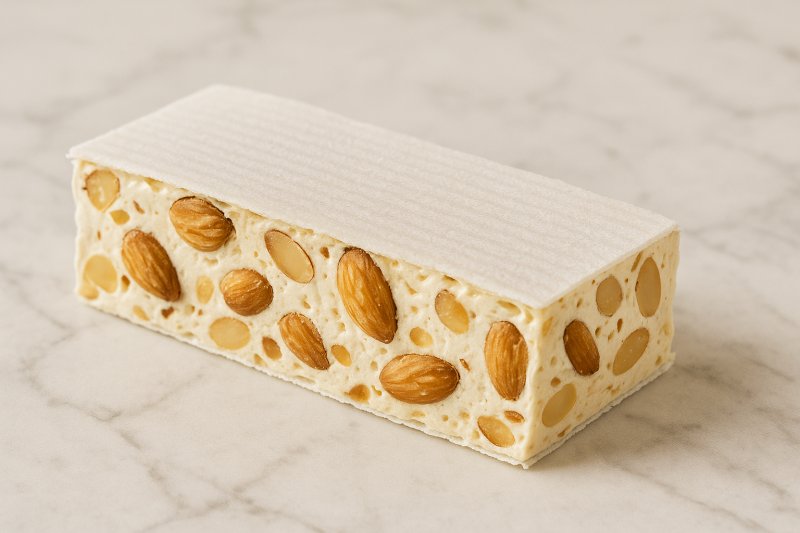
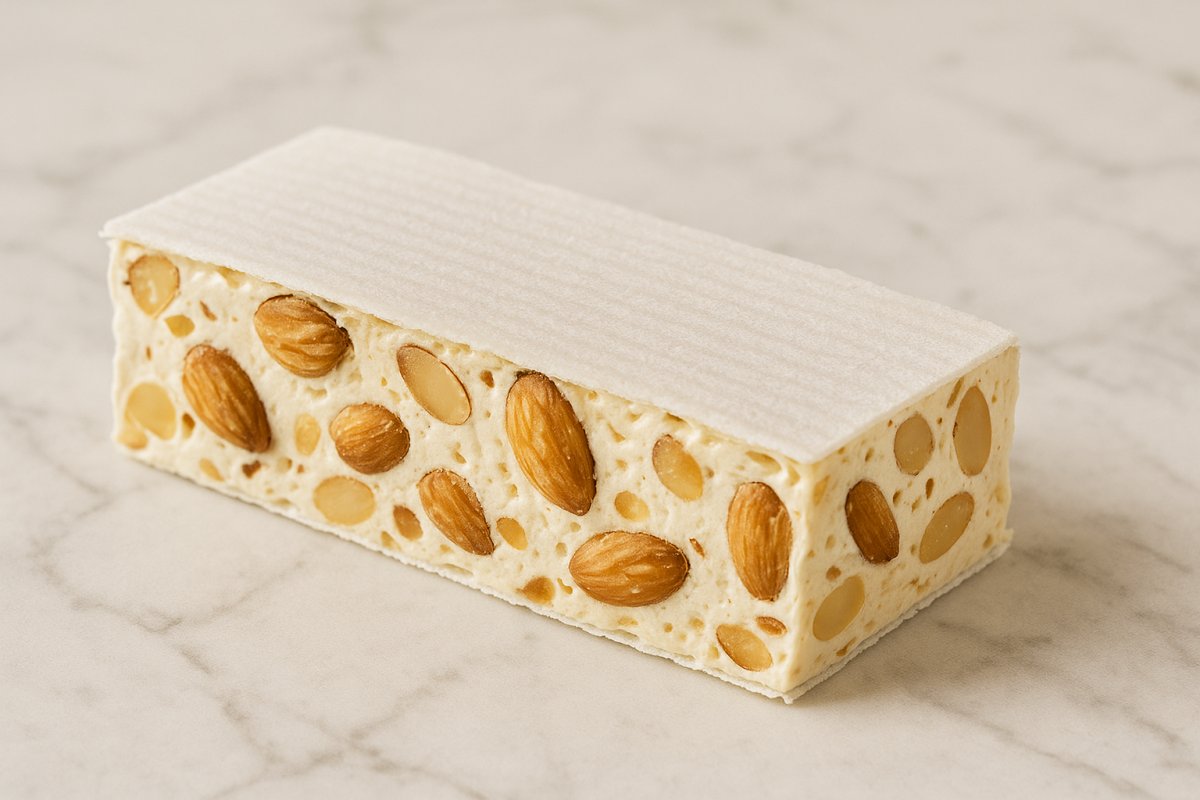
A piece of torrone with almonds, cut open
I still remember the first bite of torrone that I consciously enjoyed: it was at a market that smelled of oranges, cinnamon and freshly roasted almonds. An older vendor had shown it to me, smiling as she handed me a piece that looked so glossy and honey-sweet that I briefly feared it would stick to my teeth. Instead it broke gently, gave me a velvety almond texture and a warmth that recalled family celebrations and Sunday coffee. Since then torrone has a firm place in my culinary memories.

Torrone is a traditional nougat specialty that exists in many variants around the Mediterranean. The basic ingredients are simple: honey, egg whites and nuts, mostly almonds, sometimes hazelnuts or pistachios. But precisely this simplicity allows an astonishing range: soft or hard, with candied fruit, cocoa notes or delicate orange blossom. A friend from the south swears by the soft, almost foamy variant, while a colleague from the north prides herself on the crunchy, almost caramelized version.

What I love about torrone is its multilayered nature between artisanal tradition and personal memory. In small manufactories it is still traditionally stirred and pulled, often over an open fire, until the mass reaches the right consistency. These rituals give the product not only texture but also character. Once at a weekly market I saw a producer work nuts into the warm mass with practiced movements; the sun's rays caught the golden shine of the honey and for a moment I thought I had a small work of art in my hand.

  • Taste: sweet, nutty, sometimes slightly floral or citrusy.
  • Texture: ranges from soft and tender to hard and crispy.
  • Occasions: holidays, gifts, accompaniment for coffee and desserts.
I have served torrone on many occasions: at an impromptu evening with friends, when people were exchanging old travel stories, and on a cozy winter afternoon with strong espresso. Once an acquaintance brought a hand-wrapped variety flavored with candied bergamot — we argued so lively about whether bergamot fit the classic pattern that the dessert almost became secondary. Conversations like these show how food creates identity and evokes memories.

For me torrone remains more than just a sweet: it is a piece of culture that carries stories. It connects the craft of old confectioners with modern variations and invites you, at the next bite, to pause briefly, follow the aromas and remember those markets, kitchens and people who occasionally surprise us with something sweet.

Availability & types

Availability and types

Torrone is a sweet specialty found especially in Italy and Spain, but also in many other countries. The flavor is reminiscent of a soft, honey- or sugar-based bar with nuts. Because torrone has been made for many centuries, there are today many different kinds and versions. You can buy it in supermarkets, at Christmas markets, in confectioneries (these are shops that sell sweets and pralines) and often online.

Where does torrone come from?
Originally torrone comes from the Mediterranean region, especially Italy and Spain. In Italy many say it comes from cities like Cremona or from Sardinia; in Spain similar sweets are known under the name "turrón". These sweets were long made for holidays like Christmas and passed on, much like families share cookies today.

Growing regions and ingredients
Torrone itself does not grow in fields — it is a processed product — but the main ingredients come from certain regions:


  • Almonds: These nuts are present in many types of torrone. Almonds are often grown in warm, sunny regions like Spain, Italy or California. Almonds give torrone its nutty flavor and its firm bite structure.
  • Hazelnuts and pistachios: Sometimes other nuts are used as well. Pistachios often come from regions such as Sicily or the Middle East.
  • Honey and sugar: These ingredients make torrone sweet and sticky. Honey comes from beehives kept in many countries.
  • Egg whites: This is the white part of chicken eggs. It helps make the mass lighter and airier, similar to whipped egg white.
The quality of the nuts and the honey greatly influences how good the torrone tastes.
What varieties are there?
You can buy torrone in different shapes and levels of hardness. Here are the most common types, explained in simple terms:
  • Soft torrone: It is chewy and easy to bite, almost like soft caramel. People who do not like hard textures prefer this variant.
  • Hard torrone: This is compact and breaks easily, similar to a crispy cookie. It often contains more nuts and is drier than the soft variety.
  • Torrone with chocolate: Sometimes torrone is dipped in chocolate or contains chocolate pieces. This combines the nutty flavor with chocolate — like a chocolate bar with nuts.
  • Colored or flavored torrone: There are colorful variants or flavors with lemon, orange or cocoa. These give torrone a fresh or distinctive taste, similar to candies with different flavors.
  • Regional specialties: In Sicily there is torrone with many pistachios, in other areas with particularly high honey content or special nuts. This is comparable to how pizza tastes different from one city to another.
How to find the right variety?
If you want to buy torrone, it helps to consider: do you want something soft or something crunchy? Do you like chocolate or prefer only nuts and honey? In stores the packaging often has pictures and short descriptions. At markets you can sometimes taste before you buy — it's like trying an ice cream before getting a whole scoop.

Overall torrone is easy to obtain, especially in the pre-Christmas season, and there are many variants for different tastes. Whether soft, hard, with chocolate or with many pistachios — there is a suitable variety for almost every taste, and that makes torrone a popular sweet for special occasions.
Details & nutrition

Property Value
Unit g
Average weight per piece 30
Calories per 100 470
Protein per 100 8
Carbohydrates per 100 65
Sugar per 100 60
Fat per 100 18
Saturated fat per 100 2
Monounsaturated fat 11
Polyunsaturated fat 4
Fiber per 100 3
Vitamin C (mg) per 100 0
Vitamin D (IU) per 100 0
Calcium (mg) per 100 80
Iron (mg) per 100 1.5
Nutri-Score E
CO₂ footprint 3.5
Origin Italy and the Mediterranean region
Gluten-free Yes
Lactose-free Yes
Nut-free No
Vegan No
Note Nutritional values refer to classic white torrone with almonds; recipes may vary by manufacturer.

Technical & scientific information

Torrone is a traditional confectionery that originated in Southern Europe and North Africa and is especially widespread in Italy and Spain. Technically speaking, torrone is a solid, porous mass made from sucrose-rich sugar syrups, fats (often in the form of honey), and a high proportion of proteins from whipped egg white as well as chopped or whole nuts. The typical texture arises from the combination of crystalline-bound sugar and a stabilized foam structure achieved by mechanical incorporation of air during mixing.

Chemical composition
The main components of torrone are carbohydrates (predominantly sucrose, glucose and fructose), proteins (albumins from egg white and proteins from nuts), lipids (contained in the oils and fats of the nuts as well as any added fat) and water. The sugar syrup is often cooked to a certain Brix degree, producing a controlled concentration and viscosity. On cooling sucrose and possibly inverted sugar form a matrix that remains partly amorphous and partly develops crystalline fractions; this microstructure affects chewing sensations and shelf stability.

Ingredients and nutritional values
Standard torrone typically contains between 350 and 500 kcal per 100 g, depending on the nut content and honey amount. The carbohydrate share is usually 60–75 g/100 g, fats 10–25 g/100 g and proteins 5–10 g/100 g. Micronutrients vary with the nuts used: almonds and hazelnuts provide vitamin E, magnesium, calcium and unsaturated fatty acids. Honey brings small amounts of bee enzymes and traces of amino acids, while eggs contribute cholesterol and essential amino acids.

Processing methods
Both industrial and artisanal production include several key phases:

  • Syrup cooking: Sucrose and, if applicable, glucose are heated with water and honey to reach a syrup with defined viscosity. Temperature control is crucial to achieve the desired final consistency.
  • Beating the egg whites: Mechanical beating denatures the proteins and forms a stable foam. This is the basis for the airy structure.
  • Mixing: The hot syrup is carefully stirred into the egg whites; heat further denatures egg proteins, after which a gel-like matrix forms that can entrap the sugar.
  • Addition of nuts: Roasted nuts are incorporated, which affects the texture, fat content and flavor.
  • Shaping and curing: The mass is poured into molds or cut and then cooled and dried so that excess moisture is reduced and the structure stabilizes.
Physicotechnical aspects
The stability of torrone depends on water activity (aw), sugar crystallization and protein networks. Excessive moisture promotes microbial activity and too little moisture can lead to a brittle product. Controlling crystallization is important to avoid undesirable sugar bloom. Furthermore, the particle size of the nuts influences mechanical properties: larger pieces increase crunchiness, a finer grind produces more homogeneous textures.

Health aspects
Torrone is energy-dense and provides rapidly available carbohydrates as well as secondary lipids and proteins. From a nutritional perspective it is an indulgence that should be consumed in moderation. Allergic people must watch out for egg and nuts, as these are common triggers of severe allergic reactions. Due to the high sugar and calorie content, excessive consumption is associated with risks such as tooth decay and weight gain. Variants with reduced sugar, whole nuts or partial replacement of sugar by sugar alcohols exist, but these alter gel formation and texture.

In summary torrone is a technologically interesting food whose properties are determined by the interplay of sugar physics, protein chemistry and fat matrix. Small changes in recipe or process conditions lead to markedly different textures, flavors and storage stability, which is why production and quality control play a significant role.

Wiki entry for: torrone
Active now: 20 visitors of which 2 logged-in members in the last 5 minutes