Menu & categories

Sugar sprinkles

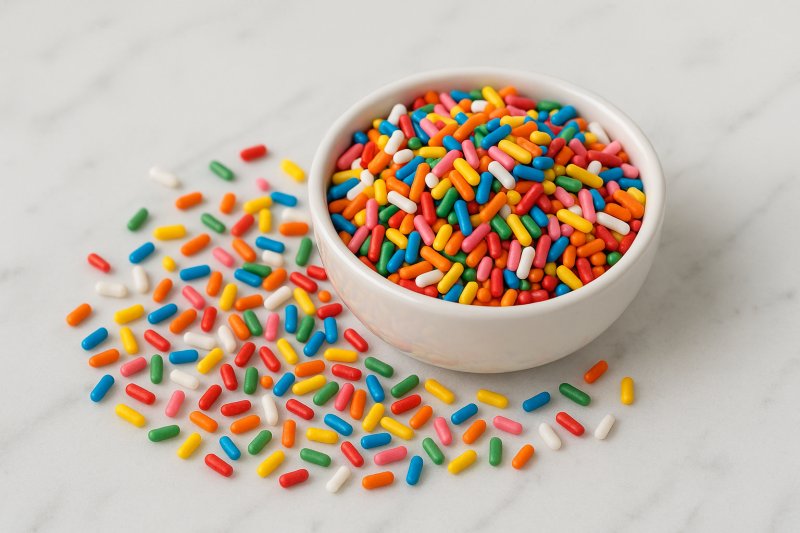
Colorful sugar sprinkles for decorating baked goods and desserts

Wiki about sugar sprinkle Nutri-Score E Vegan Yes Gluten-free Yes Lactose-free Yes Nut-free Yes
NUTRITION / 100 g
400 kcal 0.2 g Protein 98 g Kohlenhydrate 0.5 g Fett

Introduction

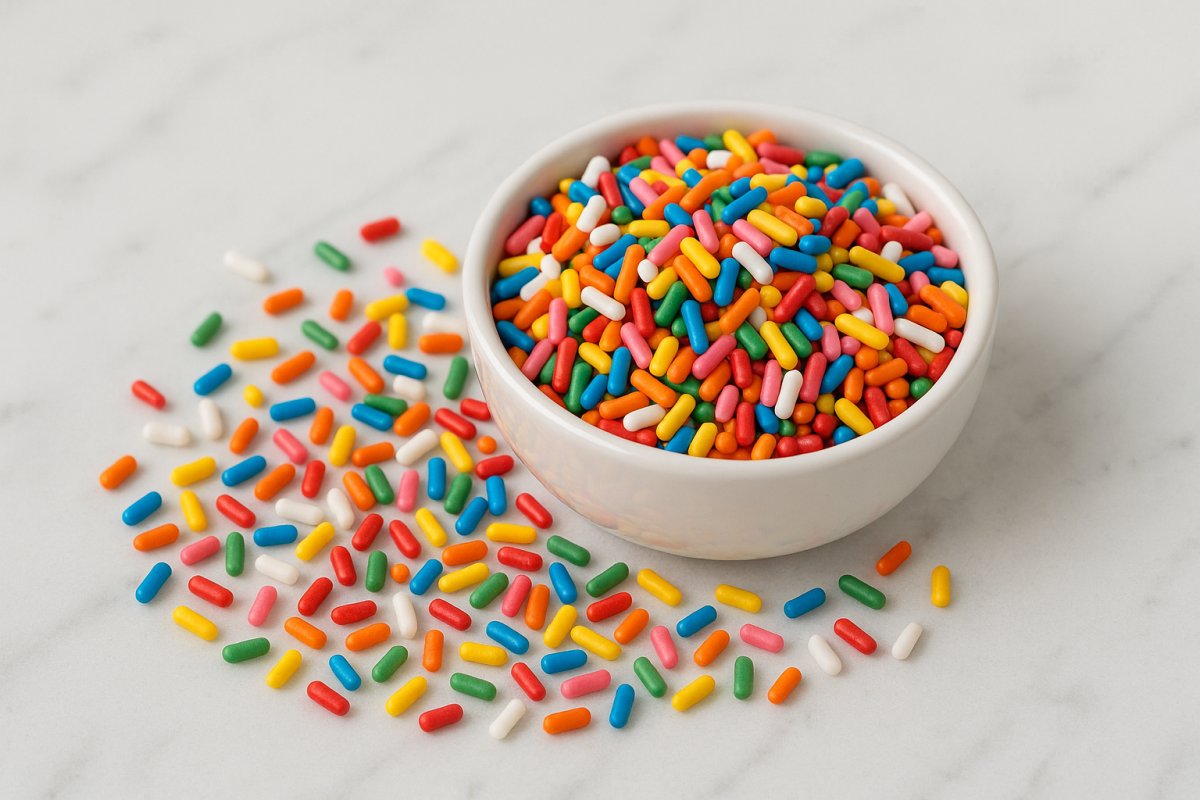
Colorful sugar sprinkles in various colors
I confess: sprinkles feel both comforting and childlike to me. When I think of them I immediately see the colorful specks on a freshly glazed donut or the fine, shimmering pearls on my grandmother's vanilla cake. In my kitchen they are always within reach in a jar, and often enough I've stolen a spoonful in the morning just to give myself a small, sugary moment of happiness. A colleague once laughed when he caught me and said sprinkles were my "secret refinement" — and maybe he was right.

What makes sprinkles so fascinating is their simple versatility. Whether fine or coarse, colorful or single-colored, they change the texture and appearance of a baked good in seconds. I remember another time when an impromptu cookie baking session with friends became a visually impressive result thanks to a bowl of mixed sprinkles. We had only a few ingredients and a bit of imagination, and suddenly our simple butter cookies looked like little works of art.

Practical tips for use

  • Sprinkle on freshly glazed or still-warm surfaces so they adhere well.
  • Fine sprinkles are excellent for delicate cupcakes, while coarse or mixed varieties give cookies and donuts character.
  • When it's humid, add sprinkles last, otherwise they lose their crunch.
When choosing I like to pay attention to quality: some sprinkles contain glazing agents or artificial flavors, which I sometimes avoid when I prefer a more natural taste. At the same time I love playing with colors — especially for holidays like Christmas or birthdays. Sometimes I mix my own versions from powdered sugar, a little food coloring and chopped nuts to vary texture and flavor. A friend once suggested combining sprinkles with spices like cinnamon or cardamom; it was a revelation and paired wonderfully with winter pastries.

In the end sprinkles for me are more than just decoration: they are a small act of joy, a visual handshake between baker and taster. They tell stories of quick gatherings, childhood tables and improvised baking sessions on rainy Sundays. So I continue to keep a jar of them in the cupboard — for the perfect, sugary finish to any pastry.

Availability & types

Availability and types of sprinkles

Sprinkles are small colorful or single-colored sugar beads or strands that you sprinkle on cakes, cookies or ice cream to make them prettier and tastier. They are usually made from simple sugar, sometimes with some color and flavor. Because they are so easy to use, you can find sprinkles in many supermarkets, bakeries or even in craft and party stores.

Origin
Sprinkles themselves are not "harvested" like fruit or vegetables. They are made from sugar, which usually comes from two plants: sugar beet and sugar cane. Sugar beets grow well in cooler areas, for example in many parts of Europe, while sugar cane grows better in warm countries like Brazil, India or parts of Africa. The sugar from these plants is refined, melted and then formed into small shapes such as beads, rods or flakes. Food coloring is often added at the end to make the sprinkles colorful.

Growing regions
The plants used to produce the sugar for sprinkles are grown in different places:

  • Sugar beets: Mainly in Europe, the USA and parts of Asia. They look like large white beets and are harvested from fields.
  • Sugar cane: This grows in hot, tropical regions. Major growing areas include countries such as Brazil, India, Thailand or Australia.
So if you look at the package of sprinkles in the supermarket, it sometimes says whether the sugar comes from beets or cane. For most people it doesn't make much difference when using them in sweets, but it explains where the raw materials come from.

Available types and varieties
Sprinkles come in many shapes and colors. Here are the most well-known types, explained simply:

  • Colored sprinkles: Small elongated bits in many colors. They recall colorful laundry fluttering in the air and are popular on muffins or ice cream.
  • Nonpareilles (sugar beads): Very small round beads that look like tiny pearls. They give cakes a crunchy surface.
  • Jimmies: Another word for the long colored sprinkles, used especially in some English-speaking countries.
  • Chocolate sprinkles: These are often made from chocolate or contain cocoa powder, so they taste like chocolate rather than just sweet.
  • Glitter or metallic sprinkles: They shimmer like glitter and are often used for special occasions. Some are edible due to food coloring, others are meant only for decoration and should not be eaten — this is usually indicated on the packaging.
  • Shape sprinkles: Small figures like hearts, stars or letters, often found on birthday cakes.
Some sprinkles are extra fine and suit small cookies well, others are larger and give a stronger crunch effect. The packaging usually states whether they are vegetarian or contain specific ingredients. That way you can easily choose the variety that best fits your cake or ice cream.

In summary: Sprinkles are widely available, are made from sugar whose raw materials come from various countries, and come in many shapes and colors. Whether colorful bits, small beads, chocolate variants or sparkling shapes — there is a suitable sprinkle for every celebration cake or ice cream cone, and they are easy to find in stores.
Details & nutrition

Property Value
Unit g
Calories per 100 400
Protein per 100 0.2
Carbohydrates per 100 98
Sugar per 100 95
Fat per 100 0.5
Saturated fat per 100 0.3
Monounsaturated fat 0.1
Polyunsaturated fat 0.1
Fiber per 100 0
Vitamin C (mg) per 100 0
Vitamin D (IU) per 100 0
Calcium (mg) per 100 5
Iron (mg) per 100 0.1
Nutri-Score E
CO₂ footprint 1.0
Origin Varies depending on the manufacturer
Gluten-free Yes
Lactose-free Yes
Nut-free Yes
Vegan Yes
Note Typical ingredients: sugar, glucose syrup, vegetable oils/fats, starch, colorings and glazing agents; exact composition may vary depending on the manufacturer.

Technical & scientific information

Sprinkles are small decorative particles of crystalline sugar used to garnish baked goods, desserts and beverages. They consist predominantly of sucrose, a disaccharide composed of glucose and fructose. Sprinkles can be uniformly white or produced in a variety of colors and shapes through addition of food colorings and carriers. Technically, they are usually colored, dried sugar grains processed to provide shape stability and a pleasant mouthfeel.

Composition and ingredients
The main component is sucrose. In addition to pure sugar, sprinkles generally contain small amounts of stabilizers, anti-caking agents and colorants. Commonly used additives include:

  • Food colorings: synthetic azo dyes or natural colorants such as concentrated beetroot juice, depending on the product label.
  • Flavors: rare, mainly used in specially flavored sprinkles.
  • Anti-caking agents such as E471 (mono- and diglycerides of fatty acids) or treated starches to prevent clumping.
  • Humectants are used in some varieties to prevent breakage and increase flexibility.
Nutritional value
Sprinkles provide primarily energy in the form of carbohydrates. Nutritional values vary slightly depending on additives but typically range around 380–400 kcal per 100 g. Macronutrient distribution is predominantly carbohydrates (> 95 %), with negligible amounts of protein and fat. Micronutrients are practically absent, so they are an energy-dense, nutrient-poor ingredient.

Manufacturing process
The production of sprinkles includes several technically controlled steps. First, a saturated sucrose solution is prepared and, if needed, mixed with colorants. This is followed by crystallization or drying in spray or agitation-condensation systems to form small, solid particles. For shaped variants, the sugar solution is poured into molds or spread on conveyor belts into thin layers that are broken and sieved after drying. Finally, anti-caking agents are applied and packaging is done under controlled climatic conditions to prevent moisture uptake and clumping.

Physical properties
Sprinkles are sensitive to moisture: sucrose is hygroscopic and tends to absorb water at high relative humidity, causing caking and partial dissolution. Temperature and storage humidity are therefore critical parameters for shelf life and appearance. Particle size affects spreading behavior and mouthfeel; finer grains melt faster, coarser ones remain crunchy longer.

Health aspects
As a sugar product, sprinkles contribute to total sugar intake, which with excessive consumption can increase the risk of dental caries, weight gain and metabolic diseases. Colorants and additives should be considered according to labeling, as some synthetic dyes can cause intolerances or allergic reactions in sensitive individuals. For people with diabetes, the effect on blood glucose should be considered; sprinkles are not a suitable alternative to sweeteners.

Environmental and food-technical aspects
Production is energy- and water-intensive, especially during drying and crystallization steps. Environmentally conscious manufacturers increasingly use natural colorants and optimized packaging to reduce food waste and moisture issues. Food safety depends on microbiological control and prevention of contamination during final processing.

Overall, sprinkles are a simply composed but technically optimized ingredient whose properties strongly depend on moisture, particle size and additives used. Their use increases the visual appeal of foods but provides no significant micronutrients nutritionally, so consumption should be in moderation.

Wiki entry for: sugar sprinkle
Active now: 18 visitors of which 2 logged-in members in the last 5 minutes