Menu & categories

Star anise

Aromatic spice with an intense licorice flavor

Wiki about star anise Nutri-Score B Vegan Yes Gluten-free Yes Lactose-free Yes Nut-free Yes
NUTRITION / 100 g
337 kcal 18 g Protein 50 g Kohlenhydrate 15 g Fett

Introduction

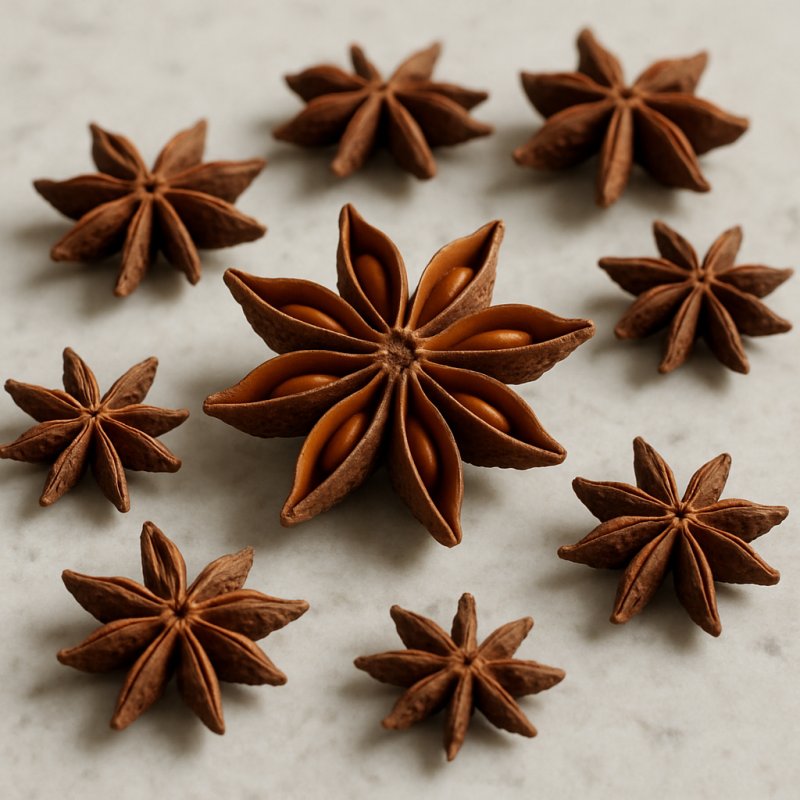
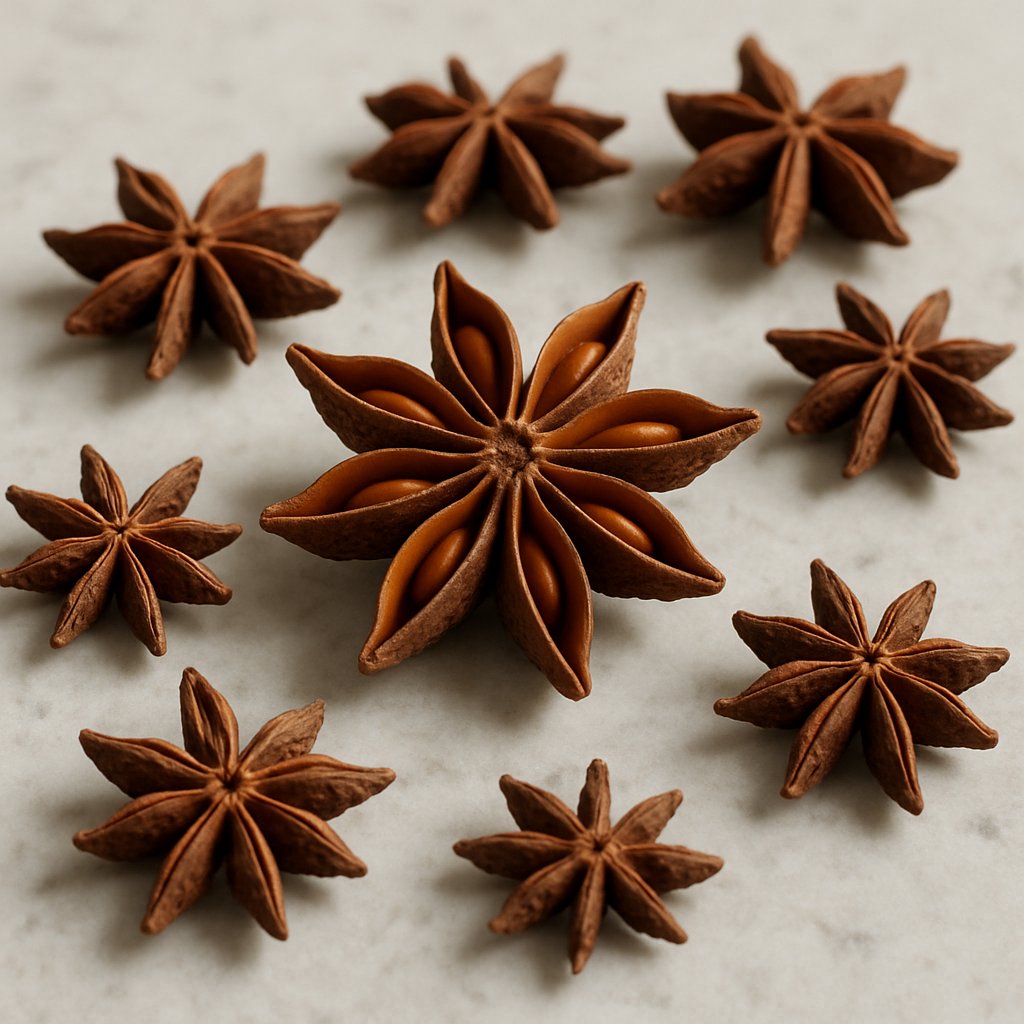
Dried star anise pods on a light background
I still clearly remember my first conscious encounter with star anise: it was on a rainy afternoon at a small market, where the scent of spices hung over the stalls like a warm blanket. A vendor handed me a handful of shiny, star-shaped fruits, and I was immediately fascinated by the combination of visual elegance and an intense, licorice-like aroma. Since then star anise has found a permanent place in my kitchen – not only as a spice but also as a source of inspiration for experiments and small culinary stories.

Star anise comes from Asia and is the dried fruit of an evergreen tree. Visually it resembles a small, perfectly formed star and brings a mixture of sweetness, spice and a clear anise note to dishes. I like to use it in braises, broths and even desserts, because it pairs so nicely with cinnamon, cloves and cardamom. A colleague of mine once swore that his borscht would never be the same without a pinch of star anise – and I had to admit he was right.

The handy shape makes star anise particularly practical: you can put the whole fruit into soups or stews and remove it before serving, or crush the seeds to release a more intense aroma. I like to break it and gently tap it with the mortar before it simmers in a stock. Its aromas develop especially well at low heat, which is why in traditional recipes it is often cooked with the dish for a long time.

Aside from the taste, star anise also has a pretty visual effect on plates and in gift jars. I once gave a jar of homemade gingerbread spice mix in which I placed a whole star anise as a decorative and fragrant element; the recipient called immediately, delighted. Such small details make cooking an experience for me.

  • Taste: Sweetish, anise-like, slightly spicy.
  • Use: Soups, stews, baked goods, desserts, liqueurs.
  • Preparation: Leave whole to infuse or open the seeds and grind.
If I may offer a tip: less is often more. One whole star anise is enough to give a large pot of broth depth without dominating. The first time you try it, proceed cautiously and let yourself be surprised by its versatility – I promise star anise will win your heart faster than you can say "anise".

Availability & types

Availability and types of star anise

Star anise is a distinctive spice fruit that looks like a star and has a strong, sweet smell similar to licorice. If you want to know where star anise comes from and what types exist, it helps to imagine it like fruit varieties: it grows in specific places, in different forms and is sold in different ways.

Origin
Star anise originally comes from Asia. The plant is called "star anise" in English and comes mainly from countries with warm, humid climates. You can think of it like oranges: they also grow best in warm regions. In the past star anise was mainly collected in gardens and parks in Asia and then brought to other countries because many people like the spice for sauces, soups and sweets.

Growing regions
Today star anise is mainly cultivated in these regions:

  • China: The largest growing area. There are many fields and plantations where the trees grow.
  • Vietnam: Also important for production. The plants there are often tended on smaller farms.
  • India and other Southeast Asian countries: Star anise is also found there, but in smaller quantities.
You can imagine it like bananas: some countries produce a lot of bananas and others only grow a few. For star anise China is the "major producer".
Available varieties and variants
There are not as many different types of star anise as there are apple varieties, but there are still differences that matter:
  • Mature star anise (dried fruits): This is the usual form you find in the supermarket. The individual seed capsules have the typical star shape. After drying they become hard and dark brown. This variant is often used for cooking.
  • Fresh star anise: Sometimes it is available fresh, when it is greener and softer. Fresh star anise has a slightly different aroma and is sold less often because it spoils quickly.
  • Ground star anise: When the stars are ground into powder, they are called ground star anise. This is practical because you don't have to chew pieces and the spice dissolves easily into dough or sauces. The disadvantage: the aroma dissipates faster than with whole stars.
  • Japanese star anise (Illicium anisatum) vs. Chinese star anise (Illicium verum): Here is an important distinction: the true edible star anise is Illicium verum and comes from China. There is a similarly appearing plant called Illicium anisatum (sometimes called Japanese star anise) that is poisonous and must not be eaten. Therefore it is important to pay attention to the correct name—just as you must be sure mushrooms are not poisonous.
Where can you buy star anise?
Star anise is available in many supermarkets, spice shops and markets. In Asian grocery stores you often find a wider selection and fresher goods. You can also order it online. When you buy star anise, pay attention to:

  • whole, intact star capsules for long-lasting aroma,
  • ground powder for quick use,
  • secure origin so you don't accidentally get a poisonous variety.
In summary: star anise mainly comes from Asia, especially China and Vietnam. You get it as dried stars, sometimes fresh or as powder. Make sure to choose the edible variety so your food tastes good and stays safe.
Details & nutrition

Property Value
Unit g
Average weight per piece 1.5
Calories per 100 337
Protein per 100 18
Carbohydrates per 100 50
Sugar per 100 0
Fat per 100 15
Saturated fat per 100 0.6
Monounsaturated fat 2.0
Polyunsaturated fat 10.0
Fiber per 100 16
Vitamin C (mg) per 100 21
Vitamin D (IU) per 100 0
Calcium (mg) per 100 640
Iron (mg) per 100 13
Nutri-Score B
CO₂ footprint 3.5
Origin China and Southeast Asia
Gluten-free Yes
Lactose-free Yes
Nut-free Yes
Vegan Yes
Note Dried star fruit of the evergreen tree Illicium verum; very intense aroma, typically used in small amounts as a spice in sweets, teas and savory dishes.

Technical & scientific information

Star anise (Botanical name: Illicium verum) is the dried fruit of an evergreen tree in the family Illiciaceae, cultivated mainly in southern China and Vietnam. The characteristic eight‑pointed star shape of the capsules makes it both visually striking and easily recognizable. Botanically it is not an anise in the sense of Pimpinella anisum, but a distinct group of species with a similar anise‑like aroma, valued especially in Asian cuisine and in pharmacy.

Chemical composition and important constituents

  • The primary volatile aroma of star anise is determined by anethole (trans‑anethole), which can often make up 80–90% of the essential oil. Anethole gives the sweet‑spicy, licorice‑like smell and taste.
  • Other components of the essential oil include estragole, linalool, limonene and smaller terpenes that complement the scent profile.
  • In addition to volatile oils, star anise contains tannins, traces of lipids, organic acids and complex polyphenols that may contribute to antioxidant properties.
  • The essential oil content varies depending on harvest time, origin and storage; typical ranges are 2–4% (w/w) for dried fruits.
Nutritional values

Used as a spice in small amounts, star anise's contribution to macronutrients is negligible. Dried star anise fruits consist mainly of fiber and contain small amounts of carbohydrates, proteins and fats. Micronutrients are usually not present in relevant amounts, so nutritional effects arise primarily from secondary plant compounds.

Processing methods and applications

  • For spice preparations whole, dried star anise capsules are used, which release their aroma slowly when cooked or brewed. Ground powder is possible but loses aroma more quickly.
  • To obtain the essential oil, steam distillation of the dried fruits is performed. The oil obtained is used in the perfume and food industries and for the production of anethole.
  • Star anise serves as a flavoring in soups, meat dishes, marinades and baked goods; it is a classic spice in five‑spice mixes and is used for mulled wine and teas.
Pharmacological and health aspects

The pharmacological effects of star anise are mainly attributed to anethole. Anethole has spasmolytic effects and may relieve gastrointestinal complaints. In vitro and in animal models antimicrobial, antioxidant and inflammation‑modulating effects of extracts and oil components have been reported. Clinical evidence in humans is, however, limited.

It is important to distinguish it from the morphologically similar but poisonous Japanese star anise (Illicium anisatum), whose constituents contain neurotoxic sesquiterpene lactones. Contamination or confusion can lead to poisoning. In industrial processes quality controls using gas chromatography and mass spectrometry are used to determine anethole content and exclude contaminants.

With normal culinary use star anise and its oil are considered safe. High doses of pure anethole, however, can be irritating and should be avoided, especially in children, pregnant women and people with potential drug interactions. Allergic reactions are rare but possible.

Sustainability and storage

Star anise requires a tropical climate and intensive manual labor for harvesting and drying. Sustainable cultivation methods and proper drying processes are crucial for the quality of the essential oils. Dried fruits should be stored protected from light and moisture to minimize oxidation and aroma loss.

Summary

Star anise is an aromatically potent spice fruit with a high content of anethole and other volatile constituents, making it interesting both culinarily and pharmacologically. Its processing includes drying, grinding and distillation to obtain the oil. Health benefits are suggested by traditional use and preclinical studies, but caution is advised in case of contamination with similar, toxic species. Quality analysis and proper storage ensure aroma and safety.

Wiki entry for: star anise
Active now: 27 visitors of which 2 logged-in members in the last 5 minutes