Menu & categories

Sour cream

Creamy dairy product with a mild tangy taste for enhancing dishes.

Wiki about sour cream Nutri-Score D Vegan No Gluten-free Yes Lactose-free No Nut-free Yes
NUTRITION / 100 g
193 kcal 2.4 g Protein 3.4 g Kohlenhydrate 20.0 g Fett

Introduction

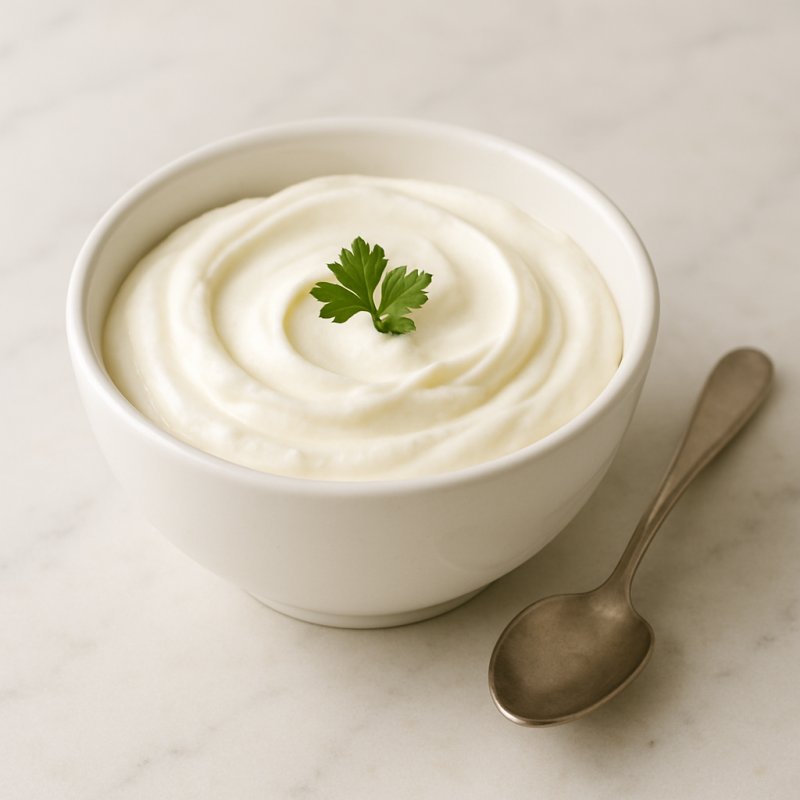
Bowl of sour cream
Sour cream for me is a little kitchen magic that instantly gives dishes depth, freshness and a touch of homeliness. I still remember a rainy afternoon when I elevated a simple baked potato with a dollop of sour cream and suddenly felt like I was holding something familiar and very good. That taste connects me equally with soups, dips and sweet oven pancakes.

Technically, sour cream is pasteurized cream fermented with lactic acid bacteria. The result is a mildly tangy, creamy product with a moderate fat level that is clearly different from Schmand or Crème fraîche. While Crème fraîche is more heat-stable and higher in fat, sour cream scores with lightness and a fresher aroma.

I use sour cream in many situations: as a cool counterpoint to spicy sauces, as a binder in salad dressings or simply plain on roasted pumpkin. A colleague of mine swears by a spoonful of sour cream in his bowl of borscht; he says it is what makes the soup complete. Sometimes I stir sour cream with herbs and lemon zest into a quick dip that will convince everyone at the next barbecue.

  • Tips for use: Add sour cream to hot dishes shortly before serving, otherwise it can curdle.
  • Substitutes: Natural yogurt, Greek yogurt or Crème fraîche depending on the desired consistency and heat tolerance.
  • Storage: Always keep well sealed in the refrigerator and consume within a few days.
I like sour cream because it is uncomplicated yet full of character. It can never dominate a dish, but it makes flavors clearer and textures more pleasant. For me it belongs to the basic equipment in the fridge, ready to transform a boring dinner into something special.

Availability & types


Availability and types of Sour cream

Origin: Sour cream comes from cow's milk. The milk is first separated to obtain cream – the thicker, fat-rich part of the milk. Then special, harmless bacteria are added to the cream; they work like tiny kitchen helpers: they consume some of the sugar in the milk and produce acid. This makes the cream slightly sour and thicker. This is called “fermentation” or “acidification” – you can think of it like yogurt, except that sour cream can be somewhat thinner or thicker depending on the variety.

Production regions: Sour cream is produced where cows are kept and milk is processed. In Europe that includes many countries such as Germany, France, the Netherlands and Poland. There are also many dairies producing sour cream in North America, Russia and other parts of the world. Some come from small farms, others from large dairies. On farms the milk is often regional and fresh; large factories produce big quantities that end up in supermarkets.

Where to buy it:

  • In the supermarket in the refrigerated dairy section.
  • At the weekly market or directly from the farm for fresh, regional varieties.
  • In health-food shops if you want organic sour cream (from ecological animal husbandry).
  • Online or in delicatessens, sometimes also in larger quantities for gastronomy.
Available types and variants: There are different kinds of sour cream. Here is a simple overview:

  • Regular sour cream: The standard, usually with 10–15% fat. Good as a dip or for potatoes.
  • Schmand: Slightly fattier (about 20–30% fat) and therefore thicker. Good for baking because it does not curdle as easily when heated.
  • Crème fraîche: Very high in fat (often over 30%) and very creamy. It is very stable in cooking and is often used in sauces.
  • Light variants: With less fat, suitable if you want fewer calories. They taste a bit thinner.
  • Lactose-free versions: For people who cannot tolerate milk sugar. They taste almost like regular sour cream.
  • Vegan alternatives: Made from plants such as soy, oats or coconut. They look like sour cream and are used similarly.
  • Seasoned or flavored varieties: With herbs, garlic or other spices as ready-made dips.
A simple comparison: if you put yogurt, sour cream and Crème fraîche next to each other, they are like three levels of creaminess and fat content. Yogurt is often a bit more fluid and tangier, sour cream is in the middle, and Crème fraîche is very rich and firm.

Storage and shelf life: Sour cream is kept in the refrigerator. After opening it should usually be consumed within a few days. The package bears a date that tells you how long it stays safely fresh.

Overall, sour cream is very versatile and available year-round – whether regional, organic or as a vegan variant. That way you can choose according to your taste and needs.

Details & nutrition

Property Value
Unit g
Calories per 100 193
Protein per 100 2.4
Carbohydrates per 100 3.4
Sugar per 100 3.4
Fat per 100 20.0
Saturated fat per 100 13.0
Monounsaturated fat 5.0
Polyunsaturated fat 0.6
Fiber per 100 0.0
Vitamin C (mg) per 100 0.5
Vitamin D (IU) per 100 8
Calcium (mg) per 100 120
Iron (mg) per 100 0.1
Nutri-Score D
CO₂ footprint 3.2 kg CO2e/kg
Origin Germany/Europe (typical)
Gluten-free Yes
Lactose-free No
Nut-free Yes
Vegan No
Note Keep refrigerated and use promptly after opening; not suitable for cooking at high heat as it may curdle.

Technical & scientific information


Sour cream is a lactic-acid fermented dairy product made from cream by adding lactic acid bacteria. Fermentation lowers the pH, alters proteins and fats and results in typical acidity, aroma and slight thickening. Sour cream differs from related products such as Crème fraîche or Schmand mainly in fat content and the resulting sensory and thermal properties.

Chemical composition and nutritional values: Composition varies with fat level; commercial variants are roughly between 10 and 30% fat. Typical average values per 100 g are:

  • Energy: about 160 to 290 kcal (depending on fat content).
  • Fat: 10–30 g, with a high proportion of saturated fatty acids.
  • Protein: 2–4 g, predominantly milk proteins (caseins and whey proteins).
  • Carbohydrates: 3–5 g, mostly present as lactose.
  • Minerals and vitamins: small amounts of calcium, phosphorus and fat‑soluble vitamins such as A and D.
Processing methods: Industrial production includes several defined steps:

  • Raw material preparation: Cream is filtered, possibly homogenized and pasteurized to reduce pathogenic microbes.
  • Inoculation: Starter cultures (typically species from the genera Lactococcus or Leuconostoc) are added to produce lactic acid.
  • Fermentation: At controlled temperatures (e.g. 20–25 °C) fermentation proceeds until a target pH or a defined acid production is reached; typical end pH values are around 4.5–4.7.
  • Cooling and maturation: After reaching the desired acidity the product is cooled and packaged for storage and distribution. Some products receive stabilizers (e.g. modified starch, pectin) to improve texture and cut stability.
Microbiology and physical properties: Lactic acid fermentation leads to casein aggregation and forms a gel-like protein network that traps fat droplets and produces viscosity. Exopolysaccharides from starter cultures can increase creaminess and water binding. The acidity inhibits many pathogenic microbes, giving sour cream relative microbiological stability; nevertheless spoilage by yeasts and molds is possible with improper storage.

Health aspects: As a dairy product, sour cream provides energy, fat‑soluble vitamins and milk proteins. The high proportion of saturated fatty acids makes it energy-dense and, with excessive consumption, conducive to increased calorie intake and blood‑vessel‑relevant lipid profiles. Fermented variants may contain live cultures that temporarily affect the gut flora; claims about long-term probiotic effects are culture-specific and require evidence-based support. Fermentation slightly reduces lactose content, so some people with lactose intolerance may experience milder reactions, but sour cream is not lactose‑free.

Culinary and technological notes: Sour cream is used for its acidity and creaminess as a topping, ingredient in dressings or salads and as a refinement in cold dishes. When heated, sour cream can be prone to curdling; products with higher fat content or Crème fraîche are more heat‑stable. For quality control parameters such as fat determination (e.g. Gerber method), protein (Kjeldahl), pH, total acidity and rheological measurements are used.

Overall, sour cream is a technically well-understood product whose properties can be specifically controlled by fat content, starter cultures used and additives. By combining microbial fermentation and technological measures, texture, taste and shelf life can be adapted to different requirements.

Wiki entry for: sour cream
Active now: 15 visitors of which 2 logged-in members in the last 5 minutes