Menu & categories

Smoked salt

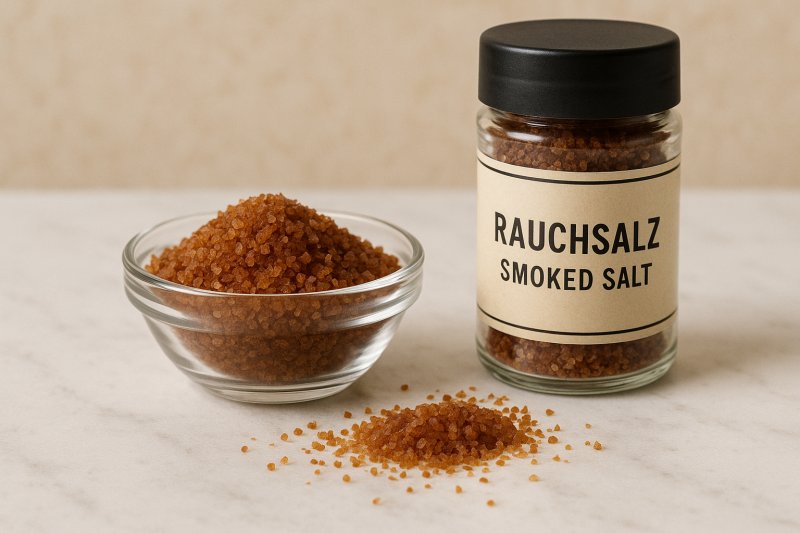
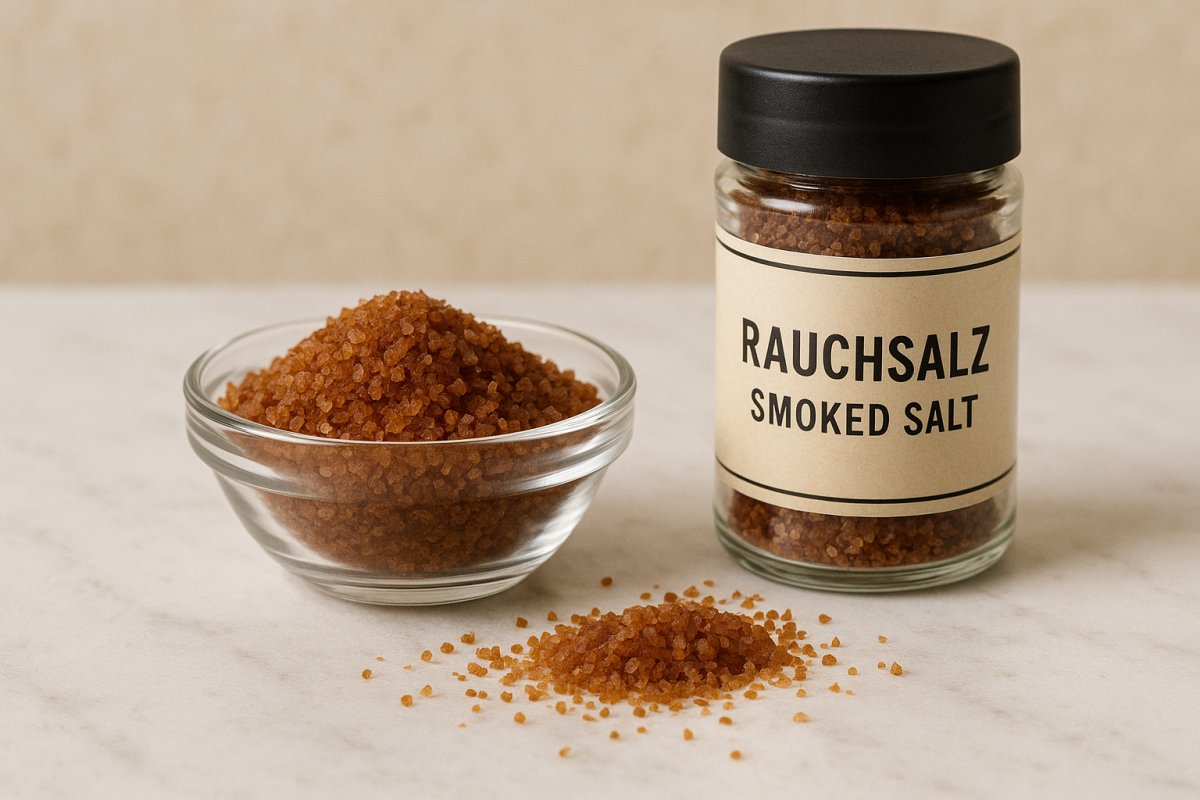
Smoked salt for an intense, smoky flavor.

Wiki about smoked salt Nutri-Score E Vegan Yes Gluten-free Yes Lactose-free Yes Nut-free Yes
NUTRITION / 100 g
0 kcal 0 g Protein 0 g Kohlenhydrate 0 g Fett

Introduction

Smoked salt in coarse crystals
I still remember the first bite that completely surprised me: a simple, rustic bread on which someone had generously sprinkled smoked salt. The scent was like a short trip to a campfire, the seasoning added a deep, almost meaty note, and suddenly the bread felt like a small culinary adventure. Since then smoked salt has found a permanent place in my kitchen, not as a substitute for regular salt, but as a dramatic finish for dishes that can take a little smoky something.

Smoked salt is usually made when sea salt is dried over wood smoke or flavored with smoke. Depending on the wood – beech, oak, apple or hickory – the aroma ranges from mild and slightly sweet to strong and robust. I once picked up a sample from a small artisanal stall where a vendor enthusiastically explained how the salt had been smoked over apple wood; the difference to industrial blends was immediately noticeable.

What I especially love is the versatility. Smoked salt pairs surprisingly well with sweet components because it contrasts and enhances flavors. A colleague of mine swears by a pinch of smoked salt over dark chocolate. I like to sprinkle it over:

  • poached eggs or avocado toast for an intense start to the day
  • grilled vegetables and steaks to deepen the grill flavors
  • buttery seafood like prawns or salmon, where the sea and the fire meet
  • desserts with caramel or dark chocolate as a surprising finish
It's important to dose sparingly. Smoked salt is a finishing touch, not a basic seasoning. A hint is enough, otherwise the smoke will overpower the actual taste. I keep my smoked salt in a tightly closed container in a dry place and only bring it out shortly before serving. Try different varieties and be surprised by small experiments – often the best combinations arise by chance and a little courage.

Availability & types


Availability and types of smoked salt

Smoked salt is, simply put, ordinary salt that has been flavored with smoke. This taste calls to mind a campfire, a grill or smoked foods like ham. You can buy smoked salt in many supermarkets, delicatessens and online. However, there are different kinds of smoked salt because different woods and smoking methods are used. In the following text I explain where smoked salt comes from, which production areas are important and what variants exist — so that even a 12‑year‑old can understand it well.

Origin and production
Smoked salt is made when salt is placed over smoke or treated together with smoke. This smoke usually comes from wood. The salt is not really "grown" like vegetables, but manufactured. Sea salt or rock salt (that is, salt from the earth) is taken, placed in a chamber or dish and the smoke is passed over it. This way the smoke aroma penetrates the salt. You can imagine it like tea: the salt takes up the flavor just as a tea bag flavors water.

Production areas
Because salt comes from the sea or from salt mines, places of origin vary. Important regions for good salt and thus also for smoked salt are:

  • Europe: Countries like France, Spain, Portugal and the United Kingdom produce a lot of sea salt. There you can also find smoked salts, often made from sea salt.
  • USA: In the USA many things are smoked with woods like hickory or mesquite — these woods give a strong flavor.
  • Scandinavia: In countries like Norway or Sweden there are smoky aromas that are rather mild and clean.
  • Asia: Here too you can find smoked salts, sometimes using exotic woods or added spices.
Types and variants of smoked salt
There are several kinds of smoked salt, depending on the wood, type of salt and smoking duration. The main differences are:

  • By wood species: oak, beech, hickory, apple wood, mesquite. Each wood smells and tastes different — apple wood is mild and fruity, hickory strong and smoky.
  • By salt type: sea salt (fine or coarse grain), fleur de sel (very fine, expensive sea salt), or rock salt (e.g. Himalayan salt). This affects texture and also appearance.
  • Fineness: Fine smoked salt dissolves quickly, coarse salt remains crunchier on the food.
  • Cold vs. hot smoking: With cold-smoking the salt remains dry and acquires a delicate aroma. With hot-smoking the smoke is more intense. “Cold-smoking” simply means: the smoke is not very warm, so the salt is not cooked.
  • With added flavor: Some smoked salts contain herbs, paprika or citrus notes — it's like seasoning a dish with several ingredients.
Everyday availability
Smoked salt is easy to find today: often in small jars at the supermarket, in health food stores or online in many varieties. For special wood types or high-quality varieties a delicatessen is worthwhile. Prices range from cheap to expensive, depending on the wood, salt type and handcrafted work.

In summary: smoked salt comes from salt and smoke, the woods and type of salt determine the flavor, and you can buy it almost everywhere — from the simple supermarket to the specialized delicatessen. It is an easy way to give dishes a smoky aroma without smoking an entire piece of meat.
Details & nutrition

Property Value
Unit g
Calories per 100 0
Protein per 100 0
Carbohydrates per 100 0
Sugar per 100 0
Fat per 100 0
Saturated fat per 100 0
Monounsaturated fat 0
Polyunsaturated fat 0
Fiber per 100 0
Vitamin C (mg) per 100 0
Vitamin D (IU) per 100 0
Calcium (mg) per 100 0
Iron (mg) per 100 0
Nutri-Score E
CO₂ footprint 0.10 kg CO2e/100 g
Origin Europe (depending on manufacturer)
Gluten-free Yes
Lactose-free Yes
Nut-free Yes
Vegan Yes
Note Smoked salt is table salt with a smoky flavor, usually produced by smoking over wood. Nutritional values are practically negligible; the main consideration is the very high salt content.

Technical & scientific information

Smoked salt refers to ordinary table salt that has been flavored through contact with charcoal smoke or smoke concentrates. It serves in the kitchen as a seasoning that gives dishes a smoky note without actually smoking them. Smoked salt can be made from various base salts, such as sea salt or rock salt, and differs in crystal form, moisture content and mineral traces depending on the raw material.

Chemical composition and nutritional values
The base material remains primarily sodium chloride (NaCl), which typically makes up 95–99% of the dry matter. Other components are trace minerals such as calcium, magnesium and potassium, which can be more pronounced especially in sea salt. Nutritionally, smoked salt is almost exclusively a source of sodium: 1 g NaCl contains about 393 mg sodium. Other nutrients are present in negligible amounts. Energy-relevant components are absent, so smoked salt is nutritionally relevant mainly because of its sodium content.

Smoke components
The smoky aroma comes from volatile organic compounds formed when wood burns and adsorbed onto the salt. Important groups are:

  • Phenols (e.g. guaiacol, 4‑methylguaiacol, syringol) – responsible for the typical smoky, often slightly sweet smell.
  • Carbonyl compounds (aldehydes and ketones) – contribute sweetish and spicy notes.
  • Organic acids – influence the perception of freshness and bitterness.
  • Polycyclic aromatic hydrocarbons (PAHs) – arise from incomplete combustion; some are toxicologically concerning.
Processing methods
Two main procedures are distinguished:

  • Direct smoking (Dry-Smoking/Cold-Smoking): The salt is exposed in chambers to the smoke of certain wood types (e.g. beech, oak, apple wood). Temperature and duration control the intensity and composition of the aroma compounds. Cold-smoking (below ~30–40 °C) mainly causes aromatization without melting the salt.
  • Liquid smoke / smoke-flavour: Condensate from wood smoke is processed and sprayed onto the salt as liquid smoke or added during drying. This method allows standardized flavoring and reduces unwanted contaminants through purification.
Food safety and health aspects
The primary health risks concern the high sodium content, which is associated with high blood pressure and cardiovascular diseases. Smoke components can have both antioxidant (phenolic compounds) and potentially harmful properties (certain PAHs). PAHs such as benzo[a]pyrene are considered carcinogenic; their formation depends on wood type, smoke temperature and duration. Industrial processes and purified liquid smoke reduce PAH levels; corresponding limits and controls exist in many regions for smoked foods, but not always explicitly for salt. Consumers should therefore use smoked salt in small amounts, especially people on reduced-salt diets.

Use, storage and labeling
Smoked salt is used sparingly as a finishing salt or in cooking to complement smoky aromas. It should be stored dry and protected from light, as moisture promotes caking and can alter the aroma compounds. Industrially, smoked salt is sometimes treated with anticaking agents (e.g. magnesium carbonate, silicates), which must be listed on ingredient lists. Packaging should indicate the origin of the salt, the smoking method or a note about liquid smoke and, where applicable, analytical information on contaminants.

Smoked salt combines the chemical basis of table salt with a complex mixture of volatile smoke compounds, whose composition determines flavor and health profile. With moderate use smoked salt remains an effective flavoring, but one that should be used carefully with regard to sodium and possible smoke contaminants.

Wiki entry for: smoked salt
Active now: 20 visitors of which 2 logged-in members in the last 5 minutes