Menu & categories

Skimmed milk

Low-fat milk with 0.3% fat – mild in taste and high in protein.

Wiki about skimmed milk Nutri-Score A Vegan No Gluten-free Yes Lactose-free No Nut-free Yes
NUTRITION / 100 ml
34 kcal 3.4 g Protein 4.9 g Kohlenhydrate 0.3 g Fett

Introduction

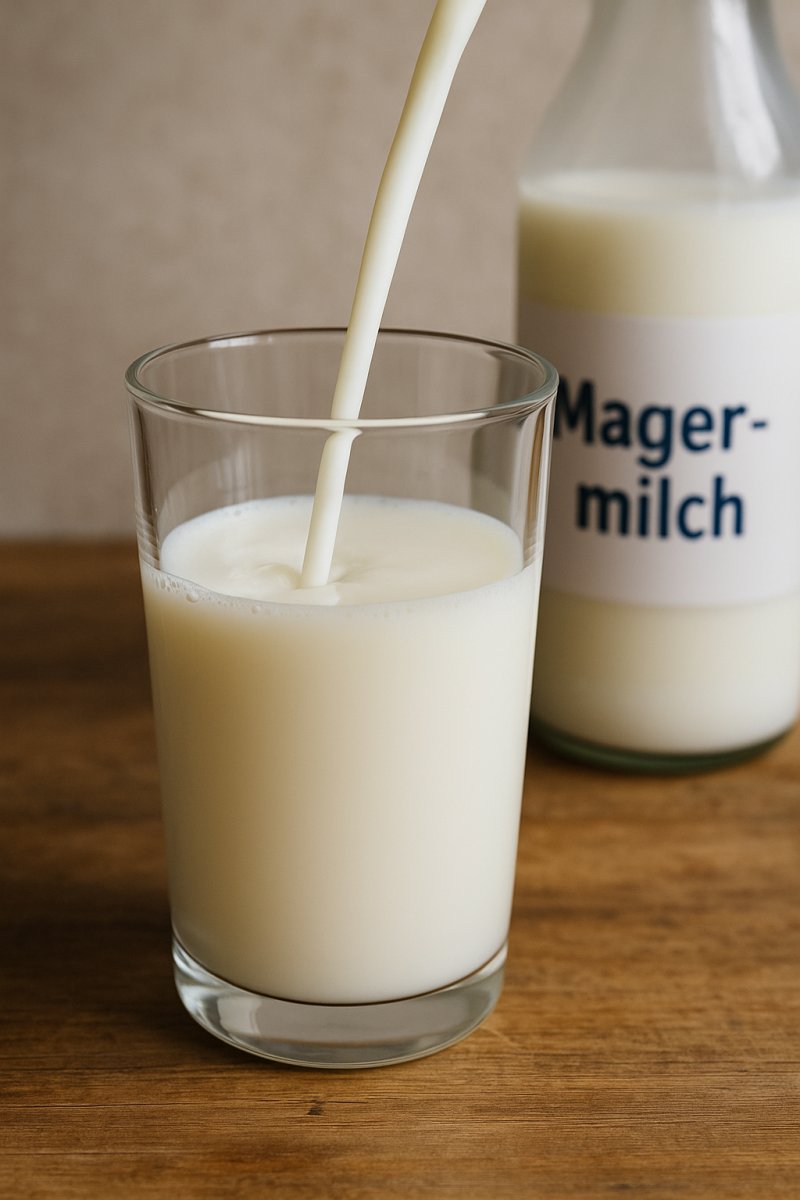
Glass with skimmed milk
I still remember as a child pulling the small glass bottle of skimmed milk 0.3% fat from the fridge and feeling proud that it tasted so “light” without losing its familiar milky character. Skimmed milk 0.3% fat has been a reliable companion for me in the kitchen and everyday life: low in fat, rich in nutrients and surprisingly versatile.

What I appreciate about this milk is its simplicity. It has less than 0.5% fat, in many countries specifically 0.3%, yet still provides valuable protein and calcium. A colleague of mine swears by using it in his morning porridge because it makes the oats lighter and creamier without weighing down breakfast. I had the same experience when baking: cakes become less greasy while puddings remain tender.

I have often discovered practical advantages and culinary possibilities through small experiments. Sometimes I blend skimmed milk with fresh berries for a velvety smoothie, other times I use it to make a light but smooth béchamel sauce. It is also excellent for:

  • Calorie-conscious diets, because it provides relatively little energy.
  • Plenty of calcium and protein, which supports bones and muscle building.
  • Baking recipes where liquid is needed without too much fat.


Of course this milk also has limits. For extra-creamy desserts I sometimes reach for whole milk or cream, and in more intense recipes the reduced fat content can make the flavor a bit milder. Still, the subtle texture changes always pleasantly surprise me.

If I had to recommend a simple, everyday ingredient to someone, my eye often falls on skimmed milk 0.3% fat. It is not a culinary spectacle, but a faithful, versatile base that balances many recipes and reminds us that sometimes less is exactly right.

Availability & types

Availability and types of the ingredient Skimmed milk 0.3% fat

Skimmed milk with 0.3% fat is regular milk from which almost all fat has been removed. You can find it in many supermarkets, discounters and organic stores. Because it has little fat, it is often cheaper and intended for people who want to eat less fat. The milk usually comes from areas around cities, since fresh milk is delivered from farms near the dairies. In countries like Germany, France or the Netherlands these are often regions with many green areas and pastures where many cows live.

The origin of the milk can be explained roughly like this: cows on farms produce milk. This milk is collected and brought to a dairy where it is cleaned, heated and packaged. Some dairies collect milk only from farmers in their region, others work with farmers from various regions or even other countries. It is like a school project: sometimes the whole class does it together, sometimes only the children from one group.

Available varieties and variants

  • Fresh skimmed milk: this is the milk that sits on the fridge shelf and has a shorter shelf life. It is gently heated so bacteria are killed but the taste remains fresh.
  • UHT milk (long-life): this milk has been heated strongly and is long-lasting, even without refrigeration, until the package is opened. This is practical if you want to keep supplies at home.
  • ESL milk: an intermediate form between fresh milk and UHT. It lasts longer than fresh milk but has more flavor than UHT milk.
  • Organic skimmed milk: this variant comes from cows kept according to organic rules. The animals get different feed and more space. Organic milk is often more expensive, but many people like the idea that the cows are kept in better conditions.
  • Lactose-free skimmed milk: lactose is the sugar in milk. Some people cannot tolerate it well. In lactose-free milk this sugar is broken down so it is easier to digest.
  • Fortified milk: some skimmed milk varieties are supplemented with vitamins like vitamin D or calcium to make them healthier. It's similar to adding extra spices to a dish.
  • Skimmed milk powder: here the milk has been dried to form a powder. It can be stored for a long time and is practical for baking or when fresh milk is not available.
  • Packaging types: skimmed milk is available in cartons, plastic or glass bottles and as powder sachets. Some packages are small for on-the-go use, others large for families.
Simply put: skimmed milk 0.3% fat is available in many variants – fresh, long-life, organic, lactose-free or as powder. Depending on where you go (supermarket, organic shop or online), you will find different brands and sizes. It is easy to store, especially when preserved for long life, and is suitable for muesli, cooking or baking. If you are unsure, try different types – like chocolate: some prefer one taste, others another.
Details & nutrition

Property Value
Unit ml
Calories per 100 34
Protein per 100 3.4
Carbohydrates per 100 4.9
Sugar per 100 4.9
Fat per 100 0.3
Saturated fat per 100 0.2
Monounsaturated fat 0.1
Polyunsaturated fat 0.0
Fiber per 100 0.0
Vitamin C (mg) per 100 0
Vitamin D (IU) per 100 0
Calcium (mg) per 100 120
Iron (mg) per 100 0.03
Nutri-Score A
CO₂ footprint 0.12 kg CO2e pro 100 ml
Origin Germany/EU (depending on manufacturer)
Gluten-free Yes
Lactose-free No
Nut-free Yes
Vegan No
Note Nutritional values may vary slightly depending on brand and processing.

Technical & scientific information

Skimmed milk (0.3% fat) refers to cow's milk from which milk fat has been largely removed so that the fat content is approximately 0.3%. This product is technically obtained by separating the cream fraction and then standardizing and heat-treating the milk. Skimmed milk is characterized by a significantly reduced energy and fat content compared to whole milk, while protein-, lactose- and mineral-related fractions remain largely preserved.

Chemical composition and nutritional values (approx. per 100 g)

  • Energy: approx. 142 kJ / 34 kcal
  • Fat: approx. 0.3 g (mainly as triglycerides, with a very small share of fat-soluble vitamins)
  • Protein: ≈ 3.3–3.5 g (predominantly caseins ~80% and whey proteins ~20%)
  • Carbohydrates: approx. 4.8–5.0 g (mostly lactose)
  • Minerals: Calcium ≈ 120 mg, Phosphorus ≈ 90–100 mg, Sodium ≈ 35–45 mg
  • Solids-not-fat (SNF): about 8.5–9.5 %
  • pH: typically between 6.6 and 6.8
Processing

Fat separation is performed mechanically by centrifugation (separator). After separation, the remaining milk is standardized to the desired fat content (here 0.3%) and usually heat-treated. Common processes are pasteurization (e.g. 72 °C for 15 seconds) or UHT sterilization (≈ 135–150 °C for a few seconds) for longer shelf life. Homogenization in skimmed milk is less mandatory but can be applied to prevent protein-related deposits and a slight texture change.

Functional properties

  • Proteins stabilize foams and emulsions and are heat-sensitive; at high temperature treatment denaturation occurs and gel and foam behavior change.
  • Due to the low fat content the mouthfeel is reduced; in processed products milk protein concentrates or stabilizers are sometimes used to improve texture.
  • Calcium is predominantly bound to casein micelles, so skimmed milk remains a good source of calcium.
Health aspects

Skimmed milk offers a reduced-calorie alternative to whole milk and contains high-quality protein as well as essential minerals like calcium and phosphorus. The reduced content of saturated fatty acids can be advantageous for people with specific dietary goals. On the other hand, fat-soluble vitamins (A, D, E, K) are lower in low-fat milk; therefore skimmed milk is fortified with vitamin A and/or D in some countries. People with lactose intolerance still need to pay attention to lactose content, while those with a milk allergy should avoid cow's milk proteins.

Storage, shelf life and usage notes

Unopened pasteurized skimmed milk keeps refrigerated for several days, UHT-treated variants are considerably more stable when the package is unopened. After opening the milk should be consumed promptly and kept refrigerated. Skimmed milk is suitable for cold drinks, cooking, baking and in numerous reduced-fat dairy products such as low-fat yogurts or cheeses.

Overall, skimmed milk (0.3% fat) represents a technically simple, nutrient-rich, reduced-calorie base ingredient that is used flexibly in food production but is sensorily less full-bodied than higher-fat milk types.

Wiki entry for: skimmed milk
Active now: 18 visitors of which 2 logged-in members in the last 5 minutes