Menu & categories

Rock sugar

Large-crystal sugar for tea, punch and desserts.

Wiki about rock sugar Nutri-Score E Vegan Yes Gluten-free Yes Lactose-free Yes Nut-free Yes
NUTRITION / 100 g
400 kcal 0 g Protein 100 g Kohlenhydrate 0 g Fett

Introduction

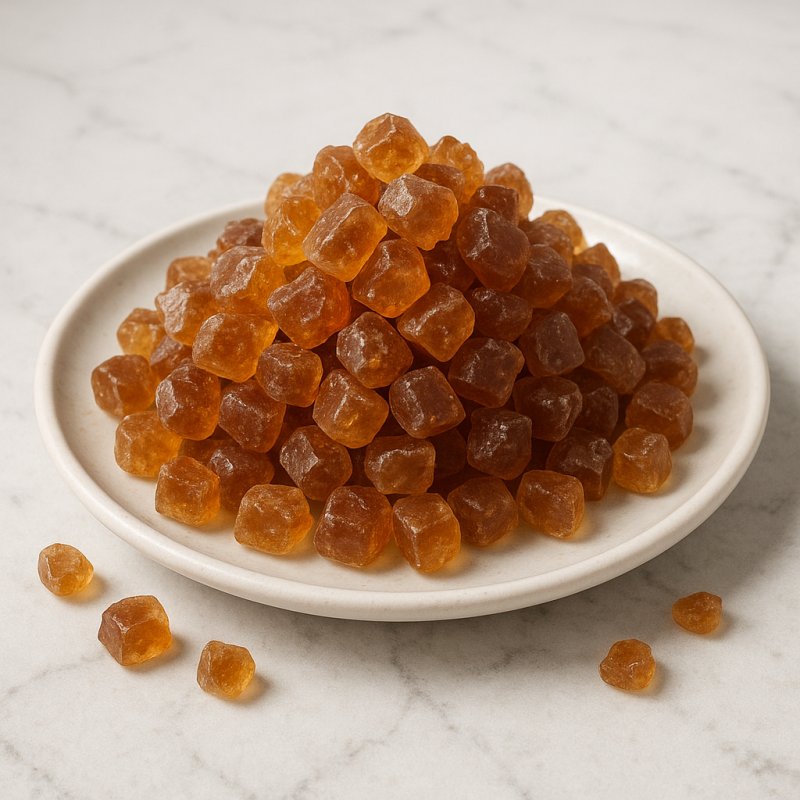
Rock sugar crystals (white or brown) close-up
I can still remember the soft crackle when, as a guest at friends' houses, I pushed the teaspoon into a piece of kandis: the delicate snap, the slow melting and that little, almost ceremonial ritual that made a simple sweetening into something special. Kandis sugar is for me more than just sweetness; it is texture, tradition and a bit of theatre on the coffee table.

Kandis consists of coarse, glittering crystals formed by the crystallization of sugar from a supersaturated sugar solution. It comes in light, almost crystal-clear pieces and in amber-coloured variants, which take on a caramel note because of molasses or cane sugar content. I recall a colleague once sweetening her early finish to the day with a sip of tea and a piece of amber kandis because she said: "It crunches so nicely between the teeth." That made me smile.

In my kitchen I use kandis in surprisingly many ways. It dissolves more slowly than fine table sugar and therefore gives drinks like tea or mulled wine a longer, gentler sweetening. In baking I like it for crusts or decorations because the crystals stay crisp and look attractive.

  • Typical uses: tea, mulled wine, syrups, dessert decoration.
  • Storage tips: store dry, airtight and separated from strongly smelling ingredients.
  • Flavor: white varieties are neutral, amber ones bring light caramel notes.
  • Alternatives: cube or granulated sugar, with loss of texture.
Sometimes I cook a small amount of kandis with water and spices because I like the depth it gives to drinks. A friend once told me that as a child he would secretly hold kandis up to the lamp light to look at the crystals like little stars; little anecdotes like that remind me that ingredients are not just ingredients but carry stories.

In the end I find that kandis sugar is a charming, versatile ingredient: useful, a little playful and ideal when you want to make small rituals out of simple moments.

Availability & types


Kandis‑Zucker is sugar in large, solid crystals, often used as a small sweet or to sweeten tea and pastries. If you want to know where this sugar comes from and what forms it comes in, I'll explain it here in a simple, child-friendly way.

Origin
Kandis is made from ordinary sugar. This sugar usually comes from two plants: the sugar beet and the sugarcane. The sugar beet grows well in cooler regions, for example in many parts of Europe like Germany, France or Poland. Sugarcane grows in warm, tropical areas – well-known countries include Brazil, India or Thailand. Sugar is obtained from both plants, then purified and processed into the large crystals – kandis –.

Where to find kandis
Kandis is available in many shops. You can buy it at:

  • supermarkets in the sugar or baking aisle
  • tea shops, because kandis is often used to sweeten tea
  • health food stores or natural food shops if you are looking for organic kandis
  • online shops, where there are often many varieties and package sizes
  • confectionery shops or at weekly markets, sometimes as colorful kandis sticks
Which types and variants exist
Kandis comes in different shapes, colours and sizes. Here are the common ones and what they mean:

  • White kandis: very light, mild in taste. It has been heavily refined, so it tastes neutral and sweet – good for tea when you don't want the taste of sugar to stand out.
  • Blond or golden kandis: slightly darker than white kandis. It has a light caramel colour and a delicate, malty taste.
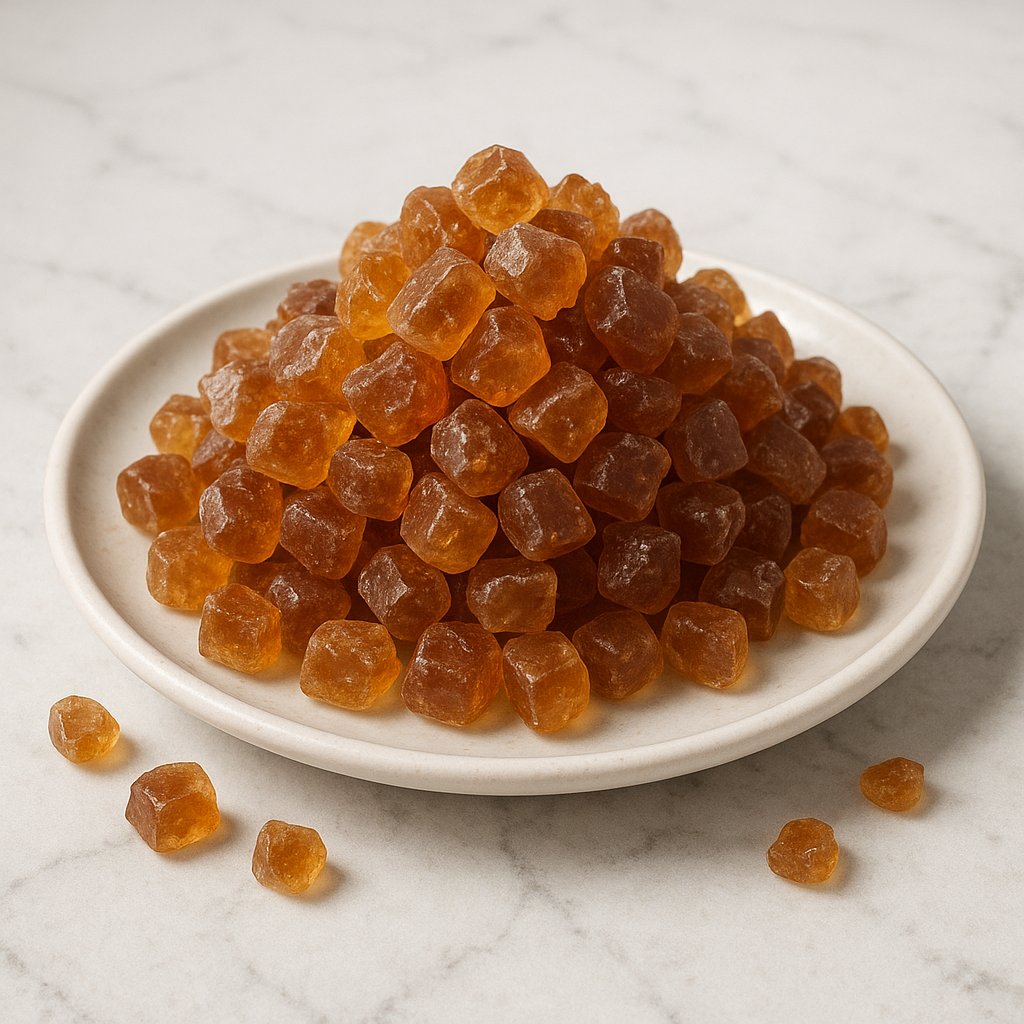
  • Brown or dark kandis: contains more molasses (that is the syrup component from sugar production). As a result it tastes stronger, almost like caramel, and pairs well with dark teas or pastries.
  • Kandis sticks: long, thin rods that you place in the cup and stir with the handle. They look pretty and are practical for tea.
  • Klunkerkandis / large crystals: large chunks, almost like ice cubes made of sugar. They are good for slow melting in hot drinks or for decorating.
  • Fine kandis / small pieces: smaller crystals that dissolve faster – practical in baking or when you need it quickly.
  • Refined variants: some kandis pieces are flavored with lemon or herbs, or there are organic and fair-trade varieties that come from sustainable cultivation.
Where each type is popular
In Europe and particularly in Germany, white to golden kandis is often found in households and in baking. In Asia, darker, coarser kandis is used more often for cooking and sweet sauces. Organic and fair-trade kandis are easier to find in health food stores and online.

In summary: kandis is versatile, originally comes from sugar beets or sugarcane and is available in many forms – from white crystals to golden chunks to dark, caramel-like pieces. You can find it in the supermarket, tea shop or online, and there are simple to special varieties like organic or flavored options, depending on how you want to use it.
Details & nutrition

Property Value
Unit g
Calories per 100 400
Protein per 100 0
Carbohydrates per 100 100
Sugar per 100 100
Fat per 100 0
Saturated fat per 100 0
Monounsaturated fat 0
Polyunsaturated fat 0
Fiber per 100 0
Vitamin C (mg) per 100 0
Vitamin D (IU) per 100 0
Calcium (mg) per 100 0
Iron (mg) per 100 0
Nutri-Score E
CO₂ footprint 0.08
Origin EU/non-EU (depending on the manufacturer; often from sugar cane or sugar beet)
Gluten-free Yes
Lactose-free Yes
Nut-free Yes
Vegan Yes
Note Nutritional values may vary slightly depending on the manufacturer (white/brown, crystal size); rock sugar consists almost entirely of sucrose.

Technical & scientific information

Kandis-Zucker refers to coarse-grained, mostly transparent or slightly amber crystals whose main component is sucrose (chemical formula C12H22O11). Chemically, these are disaccharide sugars composed of the monosaccharides glucose and fructose, which are released upon breakdown by the enzyme sucrase in the intestine. Sucrose has a molar mass of about 342 g·mol−1 and forms, when heated, crystals that only begin to caramelize or decompose at high temperatures.

Physical properties and crystal formation
Kandis forms by controlled crystallization from a supersaturated sugar solution. Important factors are the degree of supersaturation, temperature control, nucleation (seeding) and impurities. With appropriate cooling and resting time, large, well-defined crystals form that, depending on the manufacturing process, show clear white or slightly colored structures. The solubility of sucrose in water is high and increases with temperature, which is why hot, concentrated syrups are used for production that become supersaturated as they cool.

Manufacturing process
The basic process includes the following steps:

  • Preparation of a clear, concentrated sugar solution (from cane or beet sugar).
  • Clarification and, if necessary, partial removal of impurities and colourants.
  • Generation of a controlled supersaturation by cooling or evaporation.
  • Introduction of crystal nuclei to promote targeted size formation.
  • Separation of the crystals and drying.
Depending on raw material and degree of refining, different varieties arise such as white kandis (highly refined) and brown kandis (with residual molasses and minerals).
Nutritional values and metabolic aspects
Kandis sugar primarily provides rapidly available energy: about 4 kcal (≈17 kJ) per gram, that is around 400 kcal per 100 g. In the body sucrose is split into glucose and fructose; glucose quickly raises blood glucose, fructose is metabolized mainly in the liver. The glycemic effect is in the medium range; in large amounts metabolic consequences can promote overweight, insulin resistance or altered blood lipid values. For people with specific metabolic disorders (e.g., fructose intolerance) components can be problematic if free fructose is present or consumed in large amounts.
Health aspects and safety information
Kandis, like other sucrose products, is energy-dense but provides few micronutrients. Excessive consumption is associated with caries, weight gain and metabolic risk factors. Large crystals are less hygroscopic than fine sugar powder, but can still stick together when they absorb moisture. For dental hygiene and reduction of caries risk moderate consumption and regular oral hygiene are recommended.
Applications
Kandis is traditionally used as a sweetener in beverages and baked goods, as a base for cough sweets and lozenges, and for decoration. Through varying degrees of colouring or types of additives (flavours, colourants) kandis can be culinarily diversified.
Storage and quality characteristics
High-quality kandis is clear, brittle and has a clean, sweet taste. For storage dry, airtight containers are sensible to avoid moisture uptake and crystal sticking. Optical cloudiness or strong discolorations can indicate impurities or improper processing.
Overall, kandis sugar is a granulated sucrose product with a clearly defined chemical basis and well-explainable physical properties. Its production is based on classical principles of crystallization, and its nutritional effects correspond to those of other pure sugars: energy density with limited nutrient content and health risks with excessive consumption.
Wiki entry for: rock sugar
Active now: 20 visitors of which 2 logged-in members in the last 5 minutes