Menu & categories

Reduced-fat margarine

Light spread with reduced fat content

Wiki about reduced-fat margarine Nutri-Score C Vegan Yes Gluten-free Yes Lactose-free Yes Nut-free Yes
NUTRITION / 100 g
360 kcal 0.2 g Protein 0.5 g Kohlenhydrate 40 g Fett

Introduction

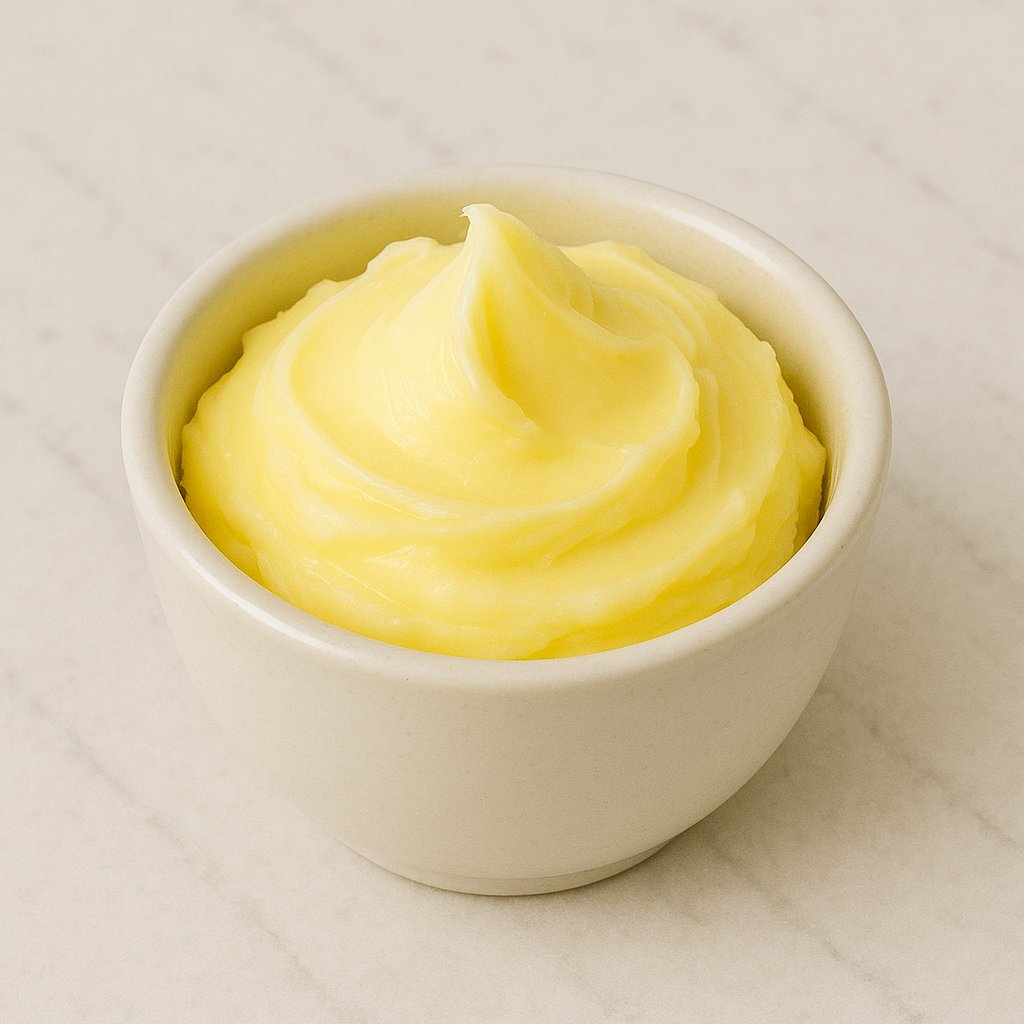
Reduced-fat margarine in a bowl with knife
Half-fat margarine is an ingredient that has long found its place in European kitchens – between traditional butter and classic margarine. As a 35-year-old editor who both tests recipes and writes about nutrition topics, I encounter half-fat margarine repeatedly in two roles: as a practical everyday aid for light cooking and as a prompt for discussion on taste, health and sustainability. What particularly fascinates me is the complexity of this ingredient: it combines modern eating habits with the desire for enjoyment, everyday practicality and a conscious approach to calories.

By half-fat margarine one means margarine with a reduced fat content, typically between 28 and 41 percent fat. That is significantly less than in regular margarine or butter. The missing fat portion is often compensated by water, emulsifiers and stabilizers so that spreadability and texture are maintained. For many households this balance of taste, consistency and calorie saving is the decisive reason why half-fat margarine is not missing from the fridge. A colleague of mine swears by it because she likes to spread it generously on fresh bread without later reproaching herself when looking at the calorie balance – her little everyday trick, which I can now well understand.

Those who look more closely at half-fat margarine find that it is usually made from vegetable oils such as rapeseed, sunflower or soybean oil. These oils can provide valuable unsaturated fatty acids. For readers who keep an eye on heart health and blood lipid values, this is an important point. In Europe many manufacturers also place great importance on enrichment with vitamins such as A and D. This has a long tradition and corresponds to the desire of many consumers for balanced products that integrate seamlessly into everyday life.

In the kitchen half-fat margarine is a pragmatic all-rounder. I like to use it cold on bread and rolls, in creamy spreads or for light dips. When baking and frying I use it with caution: because of the higher water content the result can differ from full-fat products. A hobby baker friend told me that his shortbread cookies made with half-fat margarine did not have the usual

Availability & types

Availability and types of half-fat margarine

Half-fat margarine is a particular kind of margarine that contains less fat than regular margarine. While classic margarine typically has about 80% fat, half-fat margarine typically ranges around 39–41% fat. The rest consists mainly of water, some starch or gelling agents, emulsifiers and sometimes milk or soy proteins. This gives it fewer calories and makes it a popular choice for many people when they want to watch their diet. At the same time it spreads well on bread and tastes mild, so it is easy to use in everyday life.

Origin and development

Margarine itself was developed in the 19th century as an inexpensive alternative to butter. At that time mainly animal fats were used and later increasingly vegetable oils, such as rapeseed, sunflower or soybean oil. Half-fat margarine emerged much later, when the demand for lighter, lower-calorie spreads grew. Manufacturers adapted the recipes so that a larger portion of the product consists of water and stabilizing ingredients without losing spreadability. Modern half-fat margarines are today mostly fully plant-based or vegetarian and are offered in many countries in similar form.

Availability in retail

  • Supermarkets and discounters: half-fat margarine can be found in almost every chilled shelf, often right next to butter, regular margarine and spreads. There are well-known brands and inexpensive private labels.
  • Organic shops: half-fat margarine is also available in organic stores, often made with organically produced oils and without artificial additives. The selection may be smaller, but ingredient lists are often particularly transparent.
  • Online shops: those looking for special variants (e.g. without certain allergens) will find options in online supermarkets and nutrition shops.
  • Regional differences: in some countries half-fat margarine is also called “light margarine” or “light”. The basic idea, however, is the same: less fat, same intended use.
Types and varieties

Half-fat margarine is available in different versions to suit every and
Details & nutrition

Property Value
Unit g
Average weight per piece 10
Calories per 100 360
Protein per 100 0.2
Carbohydrates per 100 0.5
Sugar per 100 0.5
Fat per 100 40
Saturated fat per 100 10
Monounsaturated fat 20
Polyunsaturated fat 10
Fiber per 100 0
Vitamin C (mg) per 100 0
Vitamin D (IU) per 100 160
Calcium (mg) per 100 5
Iron (mg) per 100 0
Nutri-Score C
CO₂ footprint 1.2 kg CO2e/kg
Origin EU
Gluten-free Yes
Lactose-free Yes
Nut-free Yes
Vegan Yes
Note Vegetable reduced-fat margarine with about 40% fat; typically fortified with vitamin D; usually contains water, vegetable oils and emulsifiers.

Technical & scientific information

Half-fat margarine is a spreadable, emulsified water-in-oil preparation that, compared with classic margarine, has a reduced fat content, typically in the range of 39 to 41 percent. It serves as a bread spread, cooking and baking ingredient and is produced on the basis of vegetable oils and fats that are combined with water, emulsifiers, stabilizers and sensory and technological additives to form a stable, creamy matrix. The aim of development is a nutritionally favourable energy density while maintaining sufficient technological functionality in the kitchen and food processing.

Composition and technology
The main ingredients include vegetable oils (e.g. rapeseed, sunflower, soybean or safflower oil), partly in mixed fractionation and with varying contents of monounsaturated and polyunsaturated fatty acids. To achieve spreadable consistencies at refrigerator temperature, fats with a higher melting point are often added, such as partially or preferably fully hydrogenated fractions, enzymatically interesterified fats or naturally firmer fats like palm fat (depending on the recipe and regional standards). The high water content in half-fat margarine requires precise emulsion control: emulsifiers such as lecithins, mono- and diglycerides of food fatty acids and milk or plant proteins stabilise the interface between oil and water phase, while stabilisers and thickeners (e.g. gelatine, pectin, guar gum, locust bean gum, xanthan) set the viscosity and prevent syneresis.

Manufacturing process
The process involves mixing and standardising the oil and water phases, adding emulsifiers, salt, acidity regulators (e.g. citric acid, lactic acid) and flavourings. This is followed by emulsification under shear, followed by controlled crystallisation in cooling drums or scraped surface heat exchangers. Through cooling rate, shear profiles and rest times the polymorphism of the fat crystals is deliberately influenced to obtain a fine-crystalline structure with smooth spreadability and

Wiki entry for: reduced-fat margarine
Active now: 20 visitors of which 2 logged-in members in the last 5 minutes