Menu & categories

Radish

Crisp, spicy root vegetable with few calories

Wiki about radish Nutri-Score A Vegan Yes Gluten-free Yes Lactose-free Yes Nut-free Yes
NUTRITION / 100 g
16 kcal 1.1 g Protein 3.4 g Kohlenhydrate 0.1 g Fett

Introduction

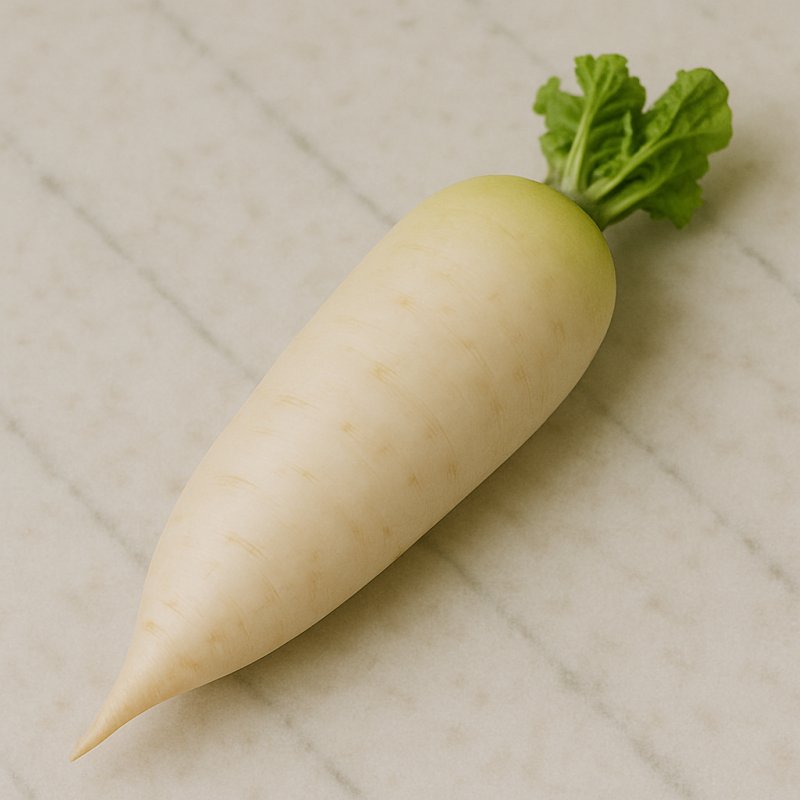
Fresh white radish
Radish is one of those ingredients that stays in the memory once you experience it consciously: crunchy, peppery, refreshing and surprisingly versatile. As a 35-year-old editor in Europe I long underestimated the radish – until I tried a slice of horseradish at a weekly market in southern Germany. The vendor sliced it paper-thin, sprinkled it with coarse salt and handed me the slice like a promise. In that moment I understood why radish is a quiet star in so many European kitchens.

Botanically, radish belongs to the Brassicaceae family and is related to cabbage, arugula and mustard. This kinship explains the characteristically sharp taste, which comes from sulfur-containing compounds – the so-called glucosinolates. Depending on variety, season and growing region, radish can range from mild to distinctly pungent. Especially popular are the white radish, the black radish with its dark skin, the delicate summer radish and colorful varieties like watermelon radish or daikon. The latter originates in East Asia but has long since arrived in European kitchens and represents an elegant, juicy mildness.

A colleague of mine – an enthusiastic amateur cook – claims radish is his “secret trick for freshness” in heavy winter dishes. He shaves it finely over potato dumplings with brown butter to counter fattiness with pepperiness. A friend from Vienna swears by radish as a snack: thin slices, a little lemon juice, a pinch of salt, with a piece of dark bread. And I rediscovered radish myself when I began to use it not only raw but also lightly sautéed: in a cast-iron pan it develops a subtle sweetness that balances its heat.

In European culinary practice radish plays a versatile role. In Bavaria it accompanies beer-garden classics, in France it refines salads as a crunchy element, and in Scandinavia it complements fish dishes with a clear, refreshing note. At the same time radish is a link between tradition and modern cuisine: it suits hearty snack platters as well as light, plant-focused diets with attention to texture

Availability & types

Availability and types of radish

Radish is a crunchy root vegetable grown in many countries and can be available almost year-round. However, exact availability depends on which variety you are looking for and in which region you live. Generally: radish prefers cooler weather. That is why it is often harvested in spring and autumn. Some varieties are bred to grow well in summer or even winter. In supermarkets you will often find radish throughout the year, because it is harvested at different times in different countries and imported.

The origin of radish is historically rooted in Asia, especially China and Japan. From there it spread over the centuries to Europe and other parts of the world. Today some of the radish in Europe comes from countries such as Germany, the Netherlands, France and Italy. In Asia, China, Korea and Japan are important growing regions. Many farmers’ markets offer regional radishes that are freshly harvested depending on the season. In winter there is often the large white daikon (also called winter radish), while in summer smaller, firmer varieties are more common.

Radish is not all the same. There are many varieties and types that differ in color, shape, size, pungency and flavor. Some are mild and juicy, others very flavorful and sharp. To give you a good overview, here are the main types:

  • White radish (Daikon, winter radish)
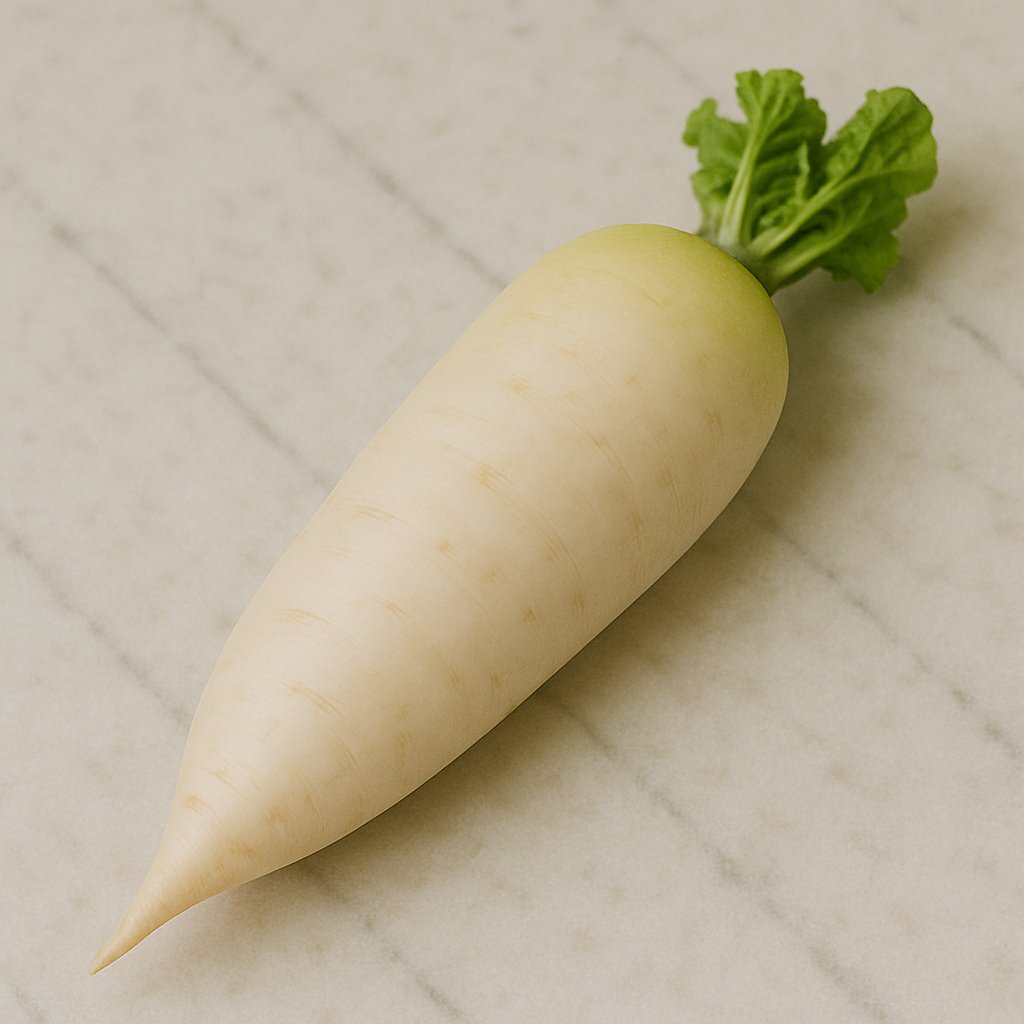
    This radish is long, cylindrical and usually snow-white. It is especially popular in East Asia. Its taste ranges from mild to slightly sharp and it contains a lot of juice. It is well suited to raw consumption, salads, pickling (for example as takuan in Japan or danmuji in Korea) and cooking in soups and stews. In Germany you get it particularly often in winter.
  • Black radish (black winter radish)
    It has a dark, almost black skin and a white, firm interior. The taste is strong and spicy, especially when fresh. It is often harvested in autumn and stores
Details & nutrition

Property Value
Unit g
Average weight per piece 300
Calories per 100 16
Protein per 100 1.1
Carbohydrates per 100 3.4
Sugar per 100 2.0
Fat per 100 0.1
Saturated fat per 100 0.02
Monounsaturated fat 0.01
Polyunsaturated fat 0.05
Fiber per 100 1.6
Vitamin C (mg) per 100 22
Vitamin D (IU) per 100 0
Calcium (mg) per 100 25
Iron (mg) per 100 0.4
Nutri-Score A
CO₂ footprint 0.2 kg CO2e/kg
Origin Europe/Asia, open-field cultivation
Gluten-free Yes
Lactose-free Yes
Nut-free Yes
Vegan Yes
Note Sharp taste due to mustard oils (glucosinolates); can be used raw or cooked.

Technical & scientific information

Radish (Raphanus sativus var. longipinnatus and var. niger) is a cultivated form of the genus Raphanus within the family Brassicaceae (mustards). The edible storage root is characterized by a high content of sulfur-containing glucosinolates, a pronounced primary root morphology and distinctive sensory properties. Depending on the variety, color differences from white through pinkish to black occur; texture ranges from crunchy and juicy to firm and pungent. From a nutritional perspective radish is low in energy but contains relevant amounts of vitamin C, potassium and bioactive secondary plant compounds.

Botany and morphology
The plant forms a thickened taproot that serves as a storage organ for water and reserves. The root parenchyma is rich in watery tissue whose cells carry the characteristic aromas. The foliage is coarsely lobed, pubescent and arranged in a rosette. Flowers appear in racemose inflorescences, are four-parted and typical for brassicas. Variety-typical differences occur in shape (cylindrical to conical), length and surface texture of the root. Black radish shows a corky, dark periderm layer with increased storability, while white radish (e.g. daikon) has a smooth epidermis and milder flavor profiles.

Origin and breeding
Archaeobotanical and historical sources place domestication in West Asia to the eastern Mediterranean, with later diversification in East Asia. Asian types (daikon) were selected for milder taste, fast growth and large root masses; European types (summer, winter, beer and black radish) for pungency, skin color and storage ability. Modern cultivars arise through classical selection, hybrid breeding and marker-assisted methods, taking into account disease resistances, bolting tendency and adaptation to photoperiod and temperature.

Constituents and chemical characteristics
Radish is rich in glucosinolates (e.g. glucoraphenin, gluconasturtiin

Wiki entry for: radish
Active now: 20 visitors of which 2 logged-in members in the last 5 minutes