Menu & categories

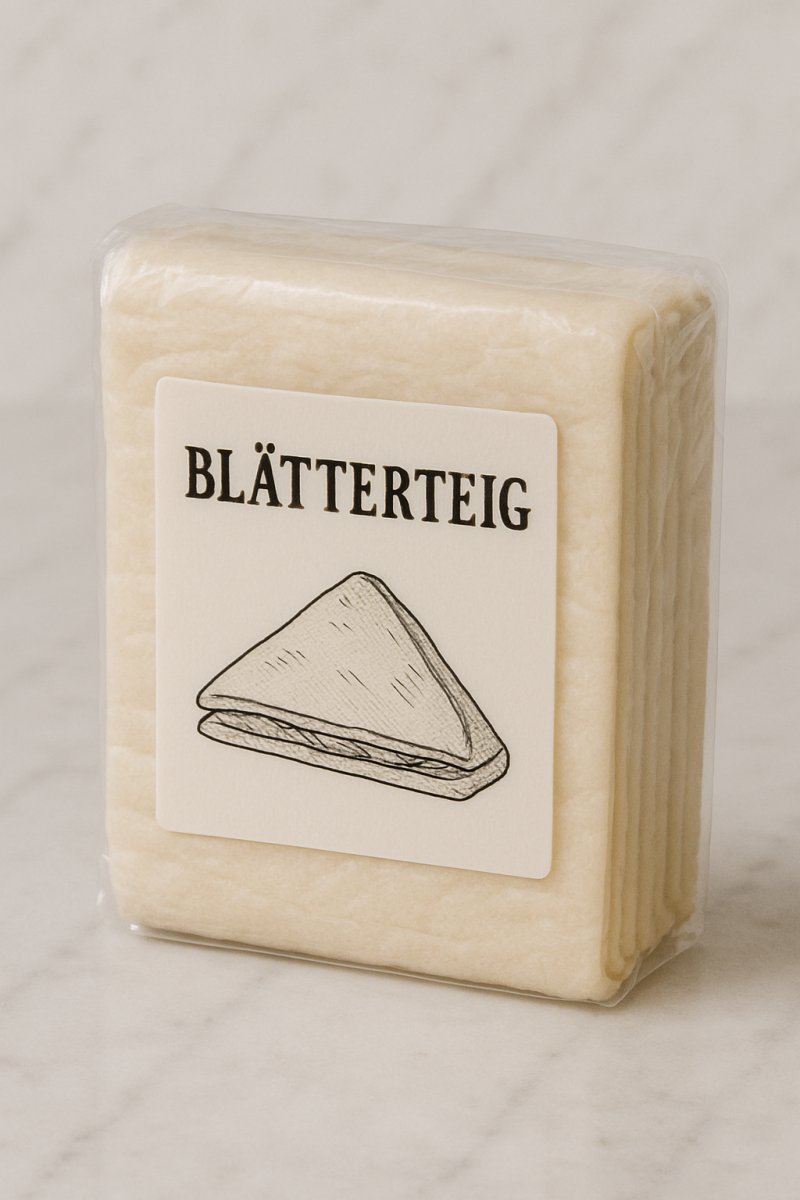
Puff pastry

Versatile, buttery dough made of multiple layers

Wiki about puff pastry Nutri-Score D Vegan No Gluten-free No Lactose-free No Nut-free Yes
NUTRITION / 100 g
380 kcal 5 g Protein 35 g Kohlenhydrate 24 g Fett

Introduction

Puff pastry
Puff pastry, to me, is a little culinary magic that never fails to elicit wide eyes in the kitchen. I still remember the first attempt when I tried to bake an apparently simple pie and the dough suddenly opened up like a golden book – crispy, buttery and with those unmistakable fine layers. Since then I've learned to appreciate puff pastry: not only as a base for sweet treats, but as a versatile element that can shine in quick everyday dishes as well as in festive menus.

The magic of puff pastry lies in its technique: countless thin layers of dough and fat that separate during baking and create the characteristic texture. A colleague of mine always raves about how, as a child, he would pull the layers apart with his fingers like a patient parrot – and I must admit I've done it too. This structure is created by careful folding, chilling and rolling, but for many of us the ready-made version from the fridge counter is an equally charming and practical alternative.

Puff pastry is surprisingly adaptable. I like to use it for:

  • Savoury tarts with goat cheese, caramelized onions and fresh herbs.
  • Quick snacks like spicy sausages in pastry or small cheese swirls.
  • Sweet classics – apple turnovers, mille-feuille or delicate pudding tarts.
Some of my favourite kitchen experiments came from spontaneous ideas: once I rolled out a leftover piece of puff pastry thinly, placed a few slices of pear and blue cheese on it, folded it over and in no time had a small, elegant dessert for unexpected guests. The visitors were impressed, and I learned that puff pastry always comes to the rescue when time is short but standards are high.

What I pay attention to when working with puff pastry is simple: work cold, don't overhandle the filling and trust the oven. And if something goes wrong, I remember the lesson from a good friend: “The nice thing about puff pastry is that it turns mistakes into charm.” That pragmatic calm has given me many delicious moments.

Availability & types

Availability and types

What is puff pastry and where does it come from?
Puff pastry is a thin dough made from flour, water, butter (or fat) and a little salt. It is rolled out repeatedly and butter is placed between the layers so that many thin layers form during baking — like the pages of a stacked book. The origin of puff pastry is in Europe, and France in particular is famous for it. But the idea of layering dough with fat also existed elsewhere, and puff pastry has spread to many countries.

Where does the fat for puff pastry come from?
The main fat ingredient is often butter. Butter is made from milk, usually from cows. Cows live in many countries, for example in Europe (France, Germany, the Netherlands), in North America (USA, Canada) and in some parts of Asia and South America. Some manufacturers, however, also use vegetable fats (such as margarine), which are made from vegetable oils. These oils come from different growing regions, for example sunflower from Europe or soy from North and South America.

How can I get puff pastry in the store?
Puff pastry is available in many supermarkets and bakeries. You will usually find it frozen in the freezer section or sometimes fresh in the chilled counter. Frozen puff pastry is practical because it has a long shelf life. Fresh puff pastry from the bakery is soft and is often sold ready to eat if you want something warm right away.

What varieties and options are there?
There are different types of puff pastry so that there is something to suit every idea in the kitchen. Here are some simple explanations:

  • Butter puff pastry: This dough uses real butter. It often has the best flavour and a particularly fine, delicate crunch. It's comparable to freshly baked bread that tastes especially good because it is made with good butter.
  • Fat- or margarine-based puff pastry: Instead of butter, vegetable fat is used. It is usually cheaper and has a longer shelf life. Sometimes it is slightly less aromatic, but it is suitable for people who avoid dairy products.
  • Pre-baked/quick puff pastry: Some doughs are already partially pre-baked or treated so they finish faster. This is practical when time is short, similar to convenience foods that only need a brief reheating.
  • Wholegrain or spelt puff pastry: For those who prefer to eat more healthily, there are doughs made from other flours such as wholegrain or spelt. These are somewhat firmer and have a nuttier flavour, like wholegrain bread compared to white bread.
  • Vegetarian or vegan variants: These doughs come without animal products, so without butter. They are particularly suitable for people who follow a plant-based diet.
Special shapes and sizes
Puff pastry is sold as large sheets, small squares, round bases or already cut strips. Large sheets are good if you want to make a tart or a large pie. Small pieces are great for snacks like mini pockets or spirals.

How do I choose the right puff pastry?
If you want something fine and crispy, choose butter puff pastry. If you need something quick and inexpensive, frozen or margarine-based pastry is practical. For specific diets look for vegan or wholegrain pastry. Also check the packaging: it will state whether the dough is fresh or frozen and whether it is pre-cut and ready to use.

Puff pastry is therefore easy to obtain and comes in many variants — so you can always find the right type for sweet tarts, savoury pies or quick snacks.

Details & nutrition

Property Value
Unit g
Calories per 100 380
Protein per 100 5
Carbohydrates per 100 35
Sugar per 100 2
Fat per 100 24
Saturated fat per 100 10
Monounsaturated fat 9
Polyunsaturated fat 3
Fiber per 100 2
Vitamin C (mg) per 100 0
Vitamin D (IU) per 100 0
Calcium (mg) per 100 20
Iron (mg) per 100 1.2
Nutri-Score D
CO₂ footprint 2.5 kg CO2e/kg
Origin Depends on the manufacturer, typically Europe
Gluten-free No
Lactose-free No
Nut-free Yes
Vegan No
Note Nutritional values for classic puff pastry made with wheat flour and butter; actual values may vary depending on recipe and manufacturer.

Technical & scientific information

Puff pastry is a widely used dough type in baking and pastry making, defined by its characteristic layering and flakiness. Technically it is not a single dough but a method of production in which a water- and flour-based base dough (dough layer) is alternated with solid fat layers (usually butter or vegetable margarine), folded and rolled out. Repeated laminating produces hundreds to thousands of thin flour-and-fat layers that separate when heated due to steam from the water, producing the rising and the crispy texture.

Composition and ingredients
Fundamentally puff pastry consists of few components: wheat flour (types vary depending on the recipe), water, fat (butter, lard or margarine), salt and optionally sugar or emulsifiers. Industrially produced variants often contain additives such as stabilizers, thickeners, preservatives or vegetable fats with increased melting stability. Butter provides aromatic milk-derived compounds and fatty acids (predominantly saturated and monounsaturated fatty acids), while margarines often contain hydrogenated or partially hydrogenated vegetable fats or interesterified fats, which give a different melting point and texture.

Physics and chemistry of rising
The typical rise of puff pastry is based on physical processes. During heating the water contained in the dough evaporates; the steam cannot escape immediately because the fat layers act as a vapour barrier. As a result the flour layers are mechanically pushed apart and multiple cavities form between the layers. In addition, the gelation of the gluten network contributes to the stability of the thin walls between the air chambers. Chemical leavening agents such as baking powder are not required in classic puff pastry and would alter the typical layering.

Manufacturing process
Traditional manual work includes rolling out a dough sheet, placing a fat block, folding (turns, e.g. single or double turns) and repeated resting in the refrigerator to allow gluten relaxation and fat solidification. Industrial processes use mechanical laminating rollers and controlled cooling. Important process parameters include dough moisture, fat viscosity, working temperature and roller speed. Processing that is too warm leads to fat smearing, processing that is too cold leads to brittle dough; both reduce the puffing effect.

Nutritional values and health aspects
Puff pastry is energy-dense: 100 g typically provide 400–550 kcal, depending on the fat content and the type of fat. Macronutrient-wise fats (30–45 g/100 g) and carbohydrates (30–45 g/100 g) dominate, protein content is usually 6–10 g/100 g. The fatty acid composition influences health assessment: puff pastry prepared with butter contains higher proportions of saturated fatty acids; with vegetable fats the share of polyunsaturated fatty acids can increase, whereas partially hydrogenated fats can contain trans fats that are unfavorable for health. Furthermore, puff pastry is low in fibre and micronutrients unless wholegrain flours or fortified fats are used.

Sensorics and application
Sensorially puff pastry is characterised by a buttery, fine-pored crust with a crisp collapse and a tender, melting texture. Applications range from sweet products like Danish pastries, croissants and tarts to savoury dishes like pies, pot pies and vol-au-vents. The choice of fat, baking temperature and pre-baking times influence colour, flavour development (Maillard reaction) and texture.

Storage and processing guidelines
Puff pastry is temperature-sensitive; cool storage prevents fat smearing and microstructure loss. Ready-made frozen puff pastry should be processed while frozen or thawed slowly in the refrigerator to avoid condensation and deformation. High initial oven temperatures (approx. 200–220 °C) are favourable to encourage rapid steam formation and lifting effects; subsequently reducing the heat can prevent excessive browning.

In summary, puff pastry is a technically demanding product whose properties are controlled by flour type, fat quality, temperature management and mechanical treatment. Its physical functional principle is based on the separation of dough and fat layers by steam expansion, which produces the characteristic flakiness. With a deliberate choice of fats and ingredients the nutritional profile can be adjusted, while the high energy density and low fibre content remain typical nutritional characteristics.

Wiki entry for: puff pastry
Active now: 18 visitors of which 2 logged-in members in the last 5 minutes