Menu & categories

Plum, dried prune

Fruity-sweet dried fruit with a lot of fiber.

Wiki about prune Nutri-Score C Vegan Yes Gluten-free Yes Lactose-free Yes Nut-free Yes
NUTRITION / 100 g
240 kcal 2.2 g Protein 63.0 g Kohlenhydrate 0.4 g Fett

Introduction

Dried plums on a wooden board
I have a particular weakness for dried plums (zwetschgen), although I used to put them in my shopping cart at the supermarket only out of pure curiosity. A colleague of mine once insisted they were the only breakfast that could still save him before Monday morning. I had to try them, and since then they have become one of my small everyday emergencies: aromatic, dense and with a deep caramel-like sweetness that recalls warm autumn days.

The term plum, zwetschge dried usually describes the classic zwetschge that has been gently dried after harvest. Unlike fresh plums, dried plums are more concentrated in flavor and nutrients. I still remember a market stall where the vendor explained how drying makes the flesh more tender and the sweetness more intense.

  • Taste and texture: very dark, slightly tart and almost jammy; chewy to juicy.
  • Nutrients: fiber, potassium, vitamin K and natural antioxidants; ideal as an energy-rich snack.
  • Culinary uses: in mueslis, baked goods, chutneys, braised dishes or simply on their own.
When I cook, I like to season pork roast with finely chopped zwetschgen, rosemary and a splash of red wine. That produces a perfect balance of sweet and sour. For sweet recipes I soak them briefly in warm water or rum; a dash of brandy once saved a recipe when the plums had become too dry.

Practical tips: store them airtight, cool and dark so they don't become too hard. For sensitive stomachs I recommend moderating the amount, because the fiber can have a laxative effect if overdone. I find dried zwetschgen are a small reason to experiment more — whether in porridge, stew or as a surprising accent on a cheese board.

Availability & types


Availability and types of the ingredient “plum, zwetschge dried”

Dried plums, often called zwetschgen, are fruits that are dried until most of the water is gone. This makes them sweeter and more shelf-stable. You can buy them year-round because they keep for a long time. Fresh plums, by contrast, are only in season in summer.

Origin
Plums originally come from Europe and Asia. Long ago people bred different varieties that taste better or store more easily. In Europe zwetschgen are especially popular because they have firm flesh and are well suited to drying. A well-known name is the French Agen plum, from which many dried plums (prunes) are made.

Growing regions
Plums grow best where winters are cool enough and summers have enough sun for ripening. Important growing regions include:

  • France – especially the area around Agen for dried prunes.
  • Germany – regions such as Rheinhessen, Pfalz and Baden-Württemberg are known for zwetschgen.
  • USA (California) – large producers of dried plums, often bred from European varieties.
  • Chile and other southern countries – supply plums in our winter months because it is summer there.
Available varieties and forms
There are different varieties and ways dried plums are offered. Here are some simple descriptions to tell the difference:

  • Zwetschge vs. plum – zwetschgen are often elongated and have firm flesh. Plums can be rounder and juicier. Zwetschge varieties are often used for drying because they store well and become sweet.
  • Whole dried plums – with pit or pitted. Whole fruits look like small, soft plums.
  • Pitted – convenient for eating or baking, since the stone is removed.
  • Chopped or diced – good for muesli, cakes or cooking.
  • Dried without additives – just fruit, no sugar or preservatives.
  • Sweetened or coated – sometimes plums are sugared or covered in chocolate.
  • Sulfited vs. sulfite-free – sulfites preserve color. Sulfite-free plums are darker; some people prefer them because they contain fewer additives.
  • Organic variant – grown without chemical pesticides.
Where to find them?
Dried plums are available in supermarkets, organic stores, health food shops and online. Some farms sell them freshly dried regionally. They are offered vacuum-packed, in tins or loose. Because they store well, they are on shelves year-round.

In summary: dried zwetschgen come from many countries, mainly Europe, California and Chile. They come in many forms – whole, pitted, chopped, with or without additives and in organic quality. So almost everyone can find the variant best suited for baking, snacking or cooking.
Details & nutrition

Property Value
Unit g
Average weight per piece 9
Calories per 100 240
Protein per 100 2.2
Carbohydrates per 100 63.0
Sugar per 100 38.0
Fat per 100 0.4
Saturated fat per 100 0.1
Monounsaturated fat 0.1
Polyunsaturated fat 0.2
Fiber per 100 7.1
Vitamin C (mg) per 100 0.6
Vitamin D (IU) per 100 0
Calcium (mg) per 100 43
Iron (mg) per 100 0.9
Nutri-Score C
CO₂ footprint 0.18 kg CO2e/100 g
Origin EU/Non-EU (depending on harvest and processing)
Gluten-free Yes
Lactose-free Yes
Nut-free Yes
Vegan Yes
Note Values refer to unsweetened dried plums/prunes; sugar and energy content may vary depending on the product.

Technical & scientific information


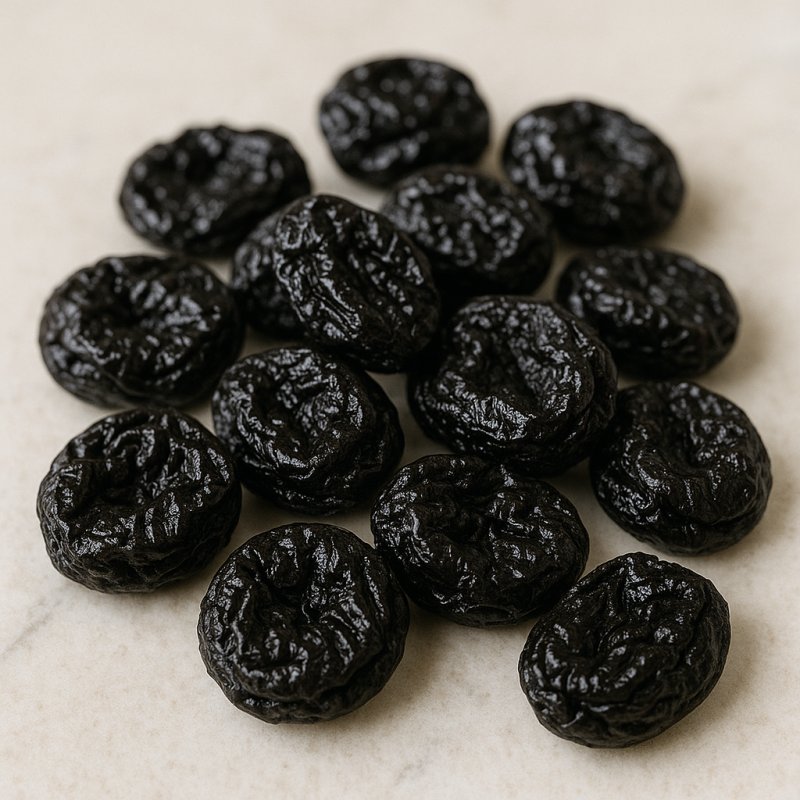
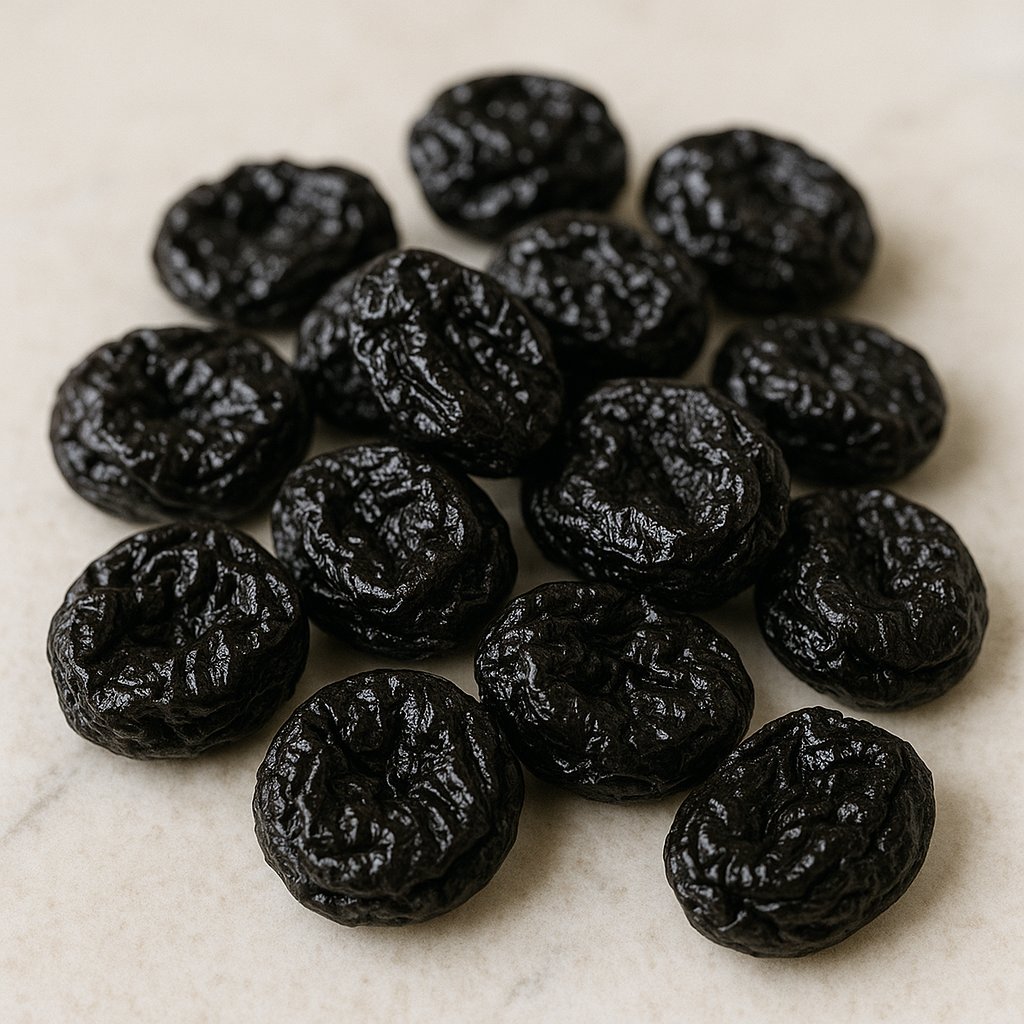
Plum, zwetschge dried denotes fruits of various plum or zwetschge cultivars conserved by drying, often from the cultivated form Prunus domestica. Dried zwetschgen (also called dried plums or "prunes") are more shelf-stable due to water removal and have a flavor more concentrated than fresh fruits. The typical external appearance is dark, wrinkled and sticky, while the aroma offers concentrated sweetness with distinct tart and caramel-like notes.

Chemical composition and nutritional values
Dried zwetschgen consist mainly of water-reduced carbohydrates, primarily monosaccharides and sucrose, along with a relatively high content of soluble and insoluble fiber. Typical nutrient values (per 100 g, indicative) are about 240 kcal energy, roughly 60–65 g carbohydrates of which 30–40 g are free sugars, about 6–8 g fiber, around 2 g protein and less than 1 g fat. Mineral-wise dried zwetschgen are a good source of potassium (often several hundred mg/100 g) and contain magnesium, iron and small amounts of calcium and sodium. Vitamin-wise heat-sensitive vitamins like vitamin C are largely reduced, while more stable components such as vitamin K and provitamin A (carotenoids) are detectable in moderate amounts.

Characteristic bioactive compounds
Chemically notable is the significant content of sugar alcohols, particularly sorbitol, as well as a range of polyphenolic compounds. Important phenols include chlorogenic acid, neochlorogenic acid, flavonoids such as quercetin derivatives and various anthocyanins (mainly cyanidin glycosides), which exhibit antioxidant activity. The combined effect of fiber, sorbitol and phenols shapes both the nutritional properties and the physiological effects on the gut.

Processing methods
Common drying methods are sun or air drying, hot-air drying, vacuum drying and freeze-drying. The choice of method affects quality and constituents: hot-air drying is economical but leads to greater losses of volatile aromas and heat-sensitive vitamins and promotes Maillard reactions between reducing sugars and amino acids, which alter color and flavor. Freeze-drying best preserves structure and heat-sensitive compounds but is costly. In practice, sulfur dioxide treatment is often used to delay enzymatic browning, so sulfite sensitivity should be considered.

Health aspects
Dried zwetschgen are valued nutritionally for their high fiber content and sorbitol content. The combination of soluble fiber, sorbitol and phenols can influence intestinal transit time and have a mild laxative effect. The antioxidants present contribute to radical-scavenging capacity, although dietary effects depend on frequency of intake and the food matrix. Due to the relatively high sugar content portion sizes should be observed, especially in metabolic conditions. People with sulfite sensitivity should choose sulfite-free products.

Safety and storage aspects
Shelf life of dried zwetschgen depends on water activity, ambient humidity and storage conditions. Low water activity inhibits microbial growth; nevertheless, mold growth can occur with improper storage and quality losses through oxidation are possible. Protection from light and oxygen and storage in a cool, dry place improve stability. Hygienic measures are important in industrial handling to avoid contamination.

In summary, dried zwetschgen are a nutrient-dense product with a characteristic composition of carbohydrates, fiber, sorbitol and phenolic compounds. Their nutritional properties make them a valuable ingredient in cooking and functional textures, while processing and storage largely determine the chemical composition and sensory quality.
Wiki entry for: prune
Active now: 17 visitors of which 2 logged-in members in the last 5 minutes