Menu & categories

Plum

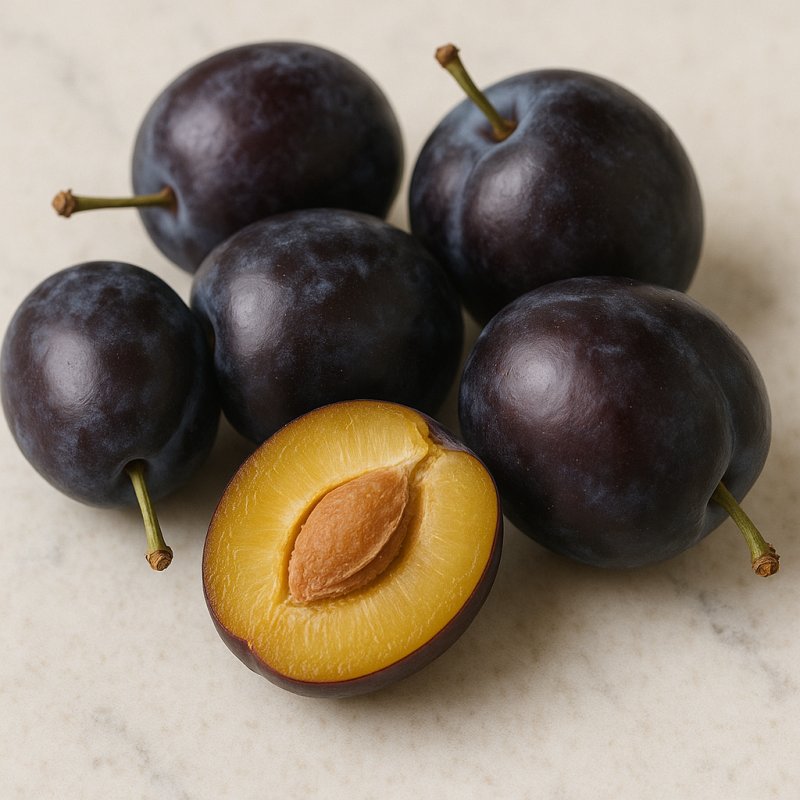
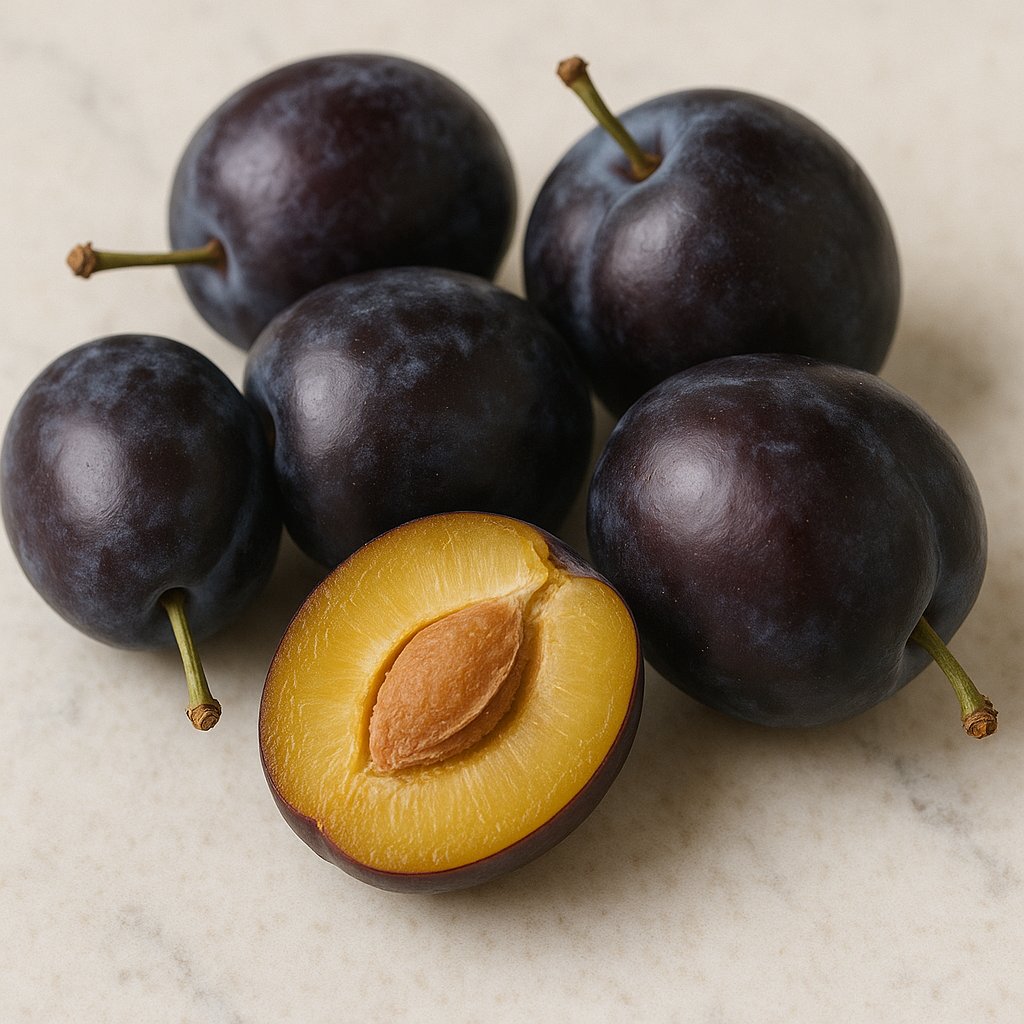
Juicy stone fruit – sweet and aromatic, ideal plain or for baking.

Wiki about plum Nutri-Score A Vegan Yes Gluten-free Yes Lactose-free Yes Nut-free Yes
NUTRITION / 100 g
46 kcal 0.7 g Protein 11.4 g Kohlenhydrate 0.3 g Fett

Introduction

Fresh plums and damsons

I love plums and damsons because they are so contradictory: juicy and restrained, sweet and tart at the same time. I still remember a weekly market where an older woman secretly slipped me a handful of freshly picked damsons because she saw me hesitate at her stall. That one bite showed me how different the fruit can be – the round plum often juicier, the elongated damson firmer and more aromatic, ideal for baking.

In my kitchen I behave very differently depending on the variety. Damsons keep their shape when heated and give a nice, slightly tart flavor to cakes and dumplings. Plums are wonderful for compotes, sauces and fresh salads because they release more juice when cooked. A colleague of mine swears by damsons in yeast dough because they don't fall apart; I like to mix both varieties for jam because the result is layered and never boring.

I've collected practical tips over the years:

  • When baking, halve damsons and place them skin-side up so they keep their shape.
  • Soak plums briefly in sugar before adding them to the compote to gain more volume.
  • For freezing, pit and slice; this way texture and flavor are better preserved.
Flavor-wise plums and damsons go well with cinnamon, vanilla, almonds, but also with more savory notes like rosemary, balsamic or game. One of my favorite combinations is damson chutney with braised pork; a friend once called it "autumn on a plate" and I couldn't disagree. When dried they become prunes and are perfect energy packs with lots of fiber and a good portion of vitamins.

Whether as a juicy snack from the tree, a classic damson cake on a Sunday afternoon or as a spicy accompaniment to savory dishes: plums and damsons are indispensable to me and always surprise with their versatility and depth of flavor.

Availability & types


Availability and types of the plum / damson

Plums and damsons are fruits originating from warm regions. Their ancestors originally grew in parts of Asia, mainly in areas that today belong to China and Central Asia. People have cultivated them for a long time and over the years brought them to many countries. Thus plums are now found in Europe, North and South America, North Africa and, of course, further in Asia.

Growing regions
In Europe plums are widely grown in countries such as Germany (for example in the Palatinate and the Rhine-Main area), France (Agen is famous for dried plums), Italy and Spain. Large plantations also exist in Eastern Europe, for example in Serbia and Croatia. In the New World, California (USA) and Chile are important growing regions. The climate should be warm enough, but cooler nights often help the trees so the fruits develop better flavor.

When are they available?
Fresh plums and damsons are usually available in summer through early autumn — roughly from July to October, depending on variety and region. If you want plums year-round, you can also find them preserved as jam, dried as prunes (also called "plums" or "dried plum"), frozen or canned in the supermarket. These forms are practical because they last longer and make the flavor available all year.

How do plums and damsons differ?
Simply put: a damson is a special type of plum. Damsons are often more elongated and have firm, somewhat mealy flesh. They are therefore particularly suitable for baking, for example for cakes or compotes. Other plums are rounder and can be juicier — very tasty eaten fresh.

Popular varieties and types

  • Damson varieties: Examples are the classic Hauszwetschge or varieties like Stanley and Jojo. These are good for baking and preserving.
  • Plum varieties: These include sweet, round varieties like Victoria or pretty yellow varieties like Greengage (Reneklode) and Mirabelle (which is very small and sweet).
  • Dried plums (prunes): Often made from special varieties that remain soft during drying. Prunes are long-lasting and very practical as a snack.
  • Preserved varieties: Jam, compote or canned products — these make plums enjoyable year-round.
Shopping tips
When buying fresh plums, they should have a slight plum aroma and give a little when gently pressed. Very hard fruits are not ripe yet, very soft ones may be overripe. To ripen them faster, place them at room temperature in a bowl; in the refrigerator they stay fresh longer.

In summary: plums and damsons are available fresh in summer and autumn, and year-round in processed forms. There are round and elongated varieties, sweet and slightly tart — something for every taste, whether for snacking, cooking or baking.
Details & nutrition

Property Value
Unit g
Average weight per piece 55
Calories per 100 46
Protein per 100 0.7
Carbohydrates per 100 11.4
Sugar per 100 9.9
Fat per 100 0.3
Saturated fat per 100 0.02
Monounsaturated fat 0.06
Polyunsaturated fat 0.12
Fiber per 100 1.4
Vitamin C (mg) per 100 9.5
Vitamin D (IU) per 100 0
Calcium (mg) per 100 6
Iron (mg) per 100 0.17
Nutri-Score A
CO₂ footprint 0.4 kg CO2e/kg
Origin Europe (seasonal), possibly imported
Gluten-free Yes
Lactose-free Yes
Nut-free Yes
Vegan Yes
Note Nutritional values refer to fresh plums/damsons (raw, edible portion without stone); sugar and vitamin levels may vary depending on variety and ripeness.

Technical & scientific information

Plum and damson refer to fruits of the genus Prunus; in Central Europe damson usually denotes the elongated-oval form of the European plum (Prunus domestica), while the term plum covers various species (for example Prunus domestica and Prunus salicina). Botanically these stone fruits consist of an outer skin, a juicy flesh and a hard endocarp (stone) with a single kernel. Typical characteristics are a sour to sweet taste, variable skin color (purple, blue, red, yellow) and a delicate fruit aroma shaped by volatile aroma compounds.

Chemical composition and nutritional values: Fresh plums consist of about 80–88% water, giving them a relatively low energy density. The content of available carbohydrates is around 10–15 g/100 g, mainly made up of glucose, fructose and sucrose. Fiber is about 1.5–3 g/100 g and includes soluble and insoluble fractions; pectin content is important. Fat and protein levels are low. Fresh plums provide moderate amounts of vitamins, particularly vitamin C and some B vitamins, as well as minerals such as potassium, magnesium and phosphorus. Dried plums (prunes) show, due to water loss, a strong concentration of sugars, fiber and minerals and have a significantly higher calorie density.

Phytochemistry and secondary plant compounds: Plums contain a range of bioactive compounds. Anthocyanins and other flavonoids in the skin determine color and possess antioxidant activity. Chlorogenic acid, neochlorogenic acid as well as various phenolic acids and proanthocyanidins are detectable in the flesh and skin. These substances contribute to radical-scavenging capacity and are linked in studies to positive effects on oxidative stress markers.

Physiological effects and health: The combination of fiber, sorbitol (a sugar alcohol) and phenolic compounds explains the mild laxative effect of prunes. Sorbitol osmotically draws water into the intestine, while fiber increases stool bulk and fermentable polysaccharides influence the gut flora. Intervention studies have shown positive effects on stool frequency and indications of beneficial effects on blood lipids and bone metabolism; the latter are partly attributed to micronutrients and bioactive polyphenols. People with irritable bowel syndrome should be cautious because of the sorbitol content, which can cause bloating and diarrhea. Bitter-tasting plum kernels can contain small amounts of cyanogenic glycosides (e.g. amygdalin); therefore consuming large quantities of bitter kernels should be avoided.

Processing and storage: Common processing methods are fresh consumption, preserving (jams, compotes), pasteurization, freezing and drying. During drying there is water loss, concentration of sugars and phenols and physical and enzymatic changes; antioxidants (e.g. sulfur dioxide) are used preventively to preserve color. Enzymes such as polyphenol oxidase cause enzymatic browning when damaged, which is reduced by pasteurization or the addition of ascorbic acid. Microbiological safety requires adequate heat treatment or appropriate moisture/sugar concentrations to prevent undesirable growth.

In summary, plums and damsons are nutrient-rich fruits with a favorable profile of water, fiber, potassium and antioxidant plant compounds. Their processing significantly alters nutrient density and biological effects; in particular dried plums show a stronger effect on bowel function and energy intake. Individual precautions are advisable for people with stone-fruit kernel allergies or sorbitol sensitivity.

Wiki entry for: plum
Active now: 6 visitors of which 2 logged-in members in the last 5 minutes