Menu & categories

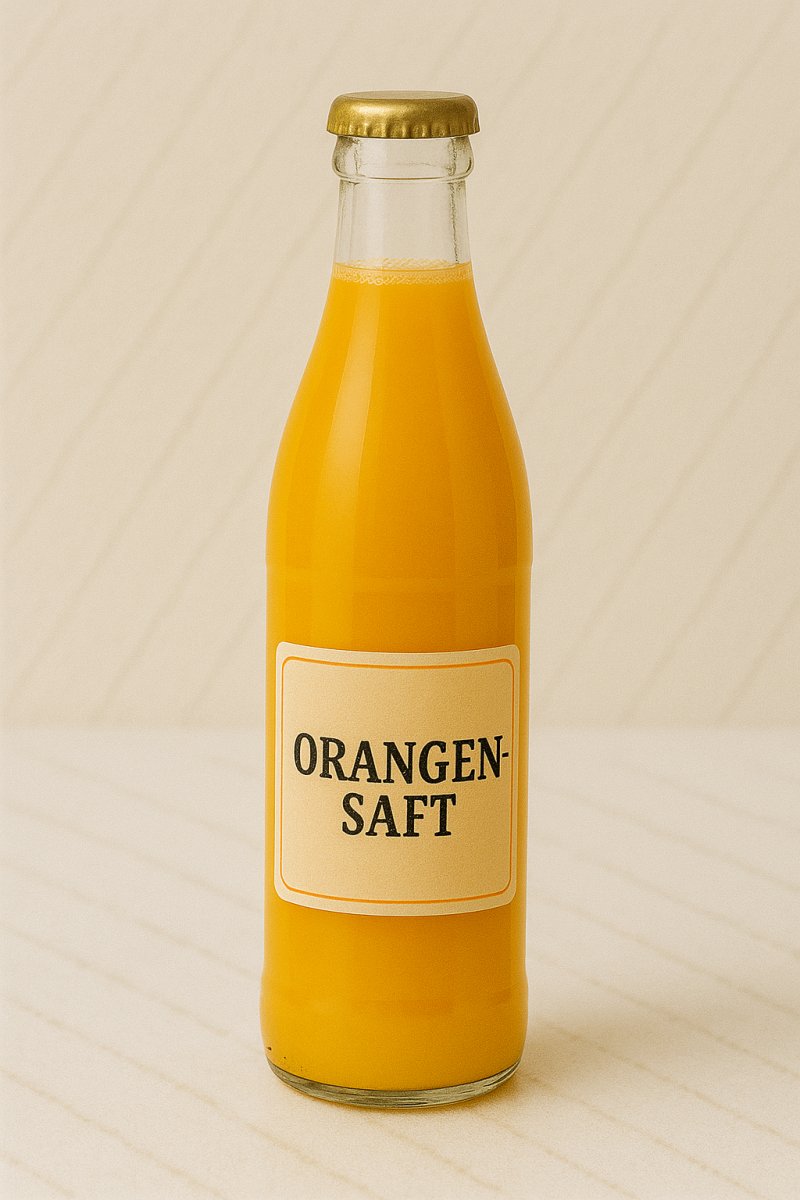
Orange juice

Fruity-sweet orange juice, rich in vitamin C.

Wiki about orange juice Nutri-Score C Vegan Yes Gluten-free Yes Lactose-free Yes Nut-free Yes
NUTRITION / 100 ml
45 kcal 0.7 g Protein 10.4 g Kohlenhydrate 0.2 g Fett

Introduction

Glass of orange juice with orange
Orange juice for me is more than a drink; it is a small morning ritual and a tiny ray of sunshine in a glass. I clearly remember a rainy morning when a colleague pulled a bottle of freshly squeezed juice out of his backpack and the room immediately smelled of citrus, as if we had all taken a short vacation. Since then I make a point of not only drinking orange juice but using it deliberately.

I love the versatility of this ingredient because it can be both sweet and tart and gives dishes depth. In my fridge there is almost always a small bottle of freshly squeezed juice next to honey and mustard. I add it to dressings to bring freshness to bitter winter salads and use it as a base for sauces that add a lively note to roasted fish or chicken. Once at dinner I accidentally used too much salt and a splash of orange juice saved the whole sauce.

Fresh tastes best, but in the kitchen the canned version is not to be dismissed either. Pulp can provide texture, while clear juice works wonderfully in cocktails and baked goods. I have compiled a small list of my favorite uses that have proven useful in everyday life:

  • Marinades: Orange juice makes meat more tender and flavorful.
  • Dressings: Together with olive oil and Dijon mustard it makes a fresh dressing.
  • Sorbets and desserts: It is an elegant, natural sweetness without artificial additives.
  • Drinks: Neat, with mineral water or as a base for creative cocktails.
A small tip: a sprinkle of freshly grated orange zest elevates the flavor to a new level because the essential oils deliver concentrated aromas. I occasionally store small portions of orange juice as ice cubes in the freezer so I can refresh sauces or drinks at any time. These small habits have enriched my kitchen and show how flexible and uncomplicated orange juice can be.

In the end, orange juice for me is an ingredient that evokes memories and at the same time leaves room for experiments, and that is why it belongs in my culinary repertoire.

Availability & types


Availability and types of orange juice

Orange juice comes from oranges, which grow in many countries around the world. The largest producers are Brazil, followed by countries such as the USA (especially Florida and California), Spain, Mexico, South Africa and Egypt. You can find orange juice year-round in supermarkets because oranges ripen at different times in different countries and juice can also be preserved. It's a bit like having strawberries in the garden in summer but still being able to eat strawberry jam from a jar in winter.

Important orange varieties

  • Navel – These oranges are often sweet and are enjoyed fresh. They have a small "navel" indentation at the end.
  • Valencia – Many juices are made from Valencia oranges because they are juicy and taste good when squeezed.
  • Blood orange – It has red-colored flesh and a somewhat more intense flavor. Juice from it often appears reddish.
  • Bitter orange / Seville – This one is very sour and is used more for marmalade or special drinks, less for regular juice.
  • Mandarins & clementines – Sometimes they are mixed with oranges, making the juice milder and sweeter.
Types and variants of orange juice

  • Freshly squeezed juice – Direct from the fruit, often at markets or juice bars. It tastes very fresh but does not keep long in the refrigerator.
  • Not from concentrate (NFC) – It is freshly squeezed and bottled immediately. It is very similar to freshly squeezed juice.
  • Reconstituted from concentrate – Water is removed from the juice leaving a thick concentrate. Water is added again before sale. This saves space in transport. You can imagine concentrate like a syrup to which water is added.
  • Cold-pressed – These juices are made without much heat so that flavor and nutrients are better preserved. They are said to taste "like fresh."
  • Pasteurized / preserved – The juice is briefly heated to kill microbes. It's similar to heating milk so it stays safe longer.
  • UHT/sterile-packed – These juices are treated so they can be shelf-stable for a long time (in cartons). After opening they must be refrigerated.
  • With or without pulp – Some people like pieces in the juice (with pulp), others prefer clear juice.
  • Organic juice – Made from oranges from organic farming, without certain pesticides.
  • Fortified or blended juices – There are often variants with added vitamin C, calcium or blends with other fruits like mango or pineapple.
  • Frozen concentrate – Practical for home use because it keeps for a long time and you can mix exactly the amount you need.
Orange juice is therefore available in many forms: fresh, processed, from different orange varieties and in different packaging such as bottles, cartons or small single-serve cups. Prices and availability depend on which variety was used, the country of origin of the fruit and whether the juice is fresh, organic or from concentrate. That way everyone – child or adult – can find the juice they like best.
Details & nutrition

Property Value
Unit ml
Average weight per piece 200
Calories per 100 45
Protein per 100 0.7
Carbohydrates per 100 10.4
Sugar per 100 8.4
Fat per 100 0.2
Saturated fat per 100 0
Monounsaturated fat 0
Polyunsaturated fat 0
Fiber per 100 0.2
Vitamin C (mg) per 100 50
Vitamin D (IU) per 100 0
Calcium (mg) per 100 11
Iron (mg) per 100 0.2
Nutri-Score C
CO₂ footprint 0.05
Origin Depending on the product (e.g. Spain, Brazil, Italy)
Gluten-free Yes
Lactose-free Yes
Nut-free Yes
Vegan Yes
Note Typical for 100% orange juice; contains natural fruit sugars. Values may vary depending on the product (direct juice/nectar).

Technical & scientific information

Orange juice is the liquid product obtained from the pressing or further processing of oranges (Citrus sinensis) and is used both as a food and as a raw material in food technology. Chemically, orange juice is a complex aqueous solution of organic acids, sugars, vitamins, secondary plant compounds, dissolved and colloidal solids and a characteristic mixture of volatile aroma compounds.

Composition and nutritional values: Typical orange juice contains predominantly water (approx. 85–90%). The dissolved solids consist mainly of carbohydrates (primarily sugars such as fructose, glucose and sucrose), with total sugar contents of about 8–12 g per 100 ml, depending on variety and degree of ripeness. Important organic acids are citric acid and to a lesser extent malic acid, which together typically keep the pH in the range of 3.3–4.0. Vitamin C (ascorbic acid) is a characteristic water-soluble vitamin and in commercial juices is often found in the range of approx. 20–60 mg per 100 ml, depending on freshness and processing. Minerals such as potassium are present in notable amounts; traces of calcium, magnesium and iron are also present. In addition, orange juice contains secondary plant compounds such as flavonoids (e.g. hesperidin) and carotenoids, which have antioxidant properties and contribute to the color.

Enzymes and colloidal structures: The turbidity or "cloud" of the fruit juice consists of cell wall fragments, pectins, proteins and lipids. Enzymes such as pectin methylesterase (PME) influence the stability of this cloud: through demethylation PME can promote the formation of calcium pectate and lead to phase separation. Polyphenol oxidases (PPO) are less pronounced in citrus fruits than in some other fruits but still play a role in oxidative reactions.

Processing methods: Important production variants are freshly squeezed, not from concentrate (NFC) and reconstituted from concentrate. Concentration is done by gentle vacuum evaporation, in which water is removed; volatile aroma compounds are lost in the process and are often recovered via aroma recovery systems and reintroduced into the final product. Thermal treatment (pasteurization, e.g. HTST processes) serves to inactivate microorganisms and enzymes, although heat-sensitive components such as ascorbic acid and aroma compounds can be partially reduced. Alternatively, technologically advanced methods such as high-pressure processing (HPP) are used, which reduce microbes while better preserving many quality attributes.

Microbiology and shelf life: The acidic pH range inhibits many pathogens, yet acid-tolerant microorganisms and specialized spore-formers such as Alicyclobacillus can cause problems. Spoilage typically occurs by yeasts, molds or heat-resistant bacterial spores. Aseptic filling, refrigeration and appropriate thermal processing extend shelf life.

Health aspects: Orange juice is a significant source of vitamin C and bioactive flavonoids, which exert antioxidant effects and contribute positively to nutrient supply. At the same time the high sugar content should be noted; regular excessive consumption can increase energy intake and affect blood sugar regulation. Allergic reactions to citrus fruits are rare, but bitter oranges may contain other bioactive substances that favor interactions with medications.

Overall, orange juice is a nutrient-rich, chemically complex food whose technological handling balances the preservation of nutrients, aroma and microbiological safety.

Wiki entry for: orange juice
Active now: 27 visitors of which 2 logged-in members in the last 5 minutes