Menu & categories

Mushrooms

Aromatic edible mushrooms – low in calories and versatile.

Wiki about mushroom Nutri-Score A Vegan Yes Gluten-free Yes Lactose-free Yes Nut-free Yes
NUTRITION / 100 g
22 kcal 3.1 g Protein 3.3 g Kohlenhydrate 0.3 g Fett

Introduction

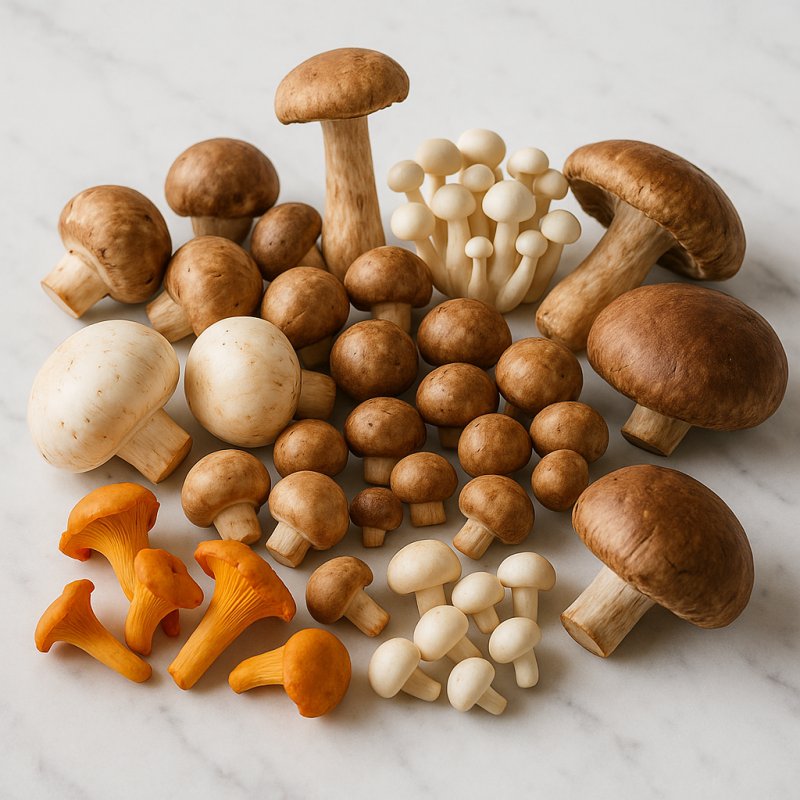
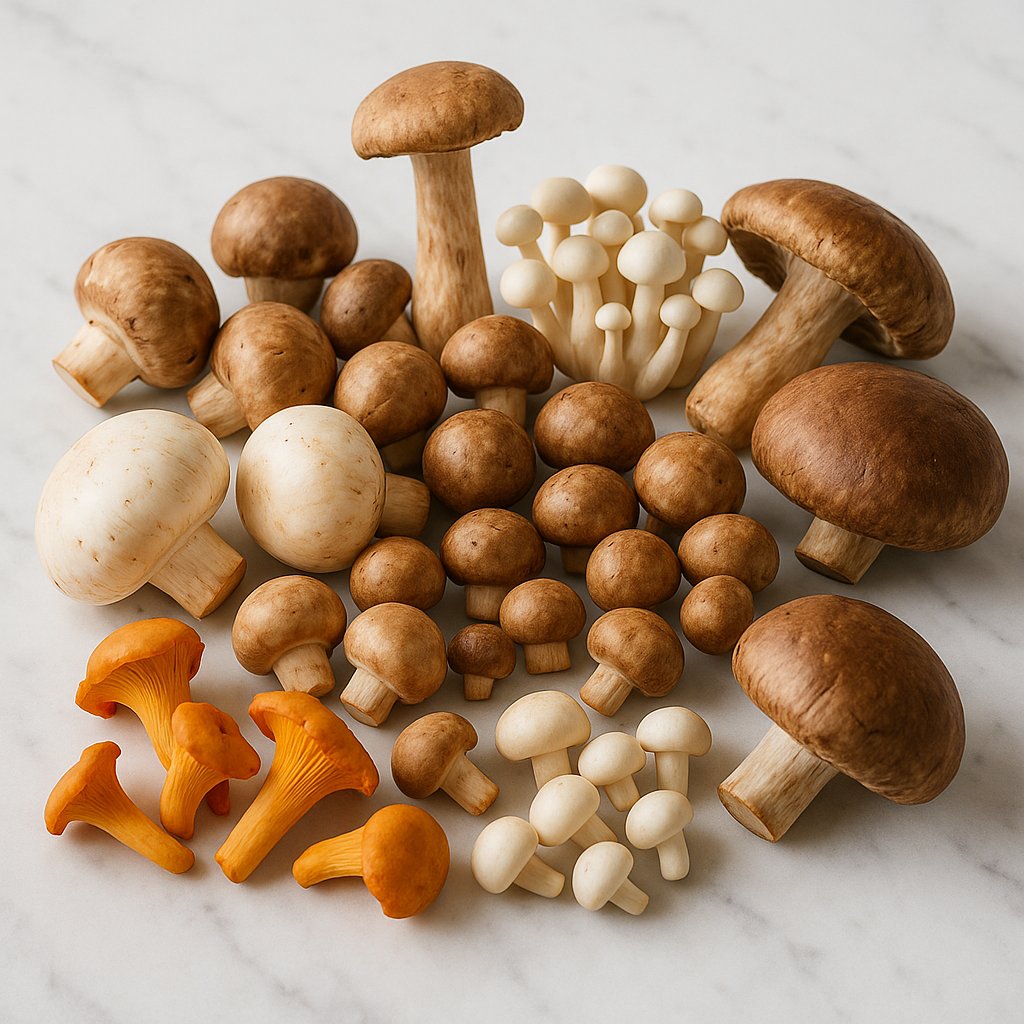
Fresh edible mushrooms close-up
I love mushrooms, and this is not a passing trend but a lasting passion. The first time I stirred a cream sauce with freshly browned mushrooms I understood how umami can change a dish; it felt like a small culinary magic trick that never gets boring. I still remember a rainy Sunday afternoon when a plate of chanterelles with garlic and parsley settled a heated discussion at the kitchen table – so simple and yet so comforting.

Mushrooms are fascinating because they are at once plain and surprisingly complex. They provide few calories but valuable nutrients like B vitamins and, when sun‑dried, even some vitamin D. While foraging in the woods I learned to move with respect and caution: you should never eat anything you do not know for sure. A colleague once brought the wrong specimen into the kitchen, and since then we have a small rule: when in doubt, leave it be.

In the kitchen mushrooms are adaptable. I like some quickly seared at high heat so they develop roasted notes; others I dry to preserve intense flavors. A well‑browned porcini in a pasta is for me like a small feast, while thinly sliced shiitake in a broth give a quiet but steady depth.

Practical tips that I always pass on I like to summarize as follows:

  • Clean, not wet: Clean mushrooms with a brush or a damp cloth, without submerging them in water.
  • High heat: Sear briefly on high heat for nice roasted flavors.
  • Drying: Dried mushrooms add aroma to sauces and soups.
  • Caution: Only collect known species and ask experts if in doubt.
Mushrooms are for me more than an ingredient; they are memory, experiment and comfort at once. Whether for a quick dinner or a slow Sunday dish: a little mushroom makes almost everything more interesting, and I am happy every time I rediscover that familiar earth aroma while cooking.

Availability & types

Availability and types

Mushrooms are a very versatile ingredient and can be found almost everywhere in the world. Important to know: mushrooms are not plants but belong to the Fungi. They grow in different places – some in forests on the ground or on dead wood, others are deliberately cultivated on mushroom farms. Mushrooms can be bought fresh, but also found dried, frozen or preserved in jars.

Origin and cultivation areas
Wild mushrooms grow naturally in forests, meadows and sometimes even in parks. Well‑known collecting areas are deciduous and coniferous forests where it is moist and shady – conditions many mushrooms prefer. Many edible mushrooms come from Europe, North America and parts of Asia. At the same time many varieties are commercially cultivated: mushroom farms are found in warehouses, old cellars or specialized greenhouses. Countries like China, the USA, Poland or the Netherlands have large mushroom productions because they have space, know‑how and appropriate technology. There are also small farms and hobby growers who cultivate mushrooms at home in boxes, bags or on logs.

Available species and varieties
At the supermarket and market you see different kinds of mushrooms. Some are available all the time, others only seasonally or in certain regions. Here are the most common, explained simply:

  • Button mushroom (Champignon) – the white or brown "kitchen mushroom", often in supermarkets. It is mild in flavor and very popular.
  • Portobello – a large, mature button mushroom with a robust flavor. Good as a "burger" substitute.
  • Shiitake – originates from Asia, has an intense aroma and is often sold dried.
  • Oyster mushroom – has caps like shells (hence the name) and a delicate texture.
  • King Oyster / Pleurotus eryngii – thick stem, meaty texture, good for frying.
  • Chanterelle (often wild) – yellow, with a peppery note, particularly popular in autumn.
  • Porcini (Steinpilz) – aromatic, commonly dried to preserve its strong flavor.
  • Morel – a rare, vividly shaped mushroom, highly prized; mostly foraged, not farmed.
  • Enoki, Shimeji – small stem mushrooms from Asia, frequently used in soups and stir‑fries.
  • Truffle – grows underground and is very expensive; small amounts suffice because the flavor is strong.
Forms on the market
You can buy mushrooms as fresh caps, sliced, canned, frozen or dried. Dried mushrooms like porcini are practical because they keep for a long time – to cook with them simply soak in warm water. Pickled mushrooms are already seasoned and can be used straight on bread or in salads. Fresh mushrooms are the most aromatic but only keep for a few days in the refrigerator.

Whether you get mushrooms fresh from the vendor, dried from the pantry or from your own small grow kit: there are many types for different dishes and tastes. That way everyone can find the right mushroom for a pan, soup or pizza.
Details & nutrition

Property Value
Unit g
Calories per 100 22
Protein per 100 3.1
Carbohydrates per 100 3.3
Sugar per 100 2.0
Fat per 100 0.3
Saturated fat per 100 0.05
Monounsaturated fat 0.02
Polyunsaturated fat 0.12
Fiber per 100 1.0
Vitamin C (mg) per 100 2
Vitamin D (IU) per 100 7
Calcium (mg) per 100 3
Iron (mg) per 100 0.5
Nutri-Score A
CO₂ footprint 0.11 kg CO2e / 100 g
Origin Germany/EU (depending on season and variety)
Gluten-free Yes
Lactose-free Yes
Nut-free Yes
Vegan Yes
Note Nutritional values can vary depending on mushroom species; vitamin D content depends, among other factors, on light/UV exposure.

Technical & scientific information

Mushrooms are the visible fruiting bodies of selected species from the kingdom Fungi and serve in the kitchen and food industry as a versatile ingredient. Biologically, fungi do not belong to the plants but to their own kingdom, characterized by a network of hyphae and mycelium. The edible part, the fruiting body, is morphologically and compositionally diverse and contains numerous compounds that make it interesting for flavor, nutrition and technology.

Composition and nutritional values
Fresh edible mushrooms consist of about 85–95% water. The remaining dry matter is composed of:

  • Proteins: approx. 2–5 g/100 g fresh weight; mushrooms contain all essential amino acids in variable composition.
  • Carbohydrates: 2–6 g/100 g, mainly in the form of polysaccharides such as β‑glucans, mannans and storage sugars.
  • Dietary fiber: including chitin in the cell wall as well as soluble fibers that are physiologically relevant.
  • Fats: very low (0.1–1 g/100 g), with a proportion of polyunsaturated fatty acids.
  • Vitamins and minerals: rich in B vitamins (e.g. riboflavin, niacin, pantothenic acid); vitamin D2 forms from ergosterol under UV‑B exposure; mineral-wise potassium, selenium and copper are particularly relevant.
  • Secondary metabolites: antioxidants such as Ergothionein, phenols and various aromatic compounds that contribute to umami taste (free glutamate, 5′‑nucleotides).
Technological processing
Mushrooms are preserved and processed in different ways. Common procedures include:

  • Fresh produce – stored chilled at low temperatures to slow microbial activity.
  • Drying – reduces water activity, extends shelf life and intensifies flavors; rehydration before use possible.
  • Pickling and preservation – in brine, oil or vinegar; pasteurizing/sterilizing treatments for shelf stability.
  • Blanching and freezing – inactivate enzymes (e.g. polyphenoloxidase) and reduce enzymatic browning.
  • Fermentation and extraction – for flavor concentrates, extracts with β‑glucans or proteins for functional foods.
Health aspects and safety
Mushrooms contribute to the nutrient density of meals due to their low energy content, protein content and specific bioactive compounds. β‑glucans are discussed in nutrition for their potential immunomodulatory properties; however, health claims depend on dose, purity and individual response. Ergosterol can be converted to vitamin D2 under UV light, which is nutritionally relevant.

Species accuracy is crucial for food safety: some wild mushrooms contain heat‑stable toxins (e.g. amatoxins in certain Amanita species) or other toxic compounds (e.g. gyromitrin in false morels), which can cause severe poisoning even in small amounts. Enzymatic browning by polyphenoloxidase is not a safety risk but can impair appearance; it can be reduced by blanching, acidic solutions or cooling. Allergies and intolerances are possible, and interactions with medications cannot be excluded for certain species.

Ecology and cultivation
Ecologically, fungi differ by their nutritional mode: many are saprotrophic (decomposers), others mycorrhizal (symbiotic with plant roots) or parasitic. Commercial cultivation focuses on saprotrophic species such as Agaricus bisporus, Pleurotus spp. and Lentinula edodes, grown on controlled substrates. Growing conditions influence the size, texture and nutrient content of the fruiting bodies.

Thus, from a nutritional and technological perspective, mushrooms are a versatile ingredient with specific physico‑chemical properties that allow both culinary and functional applications; accurate identification and appropriate processing remain central for consumer safety.

Wiki entry for: mushroom
Active now: 20 visitors of which 2 logged-in members in the last 5 minutes