Menu & categories

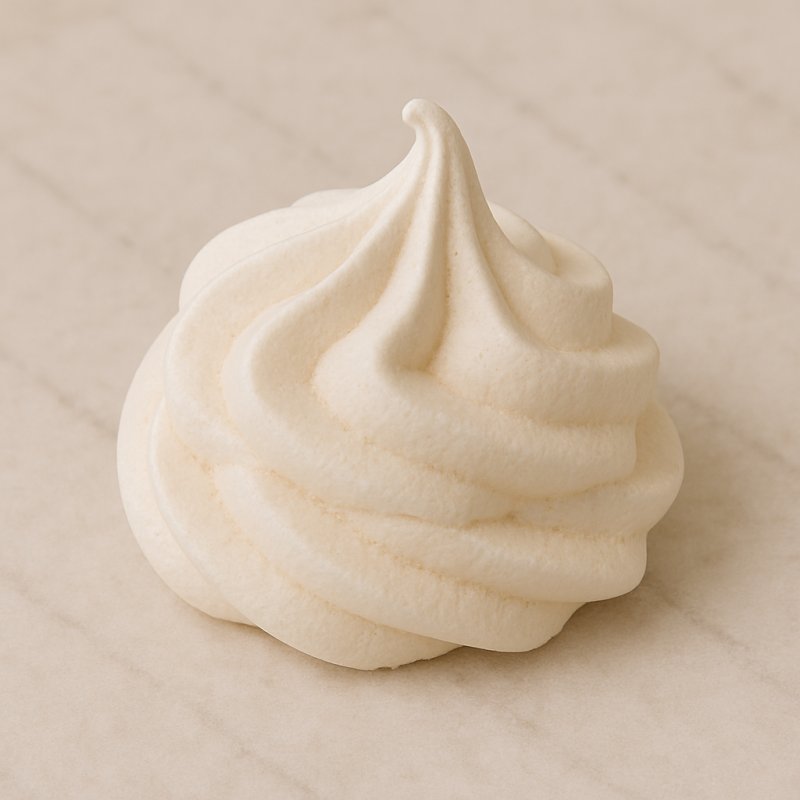
Meringue

Light, airy confection made from egg whites and sugar

Wiki about meringue Nutri-Score E Vegan No Gluten-free Yes Lactose-free Yes Nut-free Yes
NUTRITION / 100 g
380 kcal 4 g Protein 94 g Kohlenhydrate 0 g Fett

Introduction

Several small white meringues on a plate
I remember exactly the first meringue I baked myself: a whole tray full of snow-white dollops that were tinkling-light when taken out of the oven and melted in the mouth into an almost tenderly dissolving whisper. To me, meringue is the art of turning something simple into something magical. At its core it consists of only two basic ingredients — egg whites and sugar — and yet it opens up countless variations, from crisp-thin rounds to opulent pavlovas with cream and fresh fruit.

What I especially love about meringue is the mix of technique and spontaneity. Once, in a hectic kitchen, I tried to whip egg whites in a bowl that was too warm; the mixture simply refused to become properly stiff. A colleague handed me cool water and a fresh bowl, and in no time everything was there: glossy peaks that sparkled like little ships in the light. Those small rescue operations are part of meringue for me just as much as the patient drying in the oven.

The texture is the true star: crispy on the outside, tender to slightly marshmallow-like inside — depending on baking time you can play with it. I've learned to trust sound and feel when baking; a light tap on the bottom often reveals more than any thermometer. I'm also delighted by the variety of possibilities: you can work in flavors like vanilla, citrus zest or cocoa, fold in nuts or pipe colored dollops for special occasions.

Tips I pass on:

  • Always use completely clean, grease-free bowls.
  • Let egg whites come to room temperature for more volume.
  • Add sugar slowly to obtain a stable, glossy mixture.
  • Dry at a low temperature rather than bake at high heat to avoid cracking.
Meringue, for me, is more than just a dessert component; it is a play with air and patience, a small triumph of simplicity. Sometimes a single bite is enough to evoke childhood memories or summer days. When I have guests I often serve a simple bowl with meringue crumbs, fresh berries and a dollop of cream — the combination of crispness and freshness always produces amazed faces. Try it: meringue rewards curiosity and care with a pleasure that is light, sweet and surprisingly elegant at the same time.

Availability & types

Availability and types of meringue

Meringue is a light, sweet treat made from whipped egg whites and sugar. Although it does not grow like a vegetable or fruit, it still has an "origin" and various "types" that explain why you can find meringue in different places and in different forms. Think of meringue like a little baked cloud — wherever people bake, you can find meringue, but its style and color can vary.

Origin and history
Meringue originally comes from Europe and was invented there many hundreds of years ago. The name comes from French and roughly means "kiss" — which is why small, delicate meringue heaps are often called "kisses." Over time the recipe spread to many countries and bakers and home cooks refined it. That's why today you find meringue around the world, from simple little pillows to colorful works of art.

Growing regions? (or: where does store-bought meringue come from?)
Because meringue doesn't grow, there are no cultivation regions in the classical sense. But the ingredients — eggs and sugar — come from particular regions:

  • Eggs: Most eggs come from hens raised on farms. This can be very local (regional farms) or further away (large-scale operations). At the market you sometimes see labels such as "free-range" or "organic"; these indicate how the hens were kept.
  • Sugar: Sugar is usually obtained from sugar beets or sugar cane. Sugar beets grow well in cooler regions, for example in parts of Europe, while sugar cane is grown in warm countries such as Brazil or India.
The combination of these ingredients and the baking usually happens in home kitchens, bakeries or factories. Confectioneries often produce particularly pretty and stable meringues, while at home you can make small meringues with a simple recipe.

Available types and variants
Meringue comes in many shapes and sizes. Here are the main types, explained simply:

  • Mini meringues or meringue kisses: Tiny dry dollops that look like little sugar beads. They are light and crunchy, almost like small edible snowflakes.
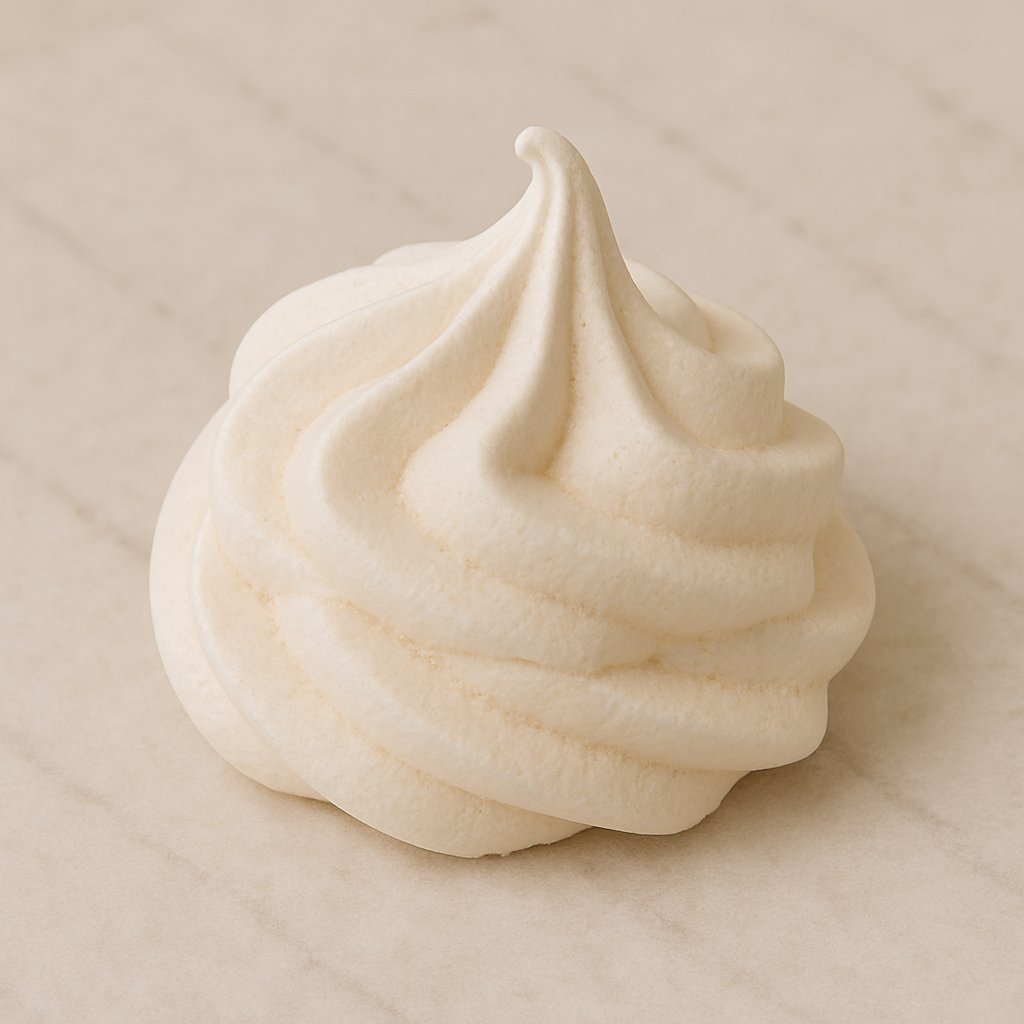
  • Larger meringue swirls: These are somewhat bigger and often crispy on the outside and still a bit soft inside. Picture a fluffy meringue mound that yields slightly when bitten.
  • Colored meringues: Food coloring is added to the whipped egg whites. This produces pink, blue or multicolored meringues that look very cheerful — like small candies.
  • Filled meringues: Sometimes two meringue halves are sandwiched with cream or chocolate — like two cookie sides with a cream in between.
  • Meringue pavlova: This is a large, flat meringue cake often topped with cream and fruit. It resembles a huge edible cloud plate.
Where to buy or find meringue
You can find meringue in supermarkets, at bakeries or in confectioneries. Some confectionery manufacturers offer small meringues as cake decorations. In some countries certain types are more popular — for example in France you often see elegant large meringue creations, while supermarkets usually sell small, simple meringues.

In summary: meringue is available wherever people bake or make sweets. Although it doesn't "grow," its availability depends on eggs and sugar that come from various regions. There are many variants — from tiny crunchy pieces to large soft ones, colored or filled — so there's something for every taste. Whether baked at home or bought from a patisserie, meringue remains a light, sweet pleasure enjoyed by children and adults alike.
Details & nutrition

Property Value
Unit g
Average weight per piece 5
Calories per 100 380
Protein per 100 4
Carbohydrates per 100 94
Sugar per 100 94
Fat per 100 0
Saturated fat per 100 0
Monounsaturated fat 0
Polyunsaturated fat 0
Fiber per 100 0
Vitamin C (mg) per 100 0
Vitamin D (IU) per 100 0
Calcium (mg) per 100 5
Iron (mg) per 100 0.2
Nutri-Score E
CO₂ footprint 1.0
Origin International
Gluten-free Yes
Lactose-free Yes
Nut-free Yes
Vegan No
Note Classic meringue is made mainly from sugar and egg whites; very high in sugar and not suitable for a vegan diet.

Technical & scientific information

Meringue (also called meringue or baiser) is an airy sugar–egg-white preparation used in the kitchen as a standalone confection or as a component of desserts and baked goods. Fundamentally, meringue consists of whipped egg whites and sugar; depending on the recipe additional stabilizers such as lemon juice, vinegar or cornstarch as well as flavors and food coloring are added. The characteristic texture — dry and crisp on the outside, optionally slightly chewy or completely dry inside — is produced by the combination of mechanical air incorporation and thermal drying during baking.

Chemical composition and function of the components

  • Egg white: The main components are proteins such as albumins (e.g., ovalbumin, conalbumin, ovomucoid). These proteins are globular and foldable in aqueous solution. Mechanical whipping denatures the proteins and forms a network that stabilizes the air and supports the foam structure.
  • Sugar: Sucrose or other sugars increase foam stability, bind water and delay protein coagulation during heating. Sugar also affects the glass transition and thus the final consistency (crisp vs. chewy).
  • Water: Acts as a solvent for proteins and sugar. The moisture that is partially removed by heating determines crust formation and storage stability.
  • Stabilizers/Acids: Small amounts of acids (citric acid, wine vinegar) lower the pH; this increases protein solubility and facilitates foam formation, producing finer and more stable air bubbles.
Manufacturing principles and processing

  • Fresh, fat-free egg whites are whipped at room temperature until foamy.
  • Sugar is added gradually so that it dissolves and stabilizes the structure. Completely dissolved sugar yields a glossy surface and a finer pore structure.
  • Temperature and baking time are critical: low temperatures (about 80–120 °C) for longer periods dry the meringue without browning it; higher temperatures create a crust more quickly but risk cracking or excessive browning through Maillard reactions and caramelization.
  • In industrial processes a partial drying is often followed by tempering or steam inactivation to control the residual moisture content.
Nutritional values and energetic properties

Meringue consists predominantly of sugar and nitrogen-containing proteins; the calorie content results almost exclusively from carbohydrates (sugar) and to a lesser extent from protein. Typical nutritional values are around 350–400 kcal per 100 g, with moderate protein content (about 6–10 g/100 g) and high sugar content (over 80 g/100 g). Fat is virtually absent, unless buttercream or other fat components have been added.

Food safety and health aspects

  • Raw egg white can carry Salmonella contamination; for this reason traditional recipes recommend baking at temperatures that inactivate pathogenic bacteria or using pasteurized egg white products to reduce risk.
  • For individuals allergic to hen egg proteins meringue is unsuitable. People with fructose intolerance or diabetes should also be cautious because of the high sugar content.
  • The low fat profile makes meringue lighter compared with fattier confections, but the high sugar content has a significant effect on blood glucose and energy balance.
Physical properties and storage

The texture of meringue depends largely on residual moisture content and the crystalline structure of the sugar. Fully dried, porous structures are hygroscopic and quickly absorb moisture under humid storage conditions, which leads to softening. Therefore meringues are usually stored airtight and dry, often with desiccants in packaging or in climate-controlled storage areas.

Variants and culinary applications

There are several preparation methods: French meringue (classic whipped egg whites with sugar), Swiss meringue (egg whites and sugar heated over a bain-marie then whipped) and Italian meringue (sugar incorporated as hot syrup into whipped egg whites), each producing different stability and moisture profiles. Meringue is used as a stand-alone cookie, as a decoration (pavlova, Eton Mess) or as a layer within creams and cakes.

In summary, meringue is a technically and biochemically interesting food product whose quality depends on protein denaturation, sugar physics and controlled heat treatment. The balance between air stability, dissolved sugar amount and residual moisture determines the sensory properties, while food safety and storage conditions are decisive for shelf life and consumer safety.

Wiki entry for: meringue
Active now: 17 visitors of which 2 logged-in members in the last 5 minutes