Menu & categories

Marshmallows

Foamed sugar confectionery with a high sugar content

Wiki about marshmallow Nutri-Score E Vegan No Gluten-free Yes Lactose-free Yes Nut-free Yes
NUTRITION / 100 g
318 kcal 3.5 g Protein 78 g Kohlenhydrate 0.2 g Fett

Introduction

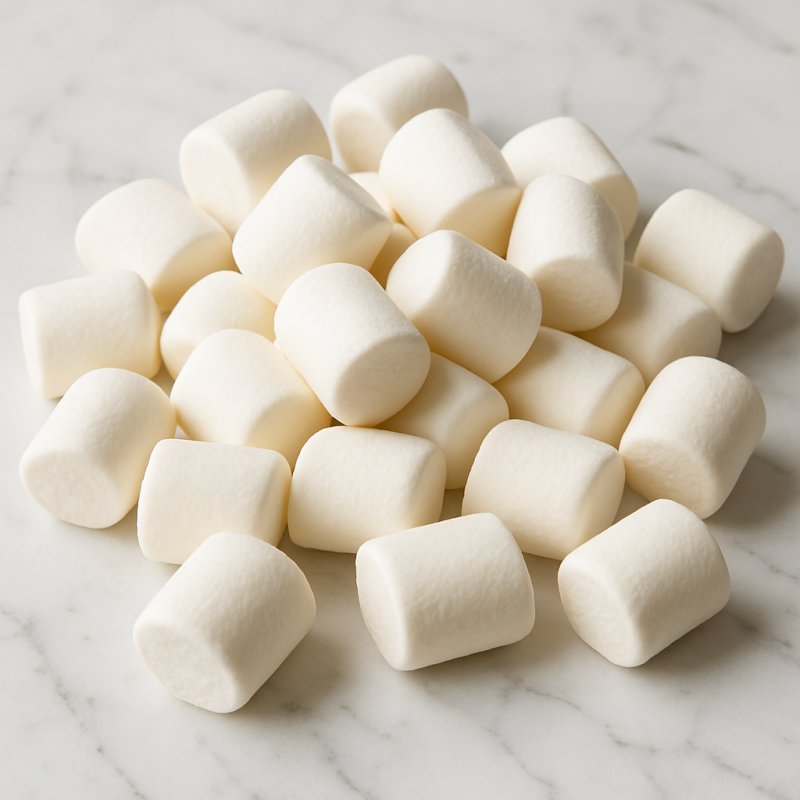
Several white and pink marshmallows
I confess: I have a crackling weakness for marshmallows. As a child I was the one who showed the most patience at the campfire to achieve the perfect golden cap, and even today I catch myself smiling nostalgically at the scent of melted sugar and vanilla. A friend once called marshmallows "airy happiness pills" – and that phrase has firmly lodged in my vocabulary.

Marshmallows are surprisingly versatile. At their core they are made of sugar, gelatin, some water and a subtle note of vanilla; sometimes corn syrup or egg white is added to refine the texture. At first glance the ingredient list seems simple, but the result is a fascinating combination of delicately melting consistency and heavenly sweetness. I still remember a market street in Paris where a small sweet stall sold handmade marshmallows scented with lavender oil – a memory that forever expanded my imagination for these little clouds.

They are not just a campfire accessory. Marshmallows work great for:

  • Baking: Between two cookies they make decadent s'mores; when caramelized in the oven they become a seductive crust on brownies.
  • As a beverage ingredient: In hot chocolate they dissolve slowly and lend a velvety sweetness.
  • For decorating: Small, colored marshmallows add playful accents to cakes and desserts.
I once tried making marshmallows at home. After a chaotic, sugar-splattered afternoon I found that the result, though uneven, was incredibly satisfying. The texture while whipping has something meditative; watching the mass grow until it reaches a perfectly glossy, sticky texture is almost therapeutic.

For me marshmallows are more than just sweets. They carry memories of summer evenings, improvised café afternoons and small culinary experiments. They can awaken childlike joy and adult creativity at the same time. And the next time I sip a hot cocoa and a marshmallow slowly melts in it, I will feel that quiet, contented smile again.

Availability & types

Availability and types

Marshmallows are soft, fluffy sweets that are easy to find in many countries. They originally come from a plant called marshmallow (in German "Eibisch"), which used to grow in marshes and wet areas. The sap of that plant was once used to make a sticky substance that was processed into sweets. Today marshmallows are usually not made from marshmallow sap anymore but from sugar, gelatin and air – nevertheless the name remained.

Where to get marshmallows:

  • Supermarkets: In almost every large store you can find marshmallows. They are usually placed with sweets, baking ingredients or near desserts.
  • Specialty shops: In shops that sell baking ingredients or special treats you will often find larger packs or special varieties.
  • Online shops: You can also order many varieties on the internet – particularly useful if you are looking for a specific shape, color or brand.
  • Seasons and holidays: In the cold season, for camping or during holidays (like Halloween or Christmas) there are often extra marshmallow offers, because they are good for roasting over the fire or for baking.
What kinds of marshmallows are there?

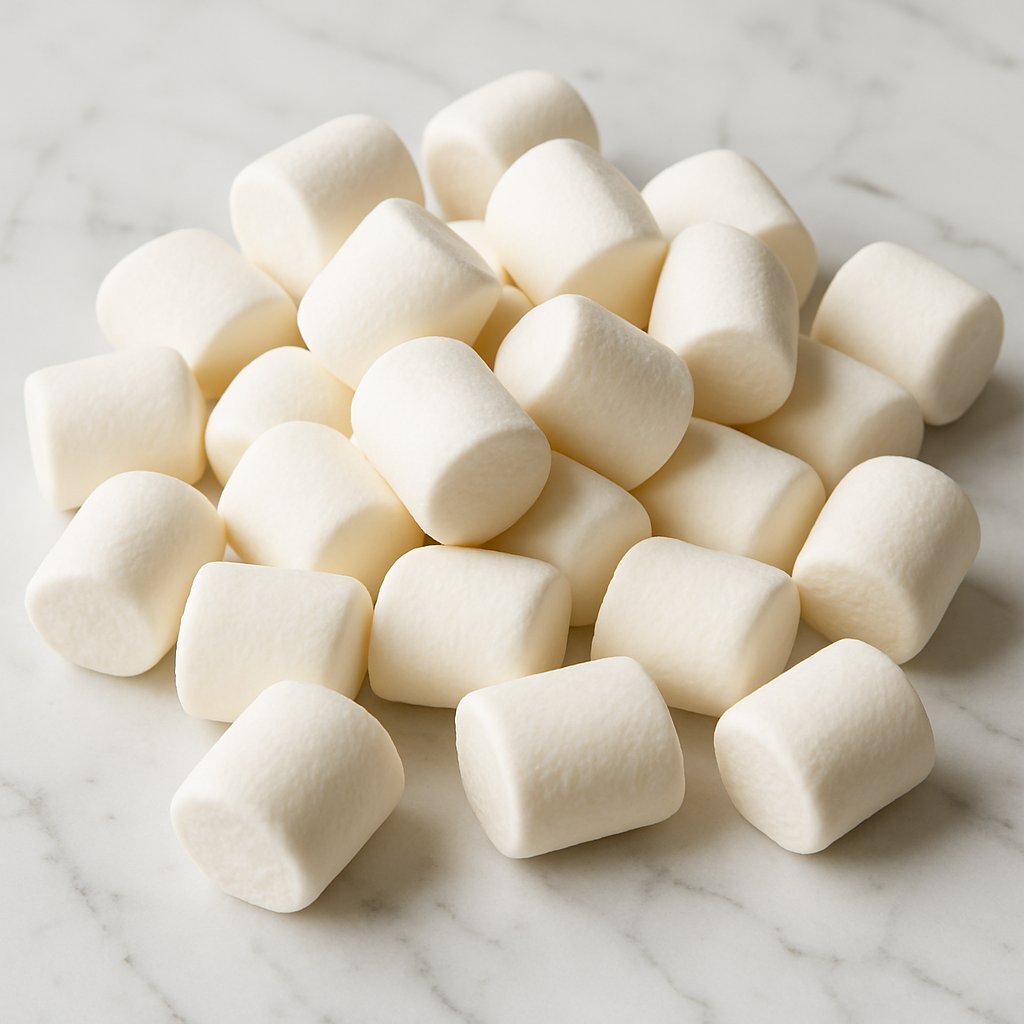
  • Standard marshmallows: These are the classic white, soft cubes or cylinders. They are good for snacking, baking or roasting.
  • Mini marshmallows: Tiny variants that often end up in chocolate, cocoa or cereal. They are practical when you only need small pieces.
  • Colored and flavored marshmallows: Some marshmallows are pink, blue, green or have vanilla, strawberry or chocolate flavor. This makes them more colorful and slightly different in taste.
  • Shape specials: There are marshmallows in hearts, stars, animals or seasonal shapes (e.g. pumpkins for Halloween). Such shapes are popular at children's birthday parties or for special desserts.
  • Vegan or gelatin-free variants: Regular marshmallows contain gelatin, which is obtained from animals. For people who do not want to eat gelatin there are varieties with plant-based binders like agar-agar or pectin.
  • Gourmet or handmade marshmallows: Some patisseries offer particularly soft or more aromatic versions, sometimes filled with chocolate, caramel or fruit purée.
  • Toasting and campfire marshmallows: These are somewhat larger and firmer so you can hold them well over a campfire until they are golden brown or melted.
Simply put: imagine marshmallows as little soft pillows made of sugar. Some pillows are simply white and small, others are colorful, fragrant or even filled with chocolate. Depending on what you need them for – baking, roasting or as colorful decoration – there is a suitable variety.

Tips on what to watch for:

  • Check the ingredients if you do not want gelatin.
  • For special shapes or flavors, check specialty stores or the internet.
  • For campfire marshmallows choose the larger, sturdier varieties.
So marshmallows are not only easy to find but also very versatile: from the classic white sweet to colorful, vegan or handmade specialties, there are many varieties for different tastes and occasions.
Details & nutrition

Property Value
Unit g
Average weight per piece 7
Calories per 100 318
Protein per 100 3.5
Carbohydrates per 100 78
Sugar per 100 58
Fat per 100 0.2
Saturated fat per 100 0.1
Monounsaturated fat 0.0
Polyunsaturated fat 0.0
Fiber per 100 0.0
Vitamin C (mg) per 100 0.0
Vitamin D (IU) per 100 0.0
Calcium (mg) per 100 5
Iron (mg) per 100 0.1
Nutri-Score E
CO₂ footprint 1.5
Origin Industrial product; depending on the manufacturer, usually EU or USA
Gluten-free Yes
Lactose-free Yes
Nut-free Yes
Vegan No
Note Marshmallows consist mainly of sugar and gelatin; often gluten- and lactose-free, but not vegan. Recipe may vary by manufacturer; always check the ingredients list.

Technical & scientific information

Definition and use
Marshmallows are sweet, airy confectionery pieces that consist of a stable foam structure. Traditionally used as treats, in desserts or as an ingredient in hot drinks and baked goods, they are characterized by their soft, elastic texture and high sweetness. Industrially produced marshmallows are available in various shapes and sizes and serve both as a snack and as a technological component in food formulations, for example to create layer stability and volume in baked goods and chocolate bars.

Basic ingredients
The typical composition of marshmallows includes:

  • Sugar: Sucrose, invert sugar or corn syrup are the primary sweeteners and provide the main share of calories.
  • Water: Used to dissolve sugar and gelling agents and to adjust moisture.
  • Gelling agent: Traditionally gelatin of animal origin; in vegetarian variants pectin, agar-agar or modified starch are used.
  • Proteins: Egg white (albumin) is often used, but in some recipes it can be replaced by gelatin. Egg white contributes to foam formation and stability.
  • Thickeners and stabilizers: Lecithin, carrageenans or modified starches improve emulsion and texture.
  • Flavors and colorings: Vanillin, fruit flavors and food colorings for sensory adjustment.
Chemical and physical properties
Marshmallows are a gas-in-liquid-gel system: air bubbles are embedded in a continuous viscoelastic matrix network of proteins and polysaccharides/gelatin. The texture results from the balance between network cohesion (gelatin/pectin) and water content. Sugar affects freezing and melting behavior and water activity through colligative effects, which significantly determine microbiological stability and texture. When heated, sugar caramelizes on the surface and alters color and aroma; roasting additionally generates Maillard chemistry, provided proteins are present.

Manufacturing process
Industrial production is divided into the following steps:

  • Syrup production: Sugar and water are dissolved and heated to defined concentrations; Maillard and caramelization reactions are intentionally avoided.
  • Gelling agent preparation: Gelatin is rehydrated in water; plant-based alternatives are activated accordingly.
  • Foaming: Air is incorporated under controlled conditions, often combined with egg white, to form fine, stable bubbles.
  • Tempering and shaping: The foam is deposited into molds, cooled and, if necessary, dusted with sugar to reduce surface stickiness.
Nutritional values and health aspects
Marshmallows primarily provide energy in the form of simple carbohydrates and contain very little fat, protein or fiber. A typical serving (approx. 28 g) provides roughly 90–110 kcal, almost exclusively from sugar. Health-relevant points are:

  • Oral health: Sticky texture and high sugar content promote the risk of cavities through bacterial fermentation.
  • Blood sugar: Rapid uptake of simple sugars can cause spikes in blood glucose, which is relevant for diabetics.
  • Allergens: Products with egg white or gelatin of animal origin are not suitable for people with allergies or certain diets.
  • Food safety: Low water activity and high sugar content inhibit the growth of many microorganisms, but contaminated raw materials can pose risks.
Variants and innovations
Modern product developments include vegetarian/vegan gelling agents, reduced-sugar versions with sweeteners or polyols, as well as functionalized marshmallows with added protein or vitamins. Texture modifications through hydrocolloids and emulsifiers enable adaptation to various application scenarios, for example heat-stable forms for baked goods.

Conclusion
Marshmallows are a technically interesting food whose structure and sensory properties are determined by the interplay of sugar, water, gelling agents and air. Their simple nutritional profile and specific technological properties make them relevant both as a treat and as a flexible ingredient type in food production, while health aspects such as high sugar content and allergens should be considered when using them.

Wiki entry for: marshmallow
Active now: 24 visitors of which 2 logged-in members in the last 5 minutes