Menu & categories

Lime

Zesty citrus fruit for juice, zest and fresh flavors.

Wiki about lime Nutri-Score A Vegan Yes Gluten-free Yes Lactose-free Yes Nut-free Yes
NUTRITION / 100 g
30 kcal 0.7 g Protein 10.5 g Kohlenhydrate 0.2 g Fett

Introduction

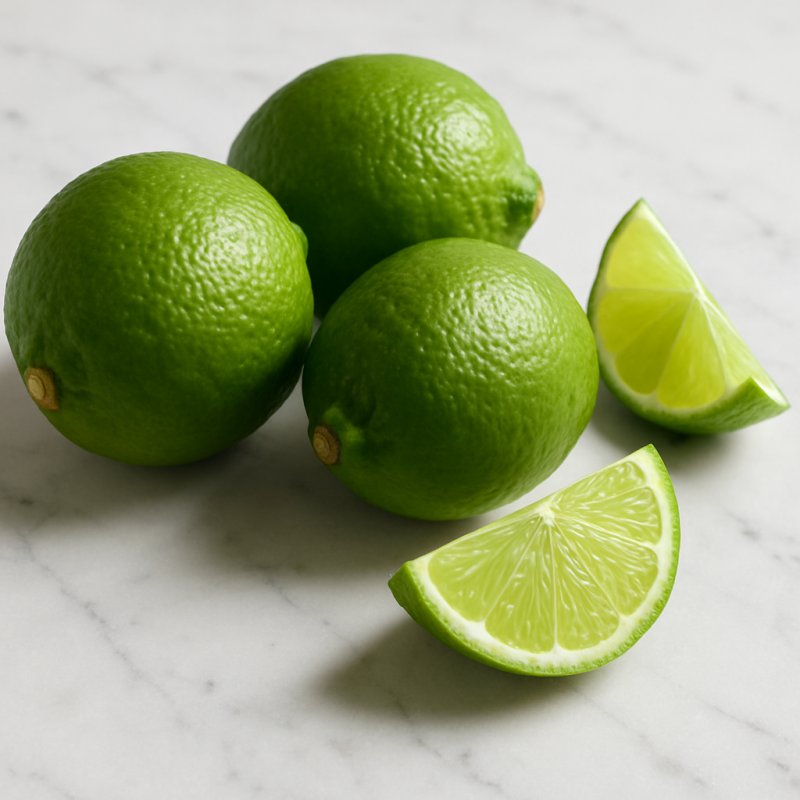
Fresh green lime, halved
I have a small weakness: limes always manage to pull me out of my routine. Their bright green exterior and that sharp, simultaneously sweet‑bitter scent immediately evoke memories of summer evenings, improvised cocktails and the one pan where a splash of lime juice turned a good dish into a great one. I still remember a market stall in a rain‑shrouded town where the vendor gave me two limes because I smiled — and that started a phase in which I carried limes into almost every recipe.

What I love about the lime is its versatility. A little juice lifts a creamy curry, a few finely chopped zests give a salad dressing surprising freshness, and a drop over grilled fish makes the flavors sing right away. A colleague of mine swears by a splash of lime in his morning kefir; I was skeptical until I tried it and wondered how I ever lived without it.

Practical and aromatic, the lime brings:

  • a bright acidity that balances fat in food;
  • aromatic oils in the peel that give cocktails and desserts a floral profile;
  • a surprising, almost tart freshness that elevates even simple dishes.
In my kitchen I like not to waste the peel: zest adds depth to baked goods and marinades, while preserved lime slices create an entirely new flavor. Sometimes I squeeze a few limes over fresh fruit because the acidity helps tell the story of the sweetness rather than overpowering it. And yes, small mishaps happen: once lime juice splashed into my tea, and the result became my new favorite infusion on rainy afternoons.

Limes are small, but they have power. They challenge me anew every day, using simple means to shape flavor and cook memories. Anyone who has learned to find the balance between acidity, sweetness and fat with a lime always has a small culinary marvel within reach.

Availability & types

The lime is a small green citrus fruit used in many kitchens around the world. When we talk about availability and types, we mean first where the lime comes from and second which different varieties and forms you can buy. I explain it in an easy‑to‑understand way — like for a curious 12‑year‑old.

Origin:
Limes originally come from warm areas in Southeast Asia and India. Over the centuries these fruits spread via seafarers to many parts of the world. Today they grow best where it is warm and winters are not too cold, because limes do not like frost.

Growing regions:
Limes are grown in many countries. Important producers include:

  • Mexico – especially for limes used in drinks and cooking.
  • Brazil – large production for juice and export.
  • India – a wide diversity of citrus is grown here.
  • Thailand and other Southeast Asian countries – known for special varieties like the Kaffir lime.
  • USA (Florida, California) and Australia – these countries also have large plantations.
Available varieties and types:
There are several well‑known types of lime. Each has its own taste and distinctive shape. Here are the main ones with simple descriptions:

  • Persian lime (also Tahiti lime) – larger, often seedless and green to light green. Common in supermarkets, mild and juicy.
  • Key lime (Mexican or West Indian lime) – smaller and more intense in flavor, very sour. Great for cocktails or key lime pie.
  • Kaffir lime (Makrut) – has a very wrinkled rind and distinctive leaves used in Asian cooking for aroma. The juice is less important than the leaves.
  • Fingerlime – from Australia, inside it looks like small caviar pearls. When cut open tiny juice beads “pop” out — a visual delight!
  • Rangpur lime – more orange in appearance, looks like a small orange but tastes very sour like a lime.
Commercial forms:
Limes are available fresh, as juice, as grated peel (zest), frozen or dried. In some countries you can also find preserved limes (for example salted) or lime concentrate. For quick cooking bottled lime juices are available, but freshly squeezed lime usually has more flavor.

Simple tips for buying and storing:

  • Choose firm limes that feel relatively heavy — this usually means more juice.
  • A shiny peel is good; very shriveled limes are old.
  • In the refrigerator limes keep longer (about 1–2 weeks). At room temperature they soften faster.
In summary: limes come from warm countries, are found in many regions of the world and come in different varieties like Persian, Key, Kaffir or fingerlime. You can buy them fresh or as juice and dried products. Each variety has its own aroma and taste — like each lime having a small personality that expresses itself differently in dishes and drinks.
Details & nutrition

Property Value
Unit g
Average weight per piece 67
Calories per 100 30
Protein per 100 0.7
Carbohydrates per 100 10.5
Sugar per 100 1.7
Fat per 100 0.2
Saturated fat per 100 0.02
Monounsaturated fat 0.04
Polyunsaturated fat 0.06
Fiber per 100 2.8
Vitamin C (mg) per 100 29
Vitamin D (IU) per 100 0
Calcium (mg) per 100 33
Iron (mg) per 100 0.6
Nutri-Score A
CO₂ footprint 0.4
Origin Mexico/Spain (depending on season and trade)
Gluten-free Yes
Lactose-free Yes
Nut-free Yes
Vegan Yes
Note For zest, preferably use untreated fruit and wash the peel thoroughly before grating.

Technical & scientific information

Lime refers to the fruit of several citrus plants, primarily Citrus aurantiifolia (Key‑Lime) and Citrus latifolia (Persian‑Lime). Botanically it belongs to the family Rutaceae. The lime is characterized by a thinner peel, high acidity and a distinctive fresh aroma that is used in food production, the perfume industry and traditional medicine.

Chemical composition and constituents: The main chemical components of lime are organic acids, water, sugars, vitamins, secondary plant compounds and essential oils. The sour taste is mainly due to citric acid, which occurs in typical ranges depending on variety and ripeness. The fruits also contain ascorbic acid (vitamin C), which acts as an antioxidant and is nutritionally relevant. Flavonoids and polyphenols such as hesperidin or eriocitrin are present, as well as pectins as soluble fiber and small amounts of minerals (e.g. potassium and calcium).

Nutritional values (typical ranges): Limes have a low energy content, typically around 20–30 kcal per 100 g of flesh. Sugar content is moderate and consists mainly of glucose, fructose and sucrose. Exact vitamin C content varies by variety and ripeness, but is often in the double‑digit mg range per 100 g.

Essential oils and aroma compounds: The peel (zest) is rich in essential oils, whose main component is limonene. Monoterpenes such as β‑pinene, linalool and terpineol also occur, along with smaller amounts of aldehydes and esters that shape the fruit's aroma. These volatile compounds are obtained by cold pressing the peel or by distillation and are widely used as food flavors and fragrances.

Processing methods:

  • Juice extraction by cold pressing or centrifugation; juice can be pasteurized, concentrated or freeze‑dried.
  • Essential oil extraction by mechanical (cold pressing) or thermal methods (steam distillation), with differences in aroma intensity and composition.
  • Drying and pulverizing of zests and pressed pulp for use as spice or flavor powder.
  • Technical applications as a natural acid regulator, preservative aid by lowering pH and as a source of natural antioxidants.
Health aspects and safety: Limes provide vitamin C, which is relevant for collagen synthesis, immune functions and iron absorption. Flavonoids contribute antioxidant activity, but clinical efficacy in chronic diseases is limited and context‑dependent. From a technological perspective, the low pH inhibits the growth of many microorganisms, yet fruit juices are not sterile and can spoil microbiologically if stored improperly.

On skin contact exposure, lime juice combined with sunlight can trigger phototoxic reactions; this phenomenon is called phytophotodermatitis and is due to furocoumarins (psoralens) in the peel. Also, the high acidity can contribute to tooth enamel erosion and worsen gastroesophageal reflux symptoms in sensitive individuals. Allergic reactions are rare but possible.

Storage and quality: Fresh limes are stored cool and dry to minimize water loss and aroma loss. Ripeness is not judged by color alone; firmness, weight and scent are better indicators of juice content and quality. For long‑term preservation, juice concentrate, freezing or processing into vinegar, jam or oil extracts are suitable.

Overall, the lime is a versatile ingredient with characteristic chemical properties: it offers high acidity, volatile aroma compounds and nutritionally relevant micronutrients. Its processing requires knowledge of gentle extraction methods and hygienic handling to preserve flavor, nutrients and safety.

Wiki entry for: lime
Active now: 6 visitors of which 2 logged-in members in the last 5 minutes