Menu & categories

Kumquat

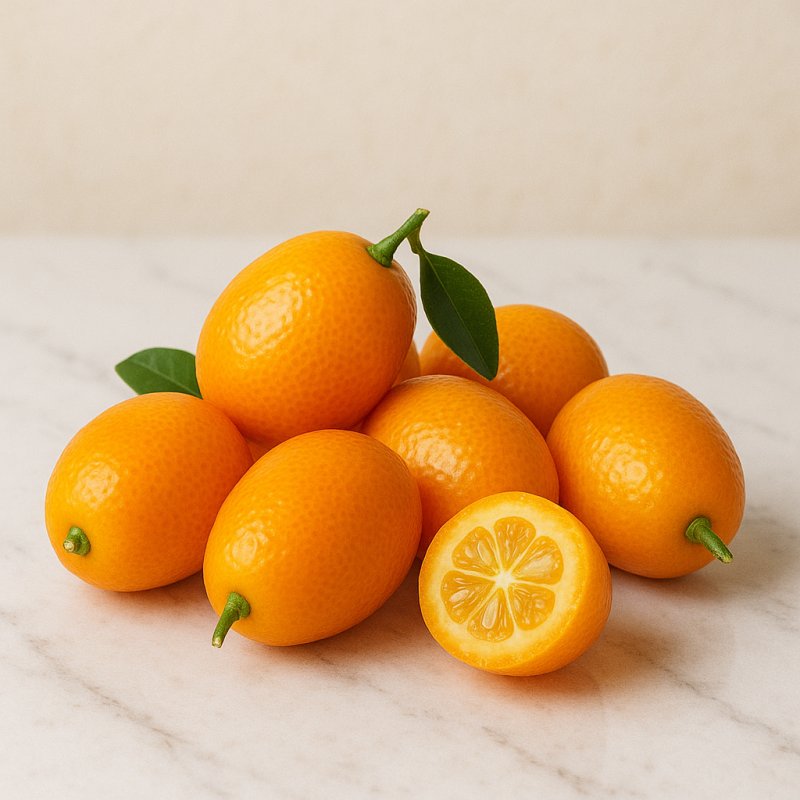
Small citrus fruit with edible peel and fresh aroma.

Wiki about kumquat Nutri-Score A Vegan Yes Gluten-free Yes Lactose-free Yes Nut-free Yes
NUTRITION / 100 g
71 kcal 1.9 g Protein 15.9 g Kohlenhydrate 0.9 g Fett

Introduction

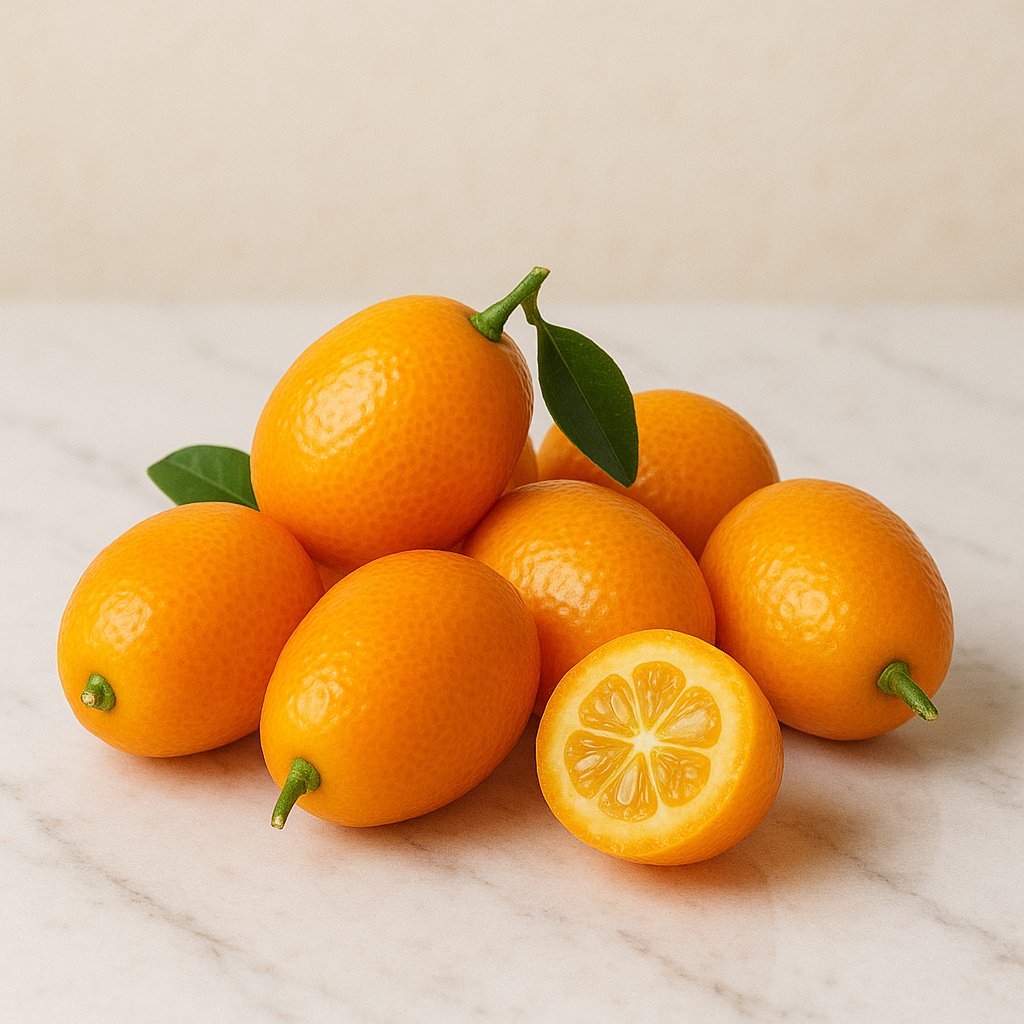
Ripe kumquats with orange skin
I still remember the day I tried a kumquat for the first time: small, bright orange and looking as innocent as a ladybird on the plate. I bit into it and was surprised by a remarkably lively balance of sweetness and acidity. Since then kumquats have been a little culinary secret for me that instantly makes dishes more charming.

The kumquat is not a miniature orange, but a distinct citrus fruit with an edible peel. The peel is surprisingly sweet, while the flesh is tart, and it is precisely this combination that makes it so versatile. In the kitchen I often use it to give sauces, salad dressings or desserts a bright, distinctive note.

A colleague once brought a jar of candied kumquats he had discovered at a market in southern France. We shared it, and the tiny, shiny pieces turned a plain slice of bread with cheese into a small flavor explosion. Since then I enjoy experimenting with pickled and caramelized variants.

Practical usage ideas:

  • Chopped into salads for a crunchy, fruity note
  • Candied as a dessert topping or a homemade gift
  • As an ingredient in chutneys and jams
  • In cocktails or as an aromatic accompaniment to fish dishes
Besides flavor, kumquats also provide vitamin C and fiber, making them a light and healthy addition. I particularly appreciate that they produce little waste: you use almost the whole fruit. That makes them appealing for spontaneous cooking and creative use of leftovers.

Sometimes I macerate kumquats in honey and serve them with goat cheese; sometimes I purée them with a little olive oil and chili for a simple dressing. Every encounter with a kumquat feels a bit like a short outing — cheerful, fresh and always open to a new idea.

Availability & types

Availability and types

Origin: The kumquat originally comes from Asia, especially southern China and the regions around the South China Sea. You can imagine it like a travel pattern: the plant first grew in one area and people later carried it with them on journeys. Thus the kumquat later reached Japan, other parts of Asia and finally warmer regions around the world.

Growing regions: Kumquats grow best where it is warm but not too hot. Important growing regions include:

  • China and Japan – the historical homelands
  • Southern Europe (e.g. Spain, Italy) – here the climate provides many sunny winters
  • USA (especially Florida and California) – where there are specialized citrus farms
  • Australia, South Africa and parts of South America – they are also cultivated and harvested there
Because kumquats are small trees, they can also be grown in pots on a balcony or in the garden if the climate is suitable or the plants are protected from frost.

Available varieties and forms: A “variety” is simply a particular type of plant, comparable to different ice cream flavors: vanilla and chocolate are both ice cream but taste different. There are some well‑known kumquat varieties:

  • Nagami – the most common variety. It is egg‑shaped, the peel is sweet and the inner flesh rather tart. Many people eat it whole, peel and all.
  • Meiwa – round and very popular because its flesh is sweeter than Nagami. It is often easier for children to eat because it is less sour.
  • Marumi – also round, slightly smaller and with a fine peel.
  • Fukushu – often a bit thicker and with a stronger aroma; it can have a more irregular shape.
In addition to fresh fruit, there are various processed forms that are practical for using kumquats year‑round:

  • Fresh (in supermarkets or markets) – usually in season, so from autumn to spring in many countries.
  • Preserved or candied – very sweet and tasty as a dessert ingredient.
  • Jam or jelly – here the whole fruit is often cooked down.
  • Frozen or dried – handy when fresh supply is unavailable.
  • As liqueur or vinegar – sometimes the flavor is used in drinks or dressings.
Everyday availability: Kumquats are seasonal, but because they are grown in many countries, they are often available for extended periods or imported into supermarkets. Markets or specialty food shops sometimes offer more varieties than a typical supermarket. When buying, look for strong color, firm peel and no soft spots – then they will be juicy and fresh. At home they keep in the refrigerator for about one to two weeks.

In summary: kumquats come from Asia, are grown today in many warm countries, there are varieties like Nagami and Meiwa, and you can buy them fresh, candied, as jam or frozen. They are special because you eat the peel too – almost like a small sweet‑and‑sour surprise from nature.
Details & nutrition

Property Value
Unit g
Average weight per piece 15
Calories per 100 71
Protein per 100 1.9
Carbohydrates per 100 15.9
Sugar per 100 9.4
Fat per 100 0.9
Saturated fat per 100 0.1
Monounsaturated fat 0.2
Polyunsaturated fat 0.2
Fiber per 100 6.5
Vitamin C (mg) per 100 43.9
Vitamin D (IU) per 100 0
Calcium (mg) per 100 62
Iron (mg) per 100 0.86
Nutri-Score A
CO₂ footprint 1.1 kg CO2e/kg
Origin China, Spain (depending on the season)
Gluten-free Yes
Lactose-free Yes
Nut-free Yes
Vegan Yes
Note Kumquats are usually eaten with the peel; the peel is sweet, the flesh is rather tart.

Technical & scientific information


Botanical classification and origin
The kumquat (commonly referred to scientifically as Citrus japonica, formerly grouped under Fortunella spp.) is a small citrus fruit in the Rutaceae family. Originally cultivated in East Asia, several cultivated forms are known, including the round kumquat and the radish‑ or oval‑shaped types. The fruits are unusual relative to their size because both peel and flesh are eaten raw.

Physical and sensory properties
Kumquats are 2–4 cm long, have a thin, glossy peel and a sweet‑bitter to tart taste. The peel is aromatic and contains most of the volatile aroma and bitter compounds, while the flesh is strongly acidic. The texture is juicy but more fibrous than that of larger citrus fruits.

Chemical composition and nutritional values
Composition varies by variety and maturity; typical average values per 100 g of fresh fruit can be summarized as follows:
  • Energy and macronutrients: about 60–75 kcal, 12–16 g carbohydrates (of which sugars such as glucose, fructose and sucrose), 4–7 g fiber, 0.7–1.9 g protein and very little fat.
  • Vitamins: relatively high content of vitamin C (typically in the range of 30–70 mg/100 g), smaller amounts of B‑vitamins and provitamin A (carotenoids).
  • Minerals: notable concentrations of potassium, calcium and trace elements such as iron and magnesium.
  • Secondary plant compounds: rich in flavonoids (e.g. hesperidin, naringin‑like compounds), carotenoids and phenolic compounds; the peel also contains significant amounts of essential oils.
Essential oils and aroma compounds
The peel of the kumquat yields volatile terpenes, with limonene often the main component. Other typical constituents are gamma‑terpinene, myrcene and linalool, which together create the characteristic citrus aroma. These oils are industrially obtained by cold‑pressing (from peels) or steam distillation; cold‑pressing preserves more terpene‑based components, while distillation yields more hydrophilic fractions.

Processing and culinary use
Kumquats are eaten fresh, processed into jams and jellies, candied or macerated into liqueurs and vinegars. The peel supplies pectin and flavor, so kumquats are particularly suitable for preserves with pronounced texture. Industrial processes include pasteurization when making spreads, freeze‑drying for powder products and oil extraction for flavors and perfumery.

Health aspects and safety
The combination of vitamin C, fiber and antioxidant flavonoids can support antioxidant capacity and digestive health. Hesperidin‑like compounds have been associated in studies with positive effects on vascular function and cholesterol distribution, though clinical evidence is limited. Because the peel is eaten, possible pesticide residues should be considered; thorough washing or buying organic products reduces this risk. Allergic reactions to citrus fruits are possible; individuals with citrus sensitivities should be cautious. Unlike grapefruit, kumquats are generally not known as strong inhibitors of the CYP3A4 enzyme, but trace furanocoumarins may be present depending on variety, so individual advice is recommended in cases of critical interactions.

Storage and shelf life
Fresh kumquats are relatively storable; at cool storage temperatures (0–4 °C) they remain fresh for several weeks. The fruits are not strongly climacteric, meaning they ripen little after harvest. For long‑term preservation, drying, preservation in sugar or alcohol and frozen concentrates are used.

In summary, the kumquat is a small‑fruited citrus species with a distinctive edible peel, nutritionally regarded as a vitamin‑C‑ and fiber‑rich ingredient. Its essential oils and secondary plant compounds make it interesting both gastronomically and industrially, while consumption of the peel calls for attention to residues and individual intolerances.

Wiki entry for: kumquat
Active now: 26 visitors of which 2 logged-in members in the last 5 minutes