Menu & categories

Irish Coffee

Coffee drink with Irish whiskey, sugar and cream

Wiki about Irish coffee Nutri-Score E Vegan No Gluten-free Yes Lactose-free No Nut-free Yes
NUTRITION / 100 ml
180 kcal 0.7 g Protein 13 g Kohlenhydrate 10 g Fett

Introduction

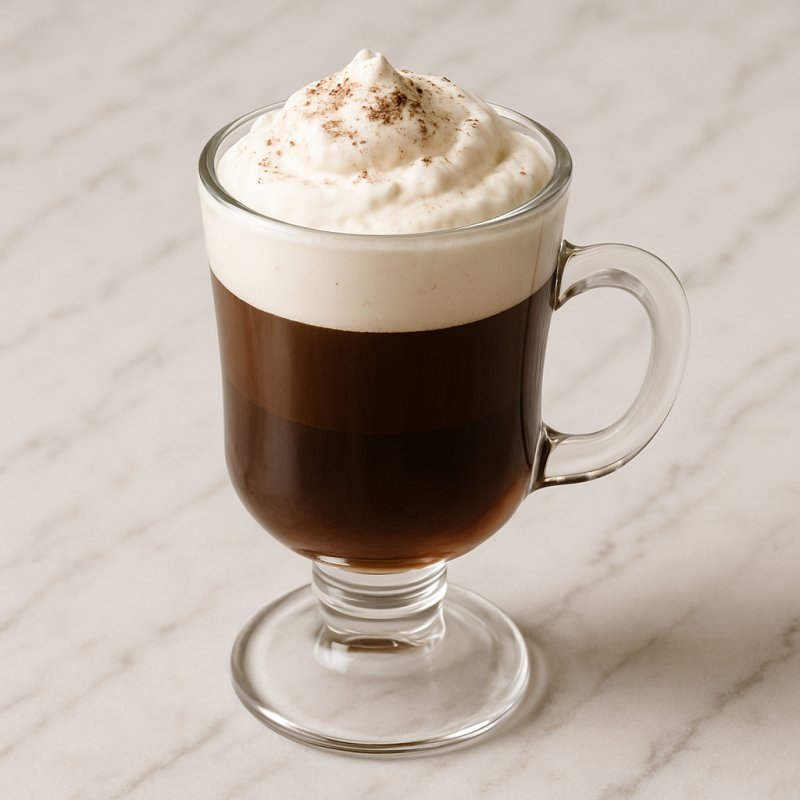
Glass of Irish Coffee with a cream topping
I still remember the first winter evening I was served an Irish Coffee: driving rain outside, warm, muted lighting inside and the smell of roasted coffee that immediately promised a small moment of coziness. Since then this mix of black coffee, brown sugar, Irish whiskey and a creamy cap has become a small ritual for me. It is a drink that does more than just warm; it tells stories of travels, of improvised bars in harbor pubs and of occasional failed attempts at layering the cream.

What I love about Irish Coffee is its simple elegance. The ingredients are familiar, but the interplay creates something special: robust coffee meets malty whiskey, the sugar balances the bitterness and the layer of lightly whipped cream provides that small, luxurious moment on the first sip. A colleague of mine insists that the cream must not be whipped too stiff so that it gently floats on the coffee and, when drinking, provides that velvety transition between hot and cool.

For preparation I have a few small rules that have proven themselves:

  • Hot, freshly brewed coffee is the foundation.
  • A decent measure of whiskey – don't skimp, but don't overdo it either.
  • Brown sugar or muscovado for depth and caramel notes.
  • Cream only lightly whipped so that it still flows when spooned.
I like to experiment: sometimes I add a pinch of nutmeg or orange zest when I want to offer guests something more exciting. On a visit to a small village pub a landlord smiled and told me that the true test of an Irish Coffee is not in the recipe but in how well it gets a conversation going. And indeed this drink has more than once helped me get into a longer, warm-hearted conversation with strangers.

In the end, Irish Coffee for me is an invitation: to pause, to exchange and to a small moment of enjoyment that sweetens both day and evening alike.

Availability & types

Availability and types

Irish Coffee is not a coffee plant but a well-known hot cocktail made from four main ingredients: hot coffee, Irish whiskey, sugar and whipped cream. When we talk about "availability and types" we mean where you can get Irish Coffee and which variants exist. You can think of it like ice cream: there is the classic variety and many tasty variations that differ slightly depending on taste.

Where does Irish Coffee come from?
Irish Coffee has its roots in Ireland, a country in the northwest of Europe. The story goes that pilots and travelers at an airport restaurant in the 1940s needed warmer drinks. A friendly cook or barkeeper mixed hot coffee with Irish whiskey and a cream topping so guests would warm up and feel better. Like hot cocoa comforts on a cold day, Irish Coffee was meant to cheer people up.

Growing regions of the ingredients
Since Irish Coffee consists of several ingredients, these come from different regions:

  • Coffee: Coffee grows in warmer countries, usually near the equator. Well-known growing regions include countries like Brazil, Colombia, Ethiopia and Vietnam. You can imagine coffee plantations like large gardens where coffee trees bear fruit from which the beans come.
  • Whiskey (Irish): Irish whiskey is made in Ireland. There are many distilleries there, that is factories where grains like barley are fermented and distilled to make whiskey. Irish whiskey often has a mild, slightly sweet taste.
  • Cream and sugar: Cream comes from cows — from the milk that is whipped into thick, foamy cream caps. Sugar is often made from sugar beet or sugar cane; these plants grow in different parts of the world.
Available varieties and variants
Irish Coffee has many variants because people like to experiment. Here are some simple examples that show how different an Irish Coffee can be — like a sandwich that you change with extra ingredients:

  • Classic Irish Coffee: Hot coffee + Irish whiskey + brown sugar + lightly whipped cream. This is the original version found in many pubs and cafés.
  • With vanilla or caramel: Some add vanilla extract or caramel syrup. This makes the Irish Coffee sweeter and tastes a bit like vanilla ice cream in the hot drink.
  • With chocolate: Add some cocoa powder or chocolate syrup and you have a chocolatey variant — like a hot chocolate-coffee cocktail.
  • Non-alcoholic version: For children or people who don't drink alcohol there is "Irish" without whiskey: instead extra strong coffee or a special flavoring is used so it tastes similar but contains no alcohol.
  • With different whiskeys: Some bars try other whiskeys or liqueurs, slightly changing the flavor — sometimes smokier, sometimes sweeter.
  • Cold variants: You can also prepare Irish Coffee cold, as an iced coffee version with ice cubes and lightly whipped cream on top.
How easy is Irish Coffee to get?
Irish Coffee is available in many countries in cafés, bars and restaurants, especially in places with Irish pubs. Ingredients are usually easy to find: coffee and sugar in every supermarket, cream as well, and Irish whiskey in well-stocked adult stores. For the non-alcoholic version you only need the simple ingredients without whiskey. Like a sandwich you can quickly make at home, Irish Coffee can also be made easily at home.

In summary: Irish Coffee comes from Ireland, is made from ingredients originating from different parts of the world, and is available in many variants — from classic to chocolate or non-alcoholic. You often find it in pubs and cafés, and at home it can be easily replicated with a few ingredients.
Details & nutrition

Property Value
Unit ml
Average weight per piece 200
Calories per 100 180
Protein per 100 0.7
Carbohydrates per 100 13
Sugar per 100 13
Fat per 100 10
Saturated fat per 100 6
Monounsaturated fat 3
Polyunsaturated fat 0.3
Fiber per 100 0
Vitamin C (mg) per 100 0
Vitamin D (IU) per 100 0
Calcium (mg) per 100 20
Iron (mg) per 100 0.1
Nutri-Score E
CO₂ footprint 0.35
Origin Ireland
Gluten-free Yes
Lactose-free No
Nut-free Yes
Vegan No
Note This is not a non-alcoholic drink; it contains Irish whiskey and should only be consumed by adults. Nutritional values can vary greatly depending on the recipe (amount of whiskey, sugar and cream).

Technical & scientific information

Irish Coffee refers in culinary practice to a hot beverage made from coffee, whiskey, sugar and a fluid cream layer on top. Understood as an ingredient the term can however describe not only the finished drink but also the combined components and their interactions. Chemically Irish Coffee consists of water, organic compounds of coffee (particularly caffeine, chlorogenic acids and melanoidins), ethanol and flavor compounds of the whiskey as well as milk fat and proteins from the cream. The composition varies with the coffee variety used, the distillation and aging of the whiskey and the type of sweetened or unsweetened cream added.

Main components and their properties

  • Coffee extract: Contains soluble solids (polysaccharides, proteins, lipids in small amounts), chlorogenic acids (affect acidity, taste and antioxidant capacity), caffeine (stimulant, 95–200 mg per cup varies) and volatile aroma compounds such as furans, pyrazines and phenols that shape the aroma.
  • Whiskey: Consists of an aqueous-ethanolic solution with 40–50 vol.-% ethanol, organic esters, aldehydes, phenolic compounds as well as smaller amounts of tannins and furans released during aging. These compounds provide aromas (vanilla, caramel, smoke) and affect solubility as well as the perception of sweetness and bitterness.
  • Cream: Contains water, milk fat (typically 30–40 % fat for whipping cream), milk proteins (casein, whey proteins) and emulsifiers. The cream layer provides texture contrasts, dampens volatile alcohol odors and influences the thermal stability of the whole beverage.
  • Sugar: Sucrose or other sweeteners change the taste balance, increase perceived sweetness and can modulate the solubility of aroma compounds.
Physicochemical interactions

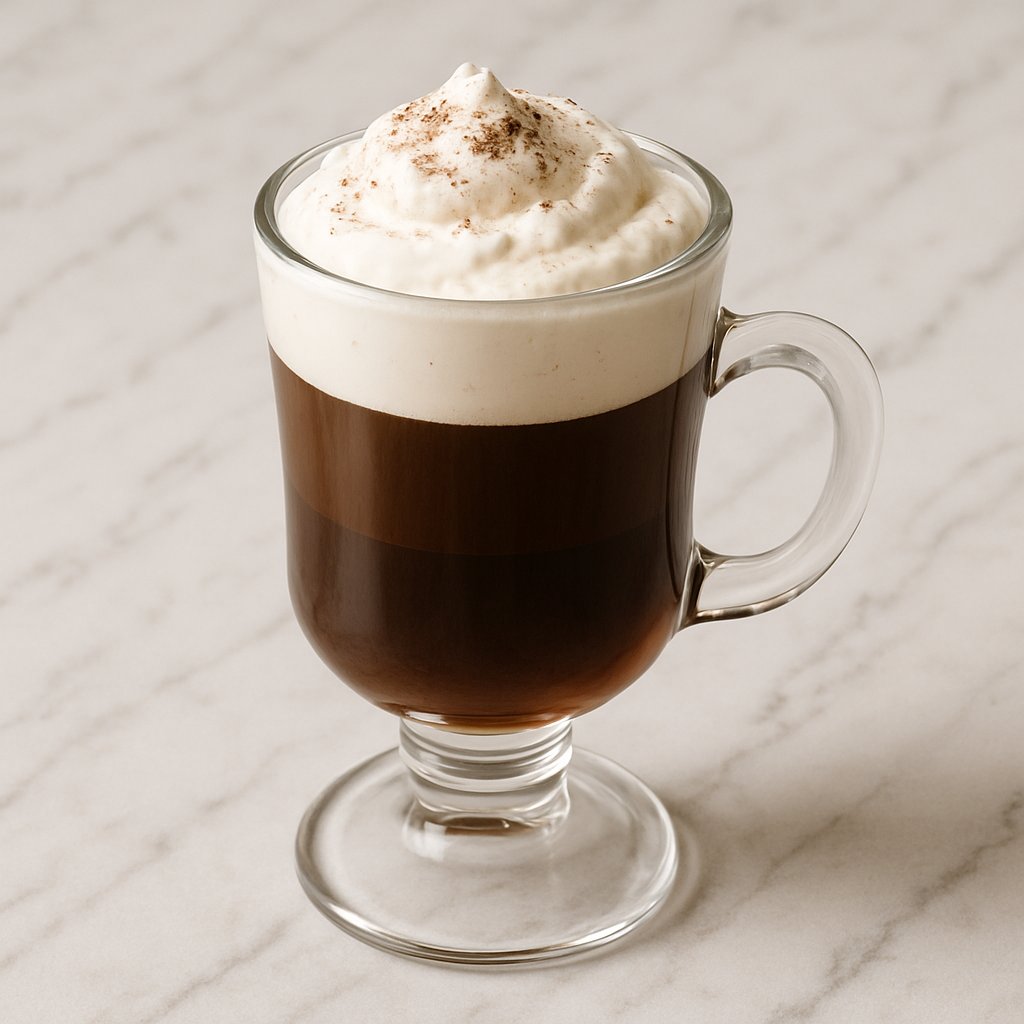
During preparation several physical processes are combined: extraction, emulsification and phase separation. Hot coffee extracts soluble compounds and volatile aroma compounds; adding whiskey increases the overall solubility of some lipophilic aroma compounds due to the organo-polar character of the ethanol-water mixture. The lightly chilled cream poured on the surface forms an internal layer that, due to differences in density and surface tension, should remain abrasion- and thermally-stable. Proteins and fat droplets in the cream interact with surface activity and prevent rapid mixing, resulting in the characteristic layering.

Nutritional value and portion sizes

The calorie count of an Irish Coffee depends strongly on the proportions of the components. A typical glass (approx. 150–200 ml) with 40–50 ml whiskey, 100–150 ml coffee and 20–30 ml cream provides roughly 200–350 kcal. These calories mainly come from ethanol (~7 kcal/g) and milk fat. In terms of macronutrients the calories primarily consist of fats (cream) and alcohol, with very small amounts of carbohydrates (sugar) and proteins (milk protein). Micronutrients are generally negligible, although traces of minerals and vitamins from coffee and milk are present.

Health aspects

  • Alcohol effects: Ethanol affects the central nervous system and metabolism; the combination with caffeine can mask the subjective reduction of tiredness without removing the psychomotor effects of alcohol. Consumption is contraindicated for pregnant people, those with alcohol use disorders and drivers.
  • Caffeine effects: Caffeine increases alertness and can modulate blood pressure and heart rate; in sensitive individuals it can cause nervousness or sleep disturbances.
  • Fat and calorie load: Regular high consumption can contribute to increased energy intake and promote metabolic effects.
  • Sensory interactions: Alcohol can round off bitter notes and enhance aromas, while cream dampens volatile components, making the taste experience seem more rounded.
Processing methods and quality

The quality of an Irish Coffee depends on parameter control: coffee amount and brewing temperature determine extraction degree and bitterness; whiskey amount and type influence the aroma profile and alcohol content; cream quality and temperature control the stability of the layer. Technically useful are preheated glasses, freshly brewed coffee (~92–96 °C for extraction) and lightly chilled but still fluid cream to float. Microorganisms play practically no role in the short preparation steps, provided pasteurized cream and hygienic conditions are used.

Overall, Irish Coffee represents an interplay of thermodynamic, colloidal and organic-chemical principles in which the selection and ratio of components as well as preparation technique decisively determine sensory quality and health implications.

Wiki entry for: Irish coffee
Active now: 17 visitors of which 2 logged-in members in the last 5 minutes