Menu & categories

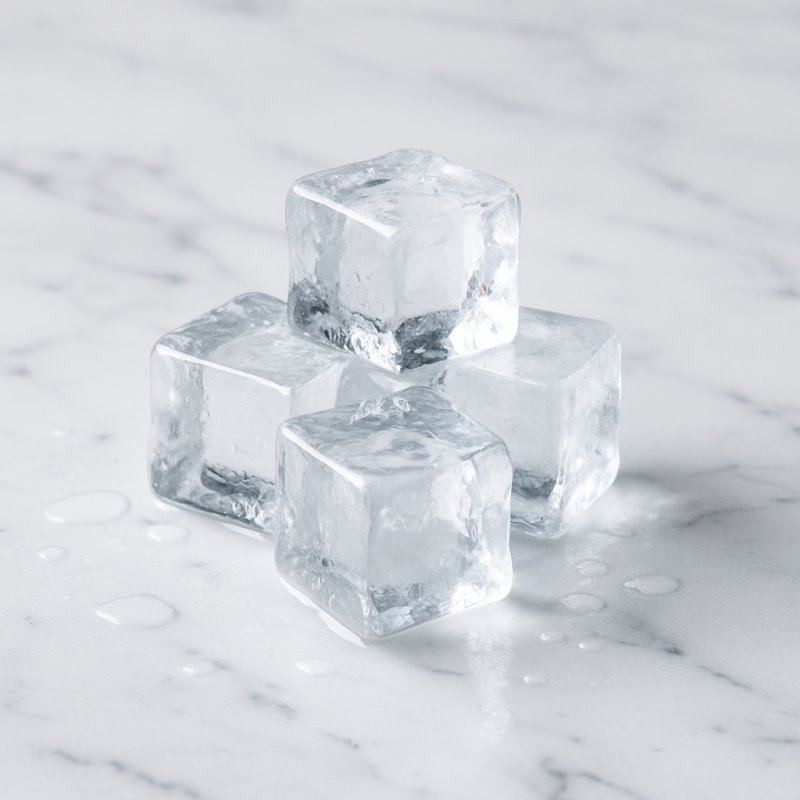
Ice cubes

Frozen water for cooling drinks and food.

Wiki about ice cube Nutri-Score A Vegan Yes Gluten-free Yes Lactose-free Yes Nut-free Yes
NUTRITION / 100 g
0 kcal 0 g Protein 0 g Kohlenhydrate 0 g Fett

Introduction

Ice cubes in a glass
I have often thought about how unobtrusive ice cubes shape our everyday life, until one evening in a noisy bar I noticed how a perfectly chilled drink can change a room. A colleague of mine swears by freezing coffee in ice cube trays so iced coffee doesn't get watered down. Such little tricks say a lot about taste and care, and they show that ice cubes are more than just frozen water.

Ice cubes are versatile: they cool, dilute, concentrate flavors and can even serve as a decorative element. Clear ice, for example, looks elegant and melts more slowly because it contains fewer air bubbles. I still remember the first experiment with a simple cooler box in the freezer, which taught me that slow, directional freezing makes the difference. Since then the method has been a fixture in my small home bar.

Practical uses and little secrets:

  • For clear ice cubes I boil the water first and let it cool before pouring it into molds.
  • Large ice cubes melt more slowly and are excellent for whiskey or long evenings on the balcony.
  • Flavored ice cubes made from mint, lemon or fruit juices give a drink character almost effortlessly.
  • Frozen stock or tomato juice are kitchen hacks for quick sauces and soups.
Sometimes I also use ice cubes beyond drinks: for first aid on bruises, to cool nail glue accidents, or for shaving in summer when nothing else helps.
The smells and textures that emerge during thawing tell stories of flavors changing and of moments that remain because they are properly lit.

In the end, ice cubes are small, unassuming helpers with surprisingly many talents. They invite us to stay curious, to play with temperatures and to rediscover simple things, because often the best culinary ideas lie in simplicity.

Availability & types

Availability and types of ice cubes

Ice cubes are something that doesn't grow like fruit or vegetables. They are made by freezing water. That means: you take clean water, put it in a mold or machine and make it cold enough to turn into solid ice. In the past people also sawed ice from frozen lakes or rivers and stored it in houses; today ice is produced artificially almost everywhere.

Where to get ice cubes
Ice cubes are very easy to find. You can get them, for example:

  • In your own freezer: with ice cube trays or automatic ice dispensers in refrigerators.
  • At the supermarket: prepackaged ice in bags, especially handy for parties or trips.
  • At petrol stations or kiosks: they often sell bags of ice cubes there.
  • In cafés, bars and restaurants: these places usually have large ice machines.
  • From manufacturers or delivery services: specialized companies supply ice for events or the hospitality industry.
Because it is not cultivated, there are no growing regions. Instead ice is produced where people need it: in kitchens, factories and shops – so practically all over the world.

Popular types and variants of ice cubes
Ice cubes come in many shapes and with different properties. Here are the main types, simply explained:

  • Regular ice cubes: small, cube-shaped pieces of ice from the freezer. They are suitable for everyday use and fit well in drinks.
  • Large ice cubes: a bigger block that melts more slowly. Good for long drinks or when you don't want to top up often.
  • Crushed ice: small shards or flakes that cool quickly. Great for cocktails or slushes.
  • Nugget or pepsi ice (chewable ice): small, soft pieces that are easy to chew. Many children like it because it "crunches" when eaten.
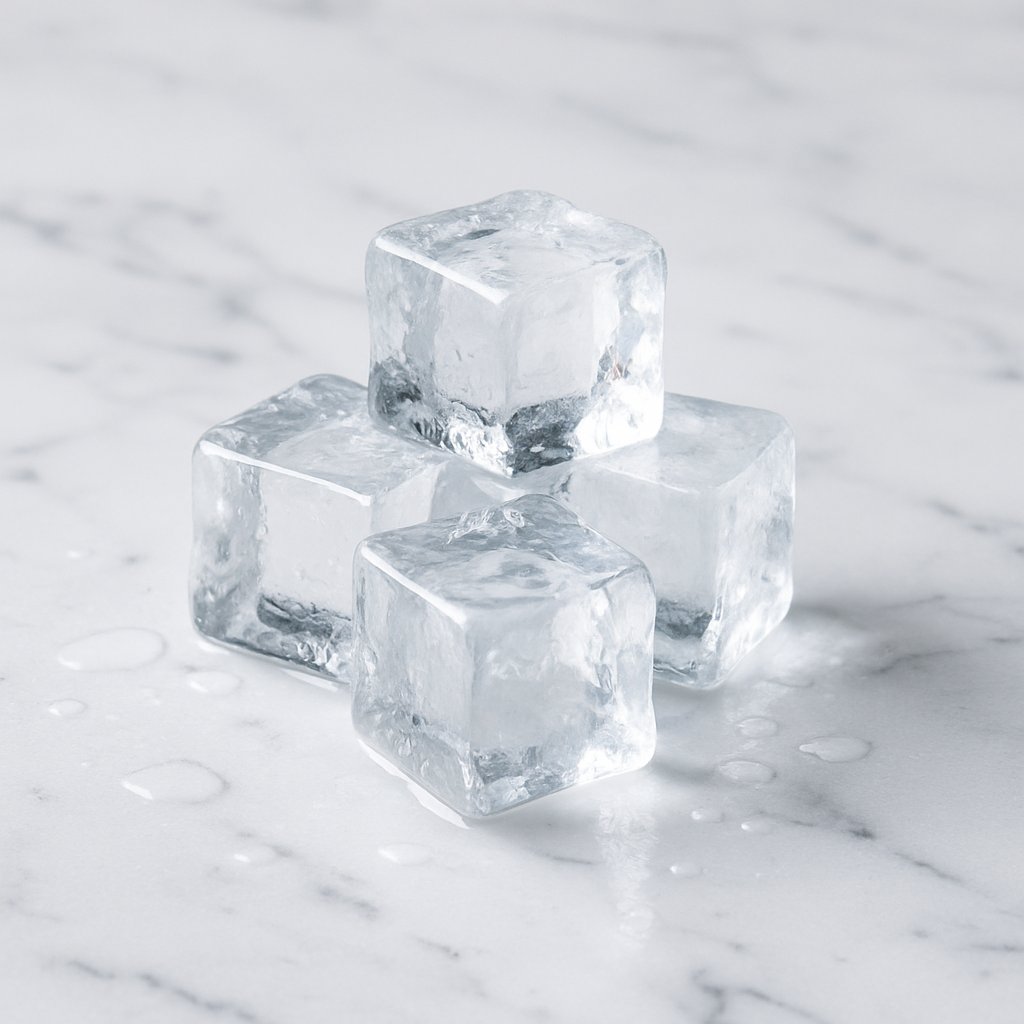
  • Clear ice: looks transparent like glass. This happens when air bubbles and impurities are removed. Bars like to use it because it looks nice and melts more slowly.
  • Colored or flavored ice: made from fruit juice or with flavoring, for example from lemon juice or juice — it melts and adds flavor to the drink.
  • Reusable ice cubes: small plastic cubes with gel inside that you freeze and use again. They cool without diluting the drink.
  • Dry ice: frozen carbon dioxide, creates fog and is very cold. This is not normal drinking ice and must be used carefully.
Tips for choosing
When you buy or make ice, pay attention to clean drinking water so that it is safe. For drinks that need quick cooling small cubes are good, for long drinking times prefer large or clear ice cubes. For special effects at parties you can use colored or flavored ice.

In summary: ice cubes are everywhere because they are very easy to produce, and they come in many shapes — from the small everyday cube to the clear, large block for cocktails. That way you can find the right type for every purpose.
Details & nutrition

Property Value
Unit g
Average weight per piece 20
Calories per 100 0
Protein per 100 0
Carbohydrates per 100 0
Sugar per 100 0
Fat per 100 0
Saturated fat per 100 0
Monounsaturated fat 0
Polyunsaturated fat 0
Fiber per 100 0
Vitamin C (mg) per 100 0
Vitamin D (IU) per 100 0
Calcium (mg) per 100 1
Iron (mg) per 100 0
Nutri-Score A
CO₂ footprint sehr gering (~0,01 kg CO2e/100 g, abhängig von Wasseraufbereitung und Gefriergerät)
Origin mostly tap water (local) or mineral water
Gluten-free Yes
Lactose-free Yes
Nut-free Yes
Vegan Yes
Note Nutritional values are practically zero; possible traces of minerals depending on water quality. For sensitive individuals, ensure clean ice cube containers and hygienic production.

Technical & scientific information

Ice cubes are frozen water in standardized cube shapes, used primarily to chill drinks, to preserve temperature-sensitive goods and in medical applications. Chemically, ice cubes consist mostly of H₂O and can, depending on the water source used, include dissolved minerals, trace elements and dissolved gases. Pure ice is practically calorie-free and contains no significant macronutrients.

Physically, ice cubes are characterized by a crystalline structure of ice, usually the hexagonal ice-Ih form that is stable at atmospheric pressure. The density of solid water is approximately 0,9167 g·cm⁻³, which is why ice floats on liquid water. When freezing, water expands due to the special crystal structure, which can cause cracks or damage in closed containers.

Thermodynamically, melting ice is a phase change associated with a specific latent heat of fusion of about 334 kJ·kg⁻¹. This high latent heat makes ice an effective cold storage medium: when melting it absorbs large amounts of energy from the environment, cooling drinks or dampening temperature spikes.

The properties of ice cubes — transparency, strength and melting behavior — depend on purity and freezing speed. Air bubbles and dissolved substances cause cloudiness. To produce clear ice cubes, methods such as directional freezing (where water freezes from one side to the other, flushing impurities out) or the use of pre-softened and degassed water are employed. In industrial plants, various shapes are used: cube, nugget, flake and block ice, which differ in surface, structure and cooling effect.

Typical household processing methods are plastic or silicone ice cube trays and electric ice makers that freeze and release pieces cyclically. Commercial production plants operate continuously and integrate water treatment, dosing and hygiene controls. Hygiene is a central aspect because ice is considered a food; safe production includes the use of hygienically safe drinking water, regular cleaning, avoidance of cross-contamination and appropriate storage at low temperatures.

  • Nutritional values: Nearly 0 kcal, no proteins, fats or carbohydrates; traces of mineral components depending on the source water.
  • Health aspects: Microorganisms often survive in an inactive state during freezing but can become viable again after thawing; therefore clean production and storage are important. Special care is required for immunocompromised individuals.
  • Environment and energy: Ice production is energy intensive; efficiency, heat recovery and minimizing water losses are important areas for optimization.
In culinary terms, the size and shape of an ice cube influence cooling rate and dilution of drinks: large, dense cubes melt more slowly and reduce dilution, while small pieces cool quickly but release more water. Scientifically, precise knowledge of freezing point, crystallization and heat transfer is crucial to achieve desired results in gastronomy, laboratory applications and industrial processes.

Ice cubes are thus a simple but technically interesting product whose properties are determined by water quality, freezing technique and hygiene measures. Their effectiveness as a coolant and the associated safety aspects make correct production and handling important topics in both household and commercial settings.

Wiki entry for: ice cube
Active now: 32 visitors of which 2 logged-in members in the last 5 minutes