Menu & categories

Gummy Worms

Fruity, sweet gummy candies shaped like worms

Wiki about gummy worm Nutri-Score D Vegan Yes Gluten-free Yes Lactose-free Yes Nut-free Yes
NUTRITION / 100 g
310 kcal 2 g Protein 75 g Kohlenhydrate 0 g Fett

Introduction

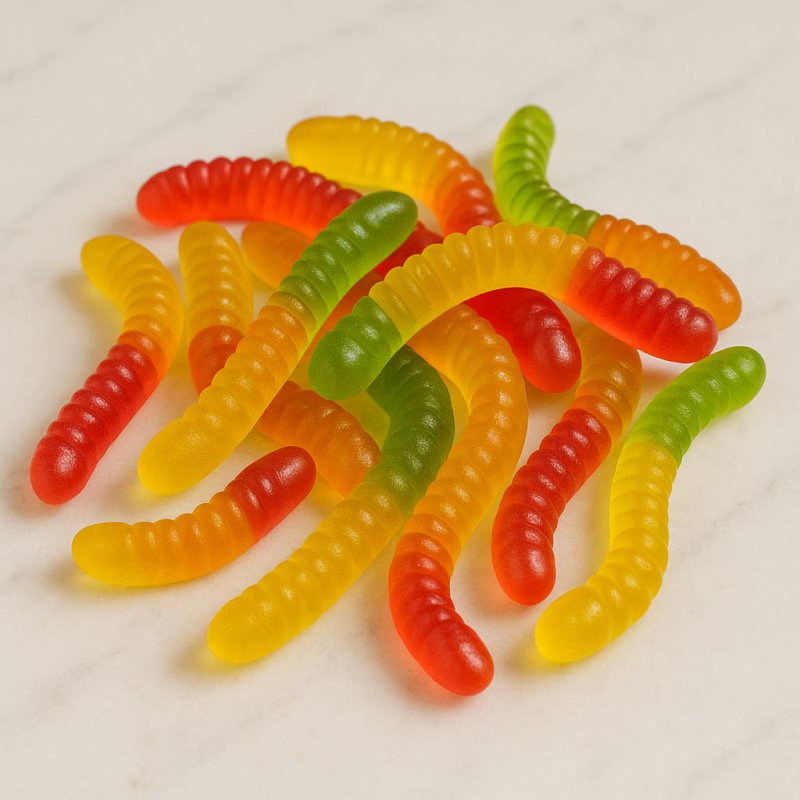
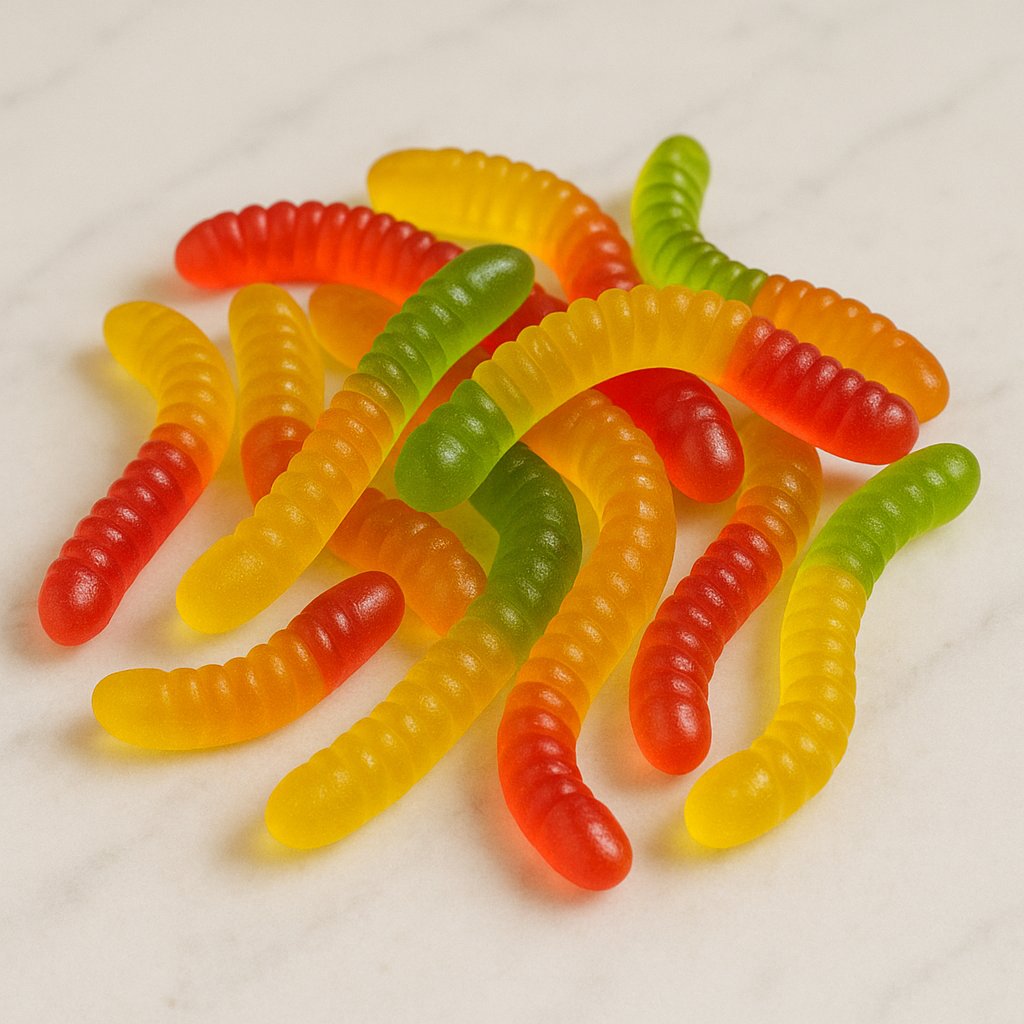
Gummy worms on a white background
I still vividly remember the time when, as a child, I stood in the candy shop and the colorful gummy worms in the display shone like little rainbows. Their yellow, green, red and blue drew me in like magic. These small, slippery treats were for me the ultimate candy — and not only because of their taste, but also because of their playful shape. Gummy worms are not just a treat; they are an experience that awakens memories and brings back the childhood magic.

Gummy worms aren't only for children. I have some friends who always make sure to treat themselves to a bag during movie night. A colleague of mine even started a small competition: who can eat the most gummy worms in one minute? It's amazing how many strategies you can develop to tackle these sweet little creatures — from the "one-worm-at-a-time" method to the "quick-quick-stuff-in-your-mouth" technique. In the end it ended in hearty laughter and a pile of crumpled bags.

The preparation of gummy worms is an art in itself. They are mainly made of sugar, gelatin, fruit juices and flavorings. Gelatin provides the characteristic gummy texture, while natural fruit flavors add a touch of freshness and taste. In recent years I've even tried making my own gummy worms. It's a bit tricky, but the process is incredibly satisfying. You need:

  • Sugar
  • Gelatin
  • Fruit juice
  • A few tablespoons of water
  • Colors of choice
The mixture is heated and poured into silicone molds, and then you wait. I can tell you, the moment I turned the molds over and the gummy worms fell out was like Christmas in summer. A small success that put a big grin on my face.

For many of us, gummy worms are more than just candy; they're a piece of nostalgia. Whether you eat them as a snack while watching a movie, incorporate them into a birthday cake, or simply snack on them — these little wonders bring joy and a bit of carefreeness to our everyday life. And let's be honest: who could resist these colorful, cheerful creatures?

Availability & types

Gummy worms are a popular candy that many people love. They are soft, colorful and taste fruity. But where do they actually come from, and what different types are there? Let's find out together!

Origin

The history of gummy worms begins in Germany. They were invented in the 1920s. A confectioner named Hans Riegel wanted to create a new type of candy. That's how the first gummy bear was born, and later gummy worms were added. These treats are made from a special mixture of sugar, gelatin and various flavors. Gelatin is an ingredient that ensures gummy worms have the right shape and consistency.

Growing regions

The ingredients for gummy worms are grown in various countries. Mainly the sugar comes from sugar beets or sugarcane. These plants grow in warm climates, for example in Brazil or parts of Europe. Gelatin is often produced from animal products processed in many countries. Also the fruit flavors that give gummy worms their taste are produced in many countries. That means gummy worms are a real "world product"!

Available varieties

There are many different kinds of gummy worms, and they differ in taste and appearance. Here are some of the best-known variants:

  • Fruit gummies: These are the classic gummy worms and come in many different flavors like strawberry, apple or lemon.
  • Sour gummy worms: For those who like it a bit sour, there are also gummy worms with a sour coating. These have a more intense taste and add a bit more excitement when eating.
  • Vegan gummy worms: There are also gummy worms produced without animal products. These use plant-based gelling agents like agar-agar. This way vegetarians and vegans can also enjoy this candy.
  • Filled gummy worms: Some gummy worms are even filled, for example with a sweet liquid or a creamy filling. That provides a special surprise when eating!
Additionally there are many colorful packagings and designs that make gummy worms even more attractive. Often they are available in large bags or small portion packs, so there's something for everyone.

Summary

Gummy worms are not only tasty but also versatile. They originally come from Germany and are made from different ingredients grown in many countries. From classic fruit gummies to sour variants to vegan or filled gummy worms, there's a variety for every taste. Whether at the cinema, at a party or simply as a snack in between – gummy worms are a popular treat for young and old. Next time you eat a gummy worm, you can enjoy it even more with a little knowledge about their origin and variety!
Details & nutrition

Property Value
Unit g
Average weight per piece 5
Calories per 100 310
Protein per 100 2
Carbohydrates per 100 75
Sugar per 100 60
Fat per 100 0
Saturated fat per 100 0
Monounsaturated fat 0
Polyunsaturated fat 0
Fiber per 100 0
Vitamin C (mg) per 100 0
Vitamin D (IU) per 100 0
Calcium (mg) per 100 0
Iron (mg) per 100 0
Nutri-Score D
CO₂ footprint 0.5
Origin Germany
Gluten-free Yes
Lactose-free Yes
Nut-free Yes
Vegan Yes
Note Popular with children and as a treat for parties.

Technical & scientific information

Gummy worms are a popular candy, especially among children and teenagers. These sugary snacks are soft and have a characteristic gummy consistency that is achieved through specific ingredients and processing techniques. The main components of gummy worms are sugar, glucose syrup, gelatin, colorings and flavors.

Chemical composition
The chemical composition of gummy worms varies by manufacturer and product line, but is essentially based on the following main components:

  • Sugar: The main ingredient that provides sweetness. A mixture of sucrose and fructose is often used.
  • Glucose syrup: A syrup derived from starch that improves the texture of gummy worms by giving them a moist and chewy consistency.
  • Gelatin: An animal protein obtained from collagen and responsible for the characteristic gummy texture. Gelatin is produced by boiling animal bones and connective tissue.
  • Colorings: Food colorings that give gummy worms their striking colors. These can be of natural or synthetic origin.
  • Flavors: Natural or artificial flavors that give gummy worms their typical, often fruity taste.
Processing methods
The production of gummy worms takes place in several steps:

  • Mixing: The ingredients are combined in large mixing machines to create a homogeneous mass.
  • Heating: The mixture is heated to dissolve the gelatin and activate the ingredients.
  • Moulding: The hot mass is poured into special moulds that form the characteristic worm shapes.
  • Cooling: After the mixture is poured into the moulds, it cools and solidifies.
  • Powdering: After setting, the gummy worms are often rolled in a sugar mixture to prevent sticking and to achieve an appealing surface texture.
Nutritional values
Gummy worms are generally high in calories and contain a significant amount of sugar. The nutritional value per 100 grams of gummy worms can be roughly summarized as follows:

  • Energy: approx. 350-400 kcal
  • Fat: 0-1 g
  • Protein: 5-7 g (mainly from gelatin)
  • Carbohydrates: 80-90 g (of which sugars: 60-80 g)
Wiki entry for: gummy worm
Active now: 11 visitors of which 2 logged-in members in the last 5 minutes