Menu & categories

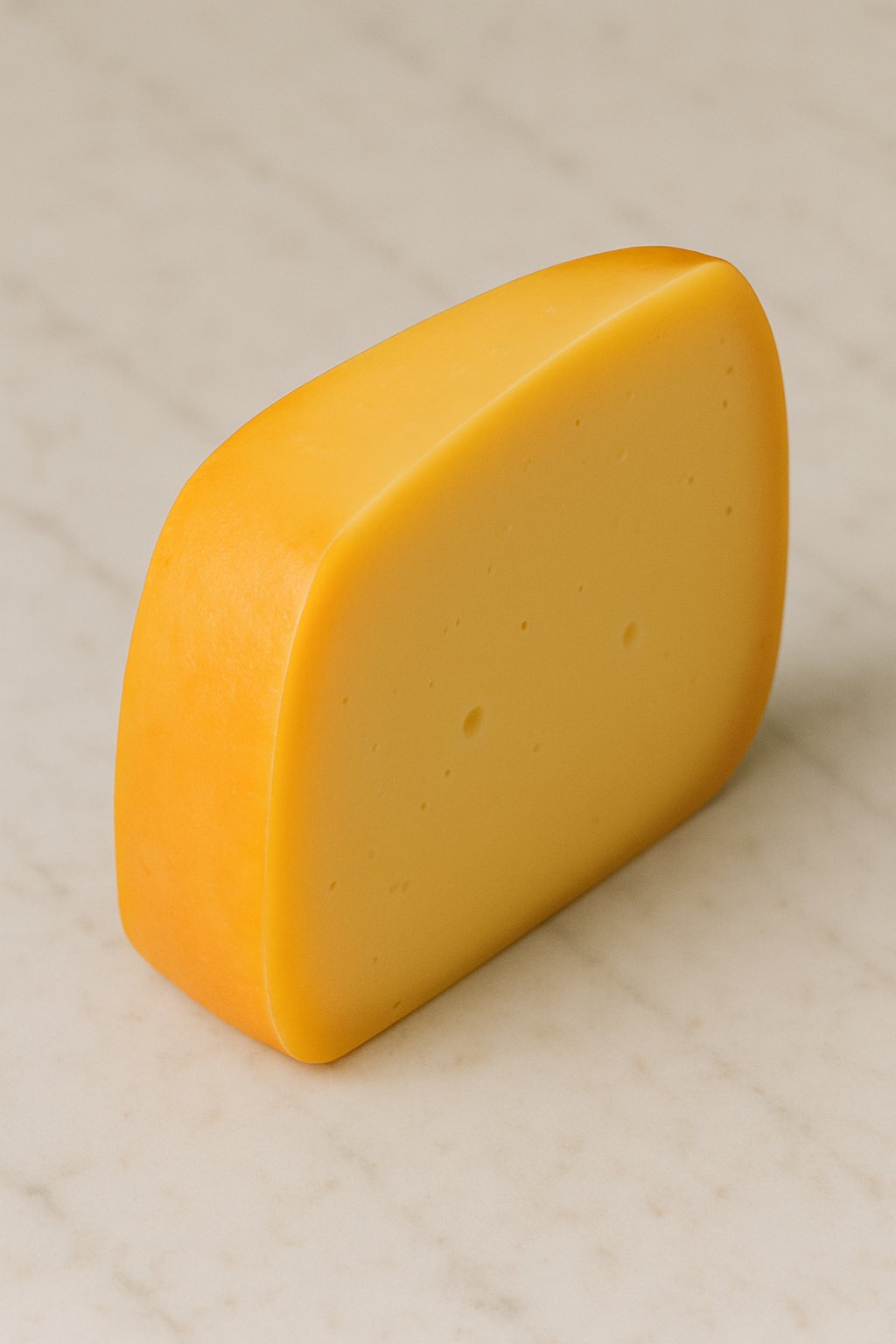
Gouda cheese 45% fat in dry matter

Mild semi-hard cheese with a creamy texture

Wiki about Gouda cheese Nutri-Score D Vegan No Gluten-free Yes Lactose-free No Nut-free Yes
NUTRITION / 100 g
356 kcal 24.5 g Protein 0.5 g Kohlenhydrate 28.0 g Fett

Introduction

Sliced Gouda cheese
Gouda cheese 45% fat in dry matter is one of those ingredients that forms a faithful constant in my European kitchen. As a 35-year-old editor who writes a lot about food professionally and cooks passionately in private, I have learned how versatile, accessible and yet refined this traditional cheese can be. When I think of Gouda, I think of that fine nutty scent that unfolds when opening the pack, and of the creamy to elastic texture that feels velvety under the knife. In the kitchen it is a multitasker: it connects, rounds off and brings dishes into balance — without imposing itself, but also without hiding.

The note “45% fat in dry matter” is a quality characteristic common in Europe that makes cheeses understandably comparable. It does not mean that the cheese consists of 45 percent fat, but that the fat content of the water-free portion is that high. In fact the absolute fat content is usually lower, which surprises many. A colleague of mine, who takes care of his marathon shape after the office, swears by moderate cheese enjoyment — and precisely thanks to this knowledge he did not remove Gouda from his diet. For me this is a good example of how transparently declared foods can contribute to informed decisions.

Gouda has its roots in the Netherlands, but is long at home throughout Europe. I remember a press trip to North Holland when I was allowed to enter the ripening cellars of a small dairy: wooden shelves, still air, time literally becoming the ally of the aroma. Young variants are mild, buttery and slightly sweet; older Goudas develop nutty, caramel notes and sometimes show crystalline breaks that produce a delicate crackle when chewing. This range makes Gouda cheese 45% fat in dry matter attractive for everyday use and for special occasions alike.

In practice the strength of Gouda is shown in its melting ability. It melts evenly without becoming greasy and produces a golden, appetizing surface. In my kitchen it ends up on roasted vegetables, in creamy gratins and as a gentle

Availability & types

Availability and types of Gouda cheese 45% fat in dry matter

Gouda is one of the best-known cheeses in the world. When “Gouda cheese 45% fat in dry matter” is mentioned, it refers to a very popular fat level of the cheese: 45 percent fat in the dry matter. That does not mean the whole cheese is half fat, but that the fat proportion in the dry portion of the cheese is 45 percent. The water portion is excluded. This allows cheeses to be compared more easily. For you as a 12-year-old, this means: 45% fat in dry matter is a medium, typical fat level — creamy but not extremely fatty.

Origin: The name Gouda comes from the city of Gouda in the Netherlands. Historically the cheese was traded there, not necessarily always produced. Today Gouda is produced throughout the Netherlands and also in many other countries, for example in Germany, Poland or even outside Europe. Genuine Dutch Gouda may carry protected designations, such as “Gouda Holland”, which means it is made from Dutch milk and matured in the Netherlands.

Everyday availability: Gouda cheese with 45% fat in dry matter is very easy to obtain. You can find it:

  • in the supermarket as slices (for bread and sandwiches),
  • as a wedge or block at the cheese counter,
  • as grated Gouda for pizza, casseroles and gratins,
  • as snack cubes for in-between or for salads,
  • sometimes as a whole rind for longer aging (to grate yourself or for cheese platters).
In many countries Gouda is available year-round. This is because cows give milk all year and cheese production can continue. Seasonal differences can slightly affect taste and color (for example due to grazing in spring and summer), but most producers ensure consistent quality.

Varieties and
Details & nutrition

Property Value
Unit g
Average weight per piece 30
Calories per 100 356
Protein per 100 24.5
Carbohydrates per 100 0.5
Sugar per 100 0.5
Fat per 100 28.0
Saturated fat per 100 18.0
Monounsaturated fat 8.0
Polyunsaturated fat 0.8
Fiber per 100 0
Vitamin C (mg) per 100 0
Vitamin D (IU) per 100 40
Calcium (mg) per 100 700
Iron (mg) per 100 0.2
Nutri-Score D
CO₂ footprint 5.5
Origin Netherlands/EU
Gluten-free Yes
Lactose-free No
Nut-free Yes
Vegan No
Note Maturation: medium-aged; salt content approx. 1.8%; suitable for vegetarians if made with microbial rennet (subject to specification).

Technical & scientific information

Gouda cheese 45% fat in d.m. – Technical and scientific profile

Gouda cheese 45% fat in dry matter is a semi-hard Dutch-origin cheese whose quality parameters are shaped by the choice of raw materials, microbiological culture management and controlled ripening conditions. The indication “45% fat in dry matter” refers to the fat content in the dry matter and allows standardized classification into fat content levels. Gouda is predominantly made from pasteurized cow’s milk, but depending on regional tradition it can also be produced from raw milk, which can modify sensory complexity and microbiological diversity. The matrix of this cheese forms a casein network that immobilizes fat globules and serum-phase components and balances the texture between elastic and smooth.

Production technology and process parameters

The production includes standardized steps: preliminary milk treatment (standardization, pasteurization), acidification by starter cultures (mainly Lactococcus lactis subsp. lactis and cremoris), coagulation with calf rennet or microbial chymosins, curd cutting and partial whey removal, followed by washing of the curd. The characteristic “washing” reduces lactose content, limits acid development and leads to a mild, slightly sweet aroma. After molding and pressing, brining in salt solution (typically 18–22% NaCl) takes place, which influences water activity, rind formation and microbiological stability. Ripening takes place at controlled temperatures (typically 10–14 °C) and relative humidity (80–90%) over days to months; young Gouda variants ripen 4–8 weeks, matured types much longer. Process variables such as target pH curve (about 5.2–5.4 after pressing), salt content (1.5–2.0% in the cheese), and the selection of secondary cultures (e.g. non-starter lactobacilli) control texture, eye formation and aroma profile.

Microbiology and biochemistry of ripening

During ripening proteolytic processes occur

Wiki entry for: Gouda cheese
Active now: 20 visitors of which 2 logged-in members in the last 5 minutes