Menu & categories

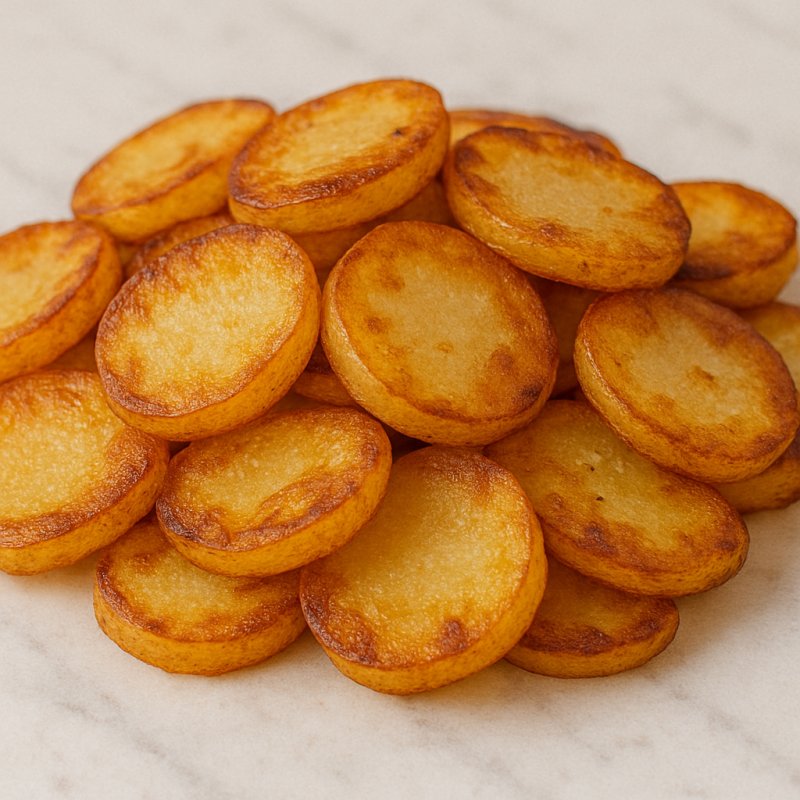
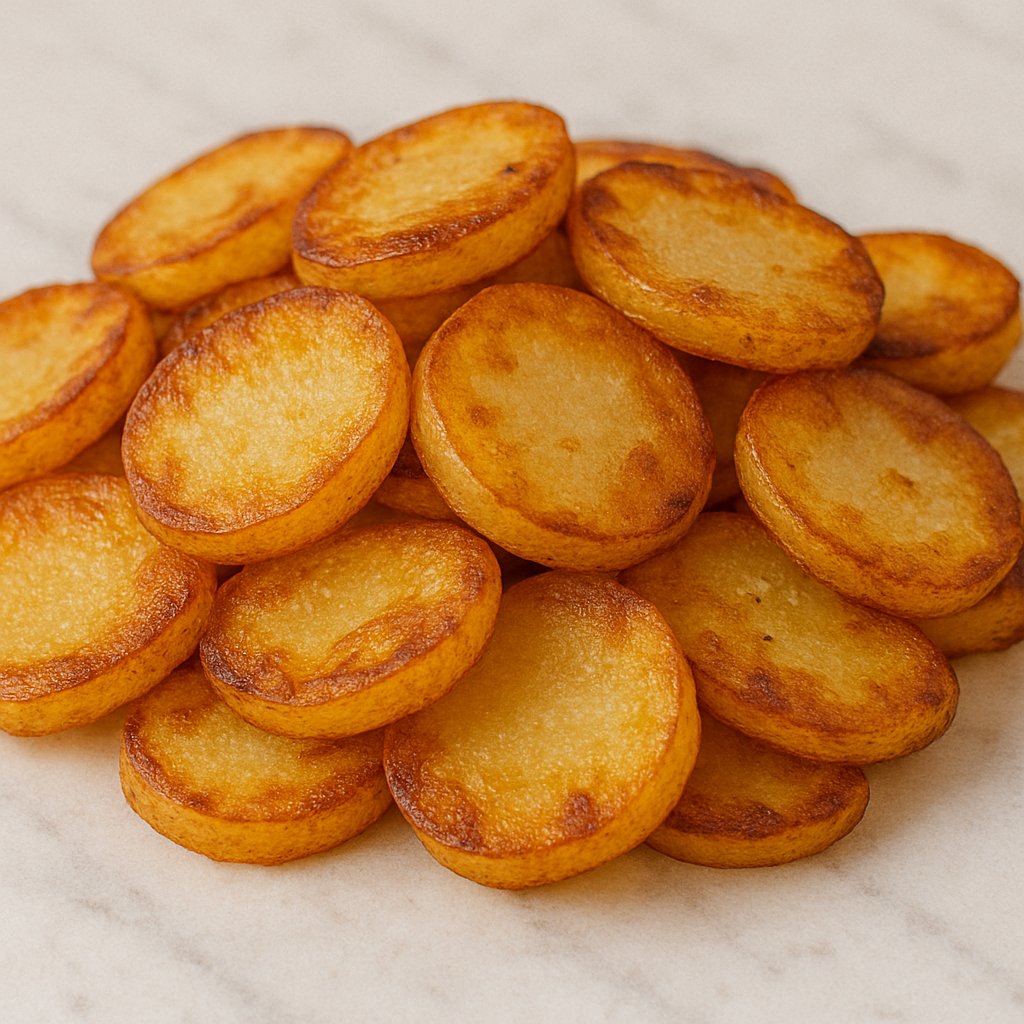
Fried potatoes

Crispy fried potato slices as a hearty side dish

Wiki about pan-fried potato Nutri-Score C Vegan Yes Gluten-free Yes Lactose-free Yes Nut-free Yes
NUTRITION / 100 g
140 kcal 2.5 g Protein 20 g Kohlenhydrate 5.0 g Fett

Introduction

Crispy fried potatoes in a pan
I have a particular weakness for pan‑fried potatoes, and this has less to do with nostalgia than with the simple, crispy joy they bring to the plate. When I think of pan‑fried potatoes, I don't just see golden slices in the pan, but also small everyday stories: the commercial colleague who once opened her lunchbox and the aroma turned her lunch break into a spontaneous celebration, or Sundays at a friend's where the two of us fire up a huge pan and argue about whether bacon belongs in them or not. Those stories taught me that pan‑fried potatoes are much more than a side dish — they are a social ritual.

For me the most important elements of a successful pan‑fried potato are clearly:

  • The potato variety: Waxy or predominantly waxy varieties are often the best choice, because the slices keep their shape and still become tender.
  • The heat: Medium‑high to high determines crispiness. Patience pays off: once flipped, don't stir constantly.
  • The fat: Butter, lard or oil — each variant brings its character.
I still remember a cold evening when I accidentally sprinkled too much caraway in the pan. Instead of panicking, I stirred in a spoonful of yogurt and suddenly the experiment became a completely new flavor layer. Such mishaps taught me to improvise with simple ingredients and achieve surprisingly tasty results.

Pan‑fried potatoes are so versatile that they adapt to any situation: as the centerpiece of a rustic dinner, as a cozy complement to a salad, or as the perfect companion to a fried egg on Sunday morning. I like to sprinkle fresh herbs on top, add a small piece of garlic to the pan or let a few onion rings caramelize. A colleague of mine swears by a splash of balsamic just before serving — I tried it and found the sweet‑sour note surprisingly fitting.

In the end pan‑fried potatoes for me are an invitation to experiment, to share and to enjoy. They require little effort but reward with a lot of flavor and warmth. So the next time I heat the pan, I know: it's not just about food, but about the stories that arise while it sizzles.

Availability & types

Availability and types of pan‑fried potatoes

When we talk about pan‑fried potatoes we usually mean a simple, tasty dish made from potatoes cut into slices or cubes and fried in a pan. But pan‑fried potatoes are not only a dish – they also depend on the potato they are made from. Potatoes are grown in fields in many countries, mainly in Europe, North America and parts of Asia. In Germany, the Netherlands, Poland, France and Spain a lot of potatoes are grown. These regions have the right climate: enough rain, not too hot and not too cold.

Origin and growing regions
The potato originally comes from South America. People there cultivated it thousands of years ago. From there explorers brought the potato to Europe. Today the potato is widespread worldwide. In cities you see it in supermarkets all year round, but there is a main season: freshly harvested potatoes are best in late summer and autumn and often cheaper. In fields potato cultivation is often recognizable by long rows of green plants – under them the tubers grow and are harvested later.

Available varieties and their characteristics
Not every potato is equally suitable for pan‑fried potatoes. There are different varieties that differ in shape, size, taste and especially in starch content. Starch is an ingredient in the potato that determines how firm or mealy it becomes. Simply put:

  • Waxy varieties: These potatoes remain firm when cooked and do not fall apart. They are ideal for slices or cubes that you want to fry crispy. Examples are varieties like “Laura” or “Nicola” (names vary by region). If you've seen small, round potatoes that keep a smooth surface when fried, those are often waxy varieties.
  • Predominantly waxy varieties: These are the all‑rounders. They are not as firm as waxy ones, but not mealy either. They are very popular for pan‑fried potatoes because they become crispy on the outside and nice and soft inside when fried.
  • Mealy varieties: These potatoes break apart more easily when cooked and are ideal for mash or soups. For classic pan‑fried potatoes they are less suitable because they might fall apart while frying. However, you can still use them if you first firm up the mash or follow specific recipes.
Fresh, pre‑cooked or ready‑made
In the supermarket you can find different variants of pan‑fried potatoes:

  • Fresh potatoes: Here you buy the raw potato and prepare it yourself. This is the cheapest and most flexible option.
  • Pre‑cooked potatoes: Some potatoes are pre‑cooked and vacuum‑packed. They save time because you only need to fry them in the pan.
  • Ready pan‑fried potatoes from the freezer: These are often already seasoned and pre‑fried. They are convenient when you need speed, but sometimes have a different texture and taste than freshly prepared ones.
Tips for selection
If you want the best potatoes for pan‑frying, pay attention to:

  • A firm, smooth appearance without green spots (green means: caution, this can be toxic).
  • No sprouting eyes – these are the small shoots that grow from the potato. Sprouted potatoes are older and not as fresh.
  • The packaging or the seller can indicate whether the potatoes are waxy or mealy. For crispy pan‑fried potatoes choose waxy or predominantly waxy varieties.
In summary: potatoes for pan‑frying come from many growing regions in Europe and the world. There are different varieties – waxy, predominantly waxy and mealy – and different commercial options: fresh, pre‑cooked or frozen. For crispy, tasty pan‑fried potatoes firmer varieties are usually the best choice.
Details & nutrition

Property Value
Unit g
Calories per 100 140
Protein per 100 2.5
Carbohydrates per 100 20
Sugar per 100 1.0
Fat per 100 5.0
Saturated fat per 100 1.0
Monounsaturated fat 2.5
Polyunsaturated fat 1.0
Fiber per 100 2.0
Vitamin C (mg) per 100 8
Vitamin D (IU) per 100 0
Calcium (mg) per 100 10
Iron (mg) per 100 0.5
Nutri-Score C
CO₂ footprint 0.25
Origin Varies depending on the potato growing region
Gluten-free Yes
Lactose-free Yes
Nut-free Yes
Vegan Yes
Note Nutritional values for potato slices fried in vegetable oil, without additional ingredients such as bacon or cheese.

Technical & scientific information

Pan‑fried potatoes denote a dish of cooked or raw potato slices or cubes that are heated in a pan with fat until browned on the outside and tender inside. As an ingredient, pan‑fried potatoes represent a combination of plant starch, water, proteins, lipids and a complex aroma potential. The starting potato decisively influences texture and nutrient content: waxy varieties tend to retain their shape more, while mealy varieties break down more and increase surface area for Maillard reactions.

Chemical composition and constituents
Potatoes consist mainly of water (about 75–80 %) and carbohydrates (total 15–20 %), the lion's share of which is starch, composed of amylose and amylopectin. Starch in potatoes behaves thermally in a specific way: on heating it swells and gelatinizes, on cooling retrogradation occurs, which alters texture and digestibility. Other constituents include proteins (approx. 2 %), organic acids, vitamins (especially vitamin C and B‑vitamins like B6), minerals (potassium, magnesium, iron) and secondary plant compounds such as polyphenols. The skin contains higher concentrations of fiber and micronutrients than the flesh.

Processing methods
There are two common procedures for producing pan‑fried potatoes: predominantly pre‑cooked, cooled potatoes are sliced and fried in fat; alternatively raw, thinly sliced potatoes are cooked directly in the pan. Pre‑cooking leads to partial starch gelatinization and a denser cell structure, making it easier to achieve a crispy crust and a soft interior when frying. Important for browning are three physicochemical processes:

  • Maillard reaction: reaction between reducing sugars and amino acids, responsible for brown color and complex roast aromas.
  • Caramelization: sugar transformations at higher temperatures contribute to sweetness and color.
  • Water loss and crust formation: evaporation of surface water leads to a crispy texture.
Use of fats and oils
The fat used affects aroma, browning temperature and nutritional value. Animal fats like lard impart a more intense flavor and greater oxidative stability while increasing saturated fatty acid intake; vegetable oils differ in smoke point and fatty acid profile. During heating lipid oxidation products are formed; polyunsaturated fatty acids are more sensitive to thermal degradation, potentially forming oxidation products of health relevance.

Nutritional value and health aspects
A portion of pan‑fried potatoes provides mainly energy from carbohydrates and fat. Nutritional value varies greatly with preparation and fat amount: classic pan‑fried potatoes can contain roughly 150–300 kcal per 100 g. Positive aspects include good potassium content and B‑vitamin levels; negative aspects include increased fat content and, with excessive browning, formation of unwanted compounds like acrylamide. Acrylamide forms preferentially at high temperatures (>120 °C) from reducing sugars and the amino acid asparagine. Measures to reduce it include using pre‑cooked and well‑cooled potatoes with low sugar content, temperature control and avoiding excessive browning.

Safety and storage
Storage affects chemical composition: cold leads to conversion of starch into resistant starch and can increase sugar content (so‑called cold‑sweetening), which in turn promotes acrylamide formation during frying. Light exposure can cause solanine accumulation in the skin, a bitter‑tasting alkaloid with toxic potential; green spots should be removed before processing. From a hygiene perspective, in upstream preparation steps rapid cooling and clean cutting surfaces are important, as damaged cell structures are more susceptible to microbial spoilage.

Sensory and culinary relevance
Sensorially pan‑fried potatoes are characterized by a balance between a crispy surface and a soft interior, complemented by roast and umami‑like aromas. Maillard chemistry generates hundreds of volatile compounds that shape the aroma. Texture and flavor can be controlled by choosing the potato variety, pre‑cooking time, cut shape and type of fat.

In summary, pan‑fried potatoes are from a nutritional and technological perspective an interesting product whose quality depends on biological starting parameters, physicochemical processes during heating and practical preparation decisions. With appropriate storage, selection of raw material and controlled frying conditions, flavor, texture and food safety can be optimized.

Wiki entry for: pan-fried potato
Active now: 18 visitors of which 2 logged-in members in the last 5 minutes