Menu & categories

French fries

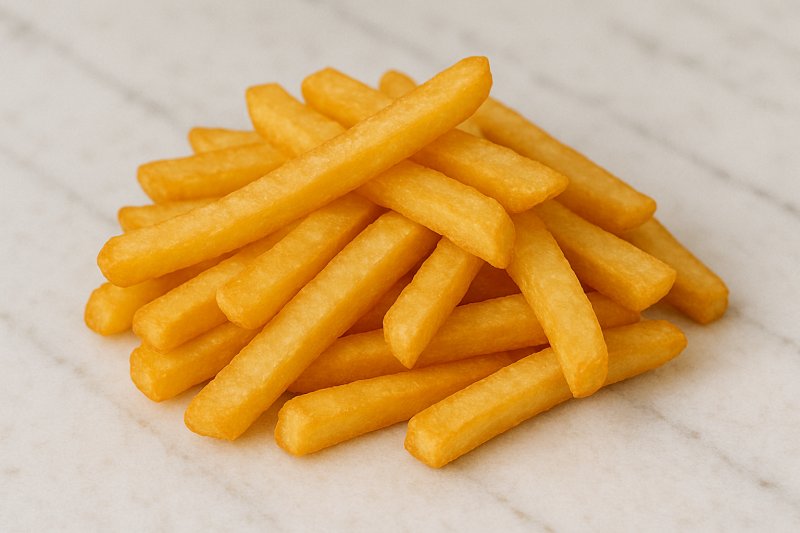
Fried potato sticks as a popular side dish or snack

Wiki about French fry Nutri-Score D Vegan Yes Gluten-free Yes Lactose-free Yes Nut-free Yes
NUTRITION / 100 g
312 kcal 3.8 g Protein 41.0 g Kohlenhydrate 15.0 g Fett

Introduction

Portion of French fries on a plate
I love french fries. For me they are not just a side dish, but a small, crunchy ritual that evokes memories and soothes the senses. Even as a child the smell of freshly fried potatoes meant: end of work, weekend, or a spontaneous trip into town. A friend of mine insisted that the perfect portion was only enjoyable with coarse sea salt and a squeeze of lemon; it took me years to understand his point of view, but today I nod in agreement while choosing my own favorite combination at the fry stand.

The history of fries fascinates me. Some claim they originated in Belgium, others in France — in everyday life that hardly matters, but this very discussion shows how much simple dishes concentrate culture and passion. I still remember a small bistro where I worked that served a traditional pan of fries: the roasting, double frying and final sprinkling of salt were almost a ceremony. Guests lingered just to watch and then enjoy the first crispy forkful.

What makes fries special is the balance between crispiness on the outside and tender potato inside. It starts with the choice of potato: waxy or floury varieties change the result considerably. Then comes the cut — thin sticks, thick and rustic or waffle-shaped — each variant brings its own texture. In my kitchen I experimented with blanching the fries briefly before frying or trying them in the air fryer; some techniques work surprisingly well, others were charming failures I still laugh about today.

A few practical principles I adopted:

  • Potato choice affects the interior of the fries.
  • Remove water: Dry well or rinse to reduce excess starch.
  • Double frying: First pre-cook at low temperature, then crisp at high heat.
  • Salt immediately: Salt sticks best right after frying.
To me fries are a symbol of uncomplicated enjoyment: they go with festive burgers and simple evenings with friends, with nostalgic walks and new taste experiments. I remember a night when an improvised plate of fries with unusual dips brought together a group who hardly knew each other before. Such small culinary bridges make fries for me more than just an ingredient — they are conversation starters, comfort and sometimes a little celebration.

Availability & types

Availability and types of french fries

French fries, or just fries, are popular everywhere and therefore easy to find. They originally come from the region around Belgium and northern France. There potatoes were cultivated long ago and people discovered that they could be cut into strips and fried — thus the crispy fries were born. Today potatoes used to make fries are grown in many countries around the world.

Potatoes grow best in temperate climates. Major growing regions are:

  • Europe – countries such as Germany, France, the Netherlands and Poland produce many potatoes.
  • North America – especially the USA and Canada have huge potato fields.
  • Latin America – Peru and other countries, where the potato originally comes from, also cultivate many varieties.
  • Asia – China and India also harvest a large quantity of potatoes.
Fries come in many varieties. You can make them at home from fresh potatoes or buy them ready-made in stores. Here are the main types, simply explained:

  • Fresh fries – these are raw potato strips that you can fry at home in hot fat or bake in the oven. They are like homemade bread: you know exactly what is in them.
  • Frozen fries – these fries have already been fried or pre-cooked and then frozen. That makes it very easy: into the fryer or oven and done. They are practical when you need something quick.
  • Ready fries from the fryer – these are fries you get directly at a restaurant or snack bar. They are fresh and usually very crispy because they are served right after frying.
  • Special shapes – fries are not only simple sticks:
    • Classic straight sticks (the best-known shape)
    • Wavy or crinkle-cut (with ridges, look like a small wave)
    • Spiral or twister fries (twisted shapes)
    • Steakhouse or country fries (thicker cut, often with skin)
    • Sweet potato-style fries (made from sweet potatoes, have an orange color and a sweeter taste)
There are also differences in taste and crispiness that depend on the potato variety and the preparation. Some potatoes are floury (they break down easily when cooked) and are good for fries with a fluffy interior. Others are waxy and remain firmer inside. Frozen fries are often made to become extra crispy on the outside because they are coated with a thin layer before freezing that crisps up when heated.

When you think of fries, various sides or sauces often come to mind — ketchup, mayo or curry sauce. In many countries there are also local variants: in Belgium fries are often served with a special sauce, in the USA there are often large portions in fast-food outlets, and in some countries fries are mixed with cheese or other ingredients.

In summary: french fries are easy to find because potatoes are grown almost everywhere. There are fresh, frozen and ready-fried fries as well as many shapes and varieties. Almost everyone can find their favorite fries, whether crispy, thick-cut or made from sweet potatoes — and that makes fries a popular snack around the world.
Details & nutrition

Property Value
Unit g
Calories per 100 312
Protein per 100 3.8
Carbohydrates per 100 41.0
Sugar per 100 0.5
Fat per 100 15.0
Saturated fat per 100 2.0
Monounsaturated fat 9.0
Polyunsaturated fat 4.0
Fiber per 100 3.0
Vitamin C (mg) per 100 6.0
Vitamin D (IU) per 100 0
Calcium (mg) per 100 10.0
Iron (mg) per 100 0.7
Nutri-Score D
CO₂ footprint 0.5
Origin Potato product, typically industrially pre-fried and frozen
Gluten-free Yes
Lactose-free Yes
Nut-free Yes
Vegan Yes
Note Nutritional values for frozen, pre-fried French fries, prepared in the oven or deep fryer. Values may vary depending on brand, oil and preparation method.

Technical & scientific information

French fries are in their simplest definition fried potato sticks eaten worldwide as a side dish or snack. The ingredient is primarily the storage tuber of the potato plant (Solanum tuberosum), whose main component is starch. The composition of a typical portion of fries includes water, carbohydrates (predominantly amylose and amylopectin), vegetable oil (as frying fat), small amounts of proteins and dietary fiber, as well as minerals and secondary plant compounds such as potassium, residual vitamin C and traces of B vitamins.

Chemical composition and physical properties
Potato starch consists of two macromolecules: amylose (largely unbranched α-1,4-glucosidic chains) and amylopectin (highly branched α-1,4 and α-1,6 linkages). When heated in water, the starch swells and gelatinizes, while during frying a complex interplay of water evaporation, Maillard reactions and starch cross-linking produces the typical texture. Surface crusting arises from dehydration and browning of starches and proteins. The Maillard reaction between reducing sugars and amino acids leads to brown color and aromatic compounds.

Processing methods
Industrial manufacture includes several stages: washing and peeling the potatoes, cutting into defined shapes, optional blanching to inactivate enzymes and solubilize starch, drying or pre-frying, freezing for shelf life and final frying before consumption. Pre-frying reduces moisture and forms a porous crust that is stabilized during subsequent freezing. Home preparation follows the same principle: temperature control of the frying fat (typical range 160–180 °C), possibly two-stage frying (lower temperature for cooking, higher temperature for crust formation) for better texture.

Fats and oils
Frying fat is largely incorporated into the surface and pores of the fries. The choice of oil affects flavor, oxidation stability and health evaluation. Oils with a higher proportion of monounsaturated fatty acids (e.g. rapeseed oil) offer better heat resistance than those high in polyunsaturated fatty acids. Repeated heating of fats promotes oxidation and formation of polymeric and degradation products that can be problematic both sensorily and health-wise.

Nutritional values and health aspects
Nutritional values vary with preparation, portion size and the oils used. On average classic deep-fried fries contain about 300–380 kcal per 100 g, with a high fat content (typically 15–20 g/100 g) and 30–40 g of carbohydrates. Health-relevant aspects include in particular:

  • Fat intake: A high proportion of saturated and trans fatty acids from poor frying processes increases cardiovascular risk.
  • Calorie balance: Energy density favors weight gain with regular consumption in large amounts.
  • Acrylamide formation: At high temperatures (>120 °C) and low moisture content, acrylamide can form from reducing sugars and asparagine, a potentially genotoxic compound. Industrial processes and domestic measures (e.g. storing potatoes at recommended temperatures, blanching, temperature control) can reduce its formation.
  • Minerals and vitamins: Peeling and heating cause losses of water-soluble vitamins; nonetheless fries provide notable amounts of potassium and small amounts of fiber.
Safety and quality criteria
Quality assurance includes storage conditions of potatoes (cool, dark, frost-free storage), control of contaminants (pesticide residues), hygienic handling and monitoring of frying oils (peroxide values, Totox value). Sensory properties such as crispiness, color and taste serve as indicators of success and freshness. Technological innovations aim to reduce fat uptake, lower acrylamide formation and improve texture through modification of pretreatment and the use of more stable oils.

Overall fries are a technologically simple but chemically complex food whose nutritional assessment depends on the method of preparation, portion size and raw materials used. With moderate consumption and controlled manufacturing conditions many health risks can be reduced, while sensory quality and shelf life can be improved by targeted process control.

Wiki entry for: French fry
Active now: 12 visitors of which 2 logged-in members in the last 5 minutes