Menu & categories

Emmental cheese

Aromatic hard cheese with characteristic holes

Wiki about Emmental cheese 45% fat in dry matter Nutri-Score D Vegan No Gluten-free Yes Lactose-free No Nut-free Yes
NUTRITION / 100 g
380 kcal 28 g Protein 0 g Kohlenhydrate 29 g Fett

Introduction

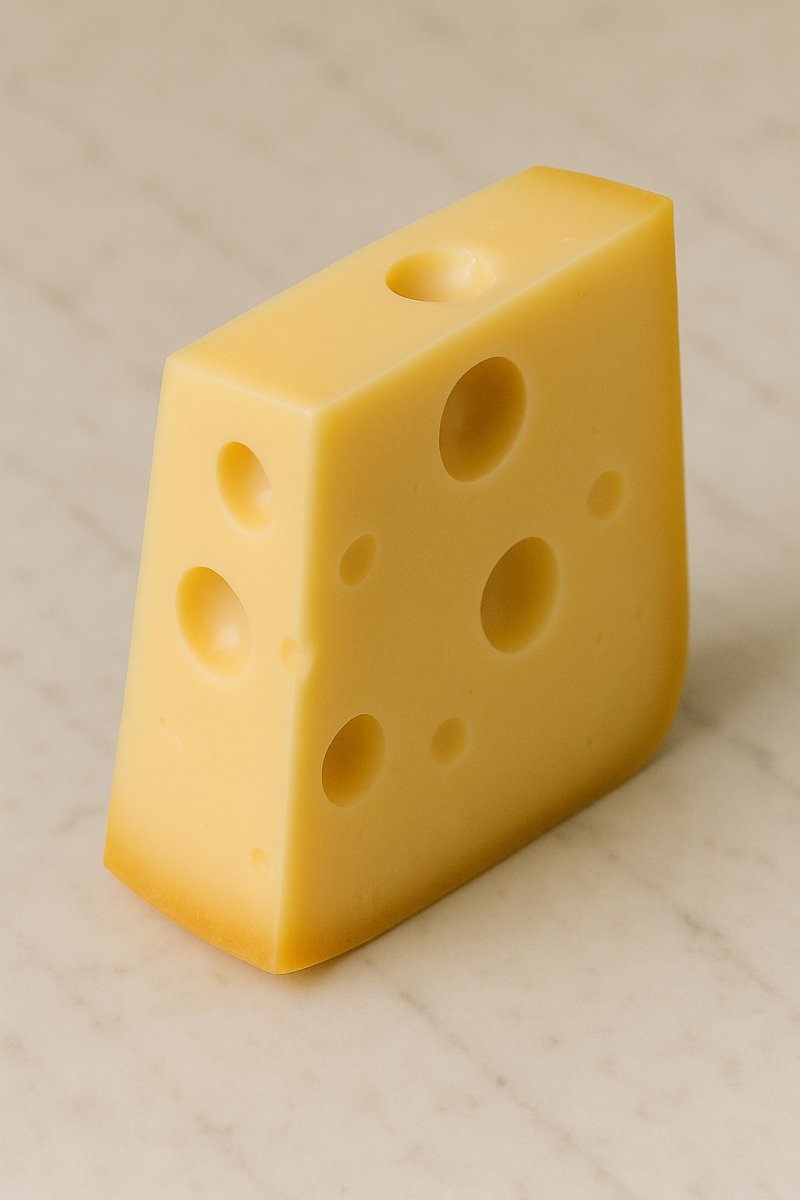
Piece of Emmental cheese with holes
Emmental cheese 45% fat in dry matter is for me, a 35-year-old editor from Europe, much more than just an ingredient — it is a piece of culinary culture that has had a fixed place on breakfast tables, in casseroles and on cheese boards since my childhood. This traditional hard cheese with its characteristic holes, nutty-mild flavor and creamy texture is a versatile classic enjoyed both in everyday cooking and in fine dining. In particular, the indication 45% fat in dry matter — i.e. fat in the dry matter — points to its balanced, pleasantly juicy consistency that is neither too fatty nor too lean and melts wonderfully evenly.

When I buy Emmental I deliberately reach for a piece that smells delicately of hay and nuts, with a golden-yellow rind and a richly straw-colored paste. A colleague of mine, a trained chef, swears by putting the cheese in the fridge for 20 minutes before grating so it can be processed more easily. And a friend from Switzerland tells me again and again that a good Emmentaler is not only recognizable by its “holes” but above all by its aroma and the balance between sweetness and savoriness. In my own kitchen the cheese is a “problem solver”: it makes a quick quiche more flavorful, elevates a sandwich and gives potato gratin a silky top that does not break when cut.

The origin story of this cheese reaches deep into European cheesemaking tradition. Originally from the Emmental, the cheese has spread beyond its borders. Artisanal production, aging in cool cellars and careful selection of cultures shape its characteristic profile. Aging time influences the aroma: younger variants taste mild and slightly sweet, while longer-aged examples develop a more intense, nutty note. The result is a cheese that is equally at home in everyday use and on festive tables.

For those wondering what 45% fat in dry matter specifically means: the fat percentage refers to the dry matter and not to the total weight, which also contains water. This makes the indication comparable and explains why

Availability & types

Availability and types of Emmental 45% fat in dry matter

Emmental is a world-famous hard cheese with the typical large holes that many simply know as “Emmentaler”. The indication “45% fat in dry matter” means the cheese contains 45% fat relative to the dry matter. It sounds complicated but is easy to understand: cheese contains water and solid components. The fat content is calculated only on the solid components, i.e. without the water. An Emmental with 45% fat in dry matter tastes full-bodied but not too heavy, and is therefore very suitable for everyday use — for example on bread, for gratinating or as cheese cubes for a snack.

Origin and production
The original Emmentaler comes from the Emmental in Switzerland. It was already produced there centuries ago in alpine dairies. Today several countries produce Emmentaler in a similar way, for example Germany, France and Austria. Nevertheless there are differences:
- Swiss Emmentaler often has a protected designation (e.g. AOP — “Appellation d’Origine Protégée”), which means it is produced according to strict rules.
- German Emmentaler is frequently produced in modern dairies and is found in many supermarkets. It is usually a bit milder and more uniform in taste.
- French Emmental (often called “Emmental Grand Cru”) can be aged longer and therefore taste stronger.

Availability in everyday life

  • Supermarkets and discounters: Emmental 45% fat in dry matter is available almost everywhere. It is usually sold sliced, in blocks or grated in bags.
  • Delicatessens and cheese counters: here you often find special variants with longer aging, stronger aroma or made from raw milk. Staff can advise which is best for your recipe.
  • Farmers' markets: regional dairies offer Emmental-like cheeses, sometimes from hay milk or organic milk. They are often seasonally available.
  • Online shops: for special varieties (e.g. AOP
Details & nutrition

Property Value
Unit g
Average weight per piece 30
Calories per 100 380
Protein per 100 28
Carbohydrates per 100 0
Sugar per 100 0
Fat per 100 29
Saturated fat per 100 18
Monounsaturated fat 8
Polyunsaturated fat 1
Fiber per 100 0
Vitamin C (mg) per 100 0
Vitamin D (IU) per 100 8
Calcium (mg) per 100 1000
Iron (mg) per 100 0.2
Nutri-Score D
CO₂ footprint 6.5 kg CO2e/kg
Origin Switzerland/Europe
Gluten-free Yes
Lactose-free No
Nut-free Yes
Vegan No
Note Hard cheese with approx. 45% fat in dry matter; naturally very low in lactose, but not labellable as lactose-free.

Technical & scientific information

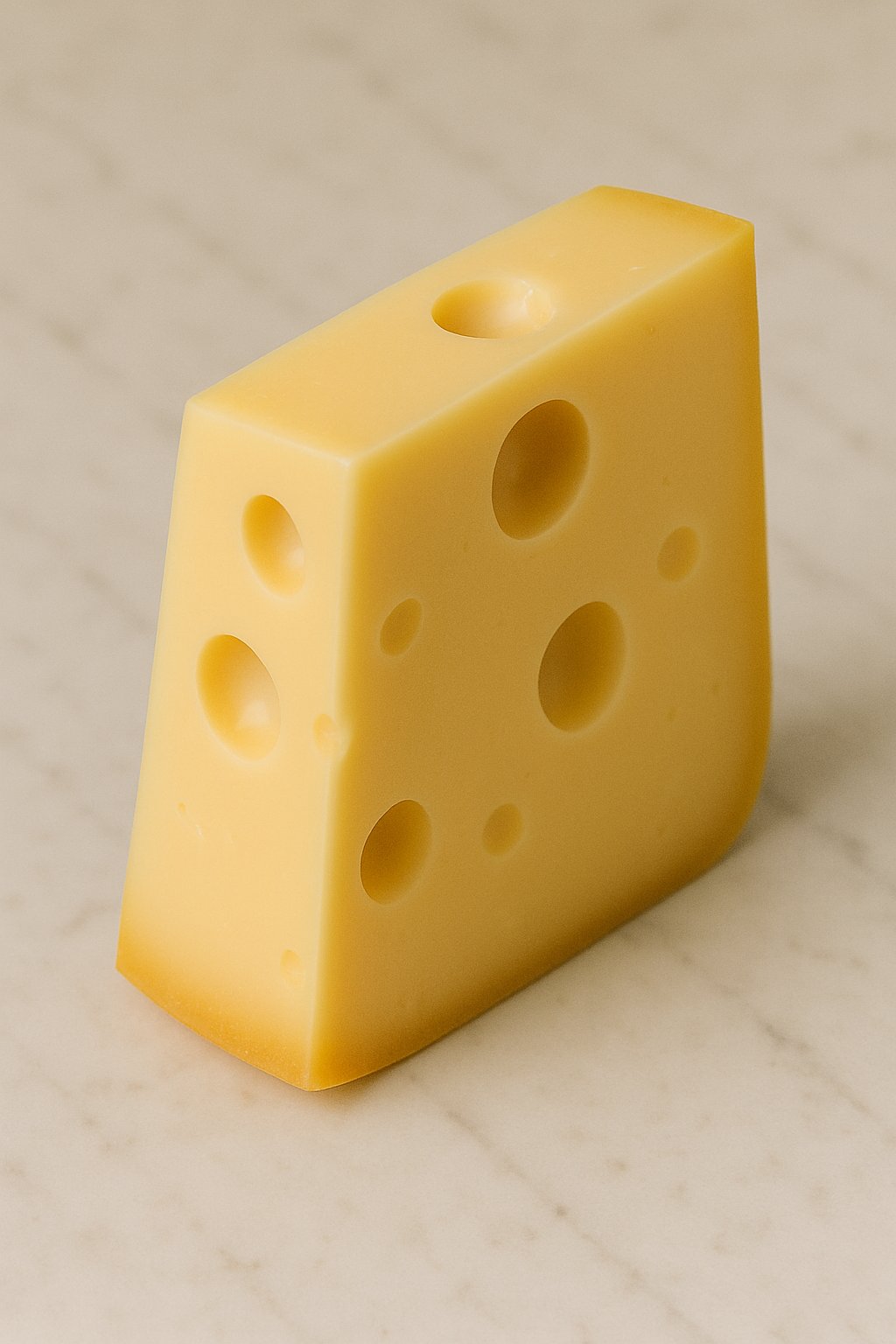
Emmental cheese 45% fat in dry matter refers to a semi-hard to hard ripened cheese of Swiss origin that forms large, round holes (the so-called “cherry eyes”) through characteristic ripening with propionic acid bacteria. The indication “45% fat in dry matter” denotes the fat content in the dry matter, a parameter established in dairy science that, independent of the variable water content, describes the relative fat concentration of the cheese. Emmentaler of this fat level has a sensory mild-nutty, slightly sweet aroma that becomes more complex and piquant with increasing age.

Raw material and production principle
The raw material is cow's milk, used depending on tradition as raw milk or thermized/pasteurized milk. The standard process includes adjustment of pH, addition of defined starter cultures (lactococci, lactobacilli) and rennet for coagulation of milk proteins. After coagulation the curd is cut ("cheese grain"), heated and stirred to achieve targeted whey separation. The press curd is molded, salted (dry or brine) and then ripened for several weeks to months. Characteristic is the propionic fermentation phase, in which Propionibacterium freudenreichii subsp. shermanii converts lactate to propionic acid, acetic acid and carbon dioxide. The resulting CO2 forms the typical eyes; propionic acid and accompanying compounds shape the aroma.

Physicochemical properties
Emmental 45% fat in dry matter typically contains in the fresh substance about 26–30% water, 27–31% fat and 26–29% protein, depending on ripening and production variant. The pH after early ripening is around approx. 5.2–5.5 and rises moderately over time due to proteolytic and decarboxylative processes. The texture is elastic to cut-firm, with a homogeneous matrix and evenly distributed eyes of 1–3 cm diameter. Fat is present as an emulsion in a casein-based gel matrix; stability is influenced by calcium-phosphate

Wiki entry for: Emmental cheese 45% fat in dry matter
Active now: 21 visitors of which 2 logged-in members in the last 5 minutes