Menu & categories

Egg liqueur

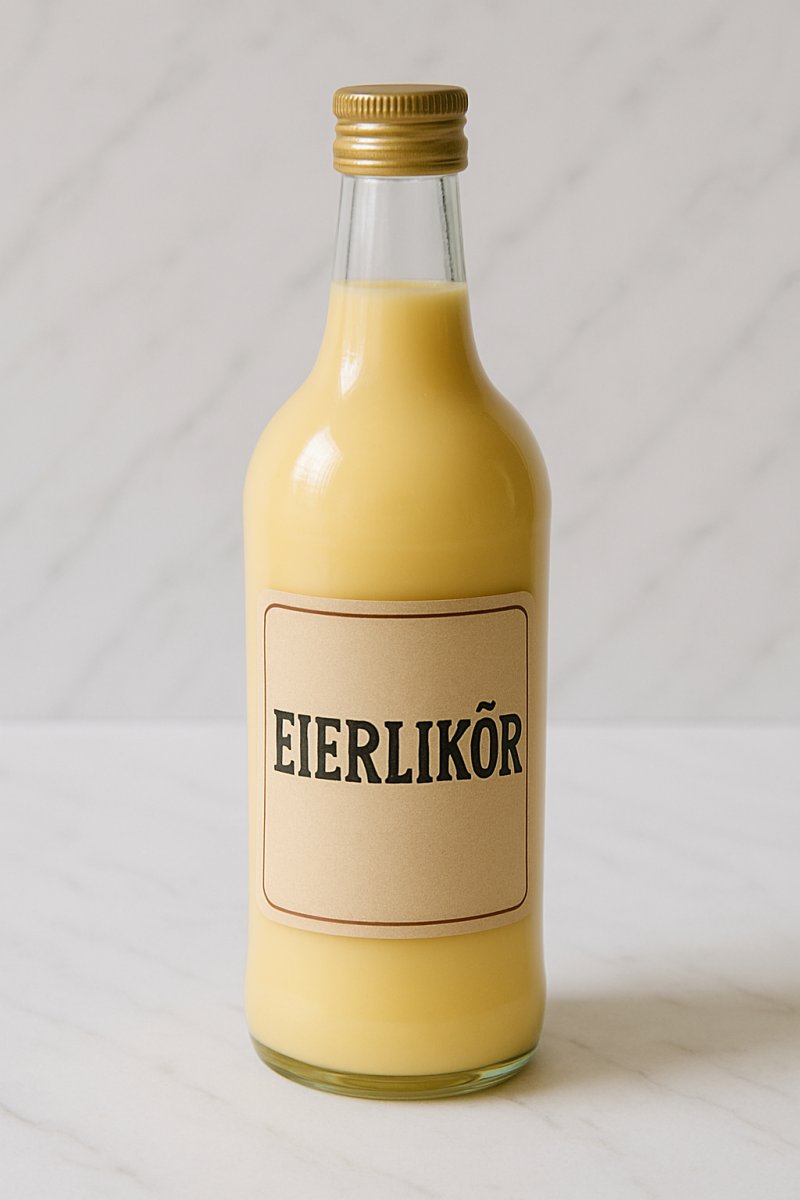
Creamy liqueur made from egg, milk/cream and alcohol – sweet and aromatic.

Wiki about egg liqueur Nutri-Score E Vegan No Gluten-free Yes Lactose-free No Nut-free Yes
NUTRITION / 100 ml
330 kcal 5.0 g Protein 28.0 g Kohlenhydrate 12.0 g Fett

Introduction

Glass with yellow egg liqueur

When I think of egg liqueur, the scent of vanilla and warm egg-yolk cream immediately comes to mind. For me it is not just a liqueur, but a small, delicious reminder of winter afternoons and improvised desserts. I clearly remember a family celebration where someone secretly produced a bottle and suddenly everything – from pancakes to chocolate cake – was improved by a dollop of egg liqueur.

The base is simple: egg yolks, sugar, vanilla and a splash of alcohol that gives the mixture stability and shelf life. Sometimes cream is added, sometimes a drop of rum or cognac. This mixture yields a velvety, yellowish cream that is both sweet and rich. A colleague of mine swears by using it in coffee instead of sugar; he calls it his "five-minute break revolution."

What I particularly like about egg liqueur is its versatility. It works as spoonable pleasure straight from the jar, as a topping for ice cream or fruit, and as a secret ingredient in baked goods. I once adapted a simple pound cake recipe by replacing part of the butter with egg liqueur – the result was moist and had that fine, warm vanilla note.

  • Preparation tips: Temper the eggs slowly so they do not curdle.
  • Storage: Store in the refrigerator and consume within a few weeks.
  • Variants: With cream for creaminess or with a robust rum for depth.
Of course there are concerns about raw eggs; those who want to be safe use pasteurized eggs or gently heat the mixture while stirring continuously. I find that homemade egg liqueur has a comforting, down-to-earth quality that store-bought kinds often do not achieve. It is not a showpiece, but a small kitchen miracle that makes simple things festive. Next Sunday afternoon I will make another jar – not only because it is delicious, but because the making itself is one of the nicest rituals to share alone or with friends.

Availability & types


Availability and types of egg liqueur

Origin: Egg liqueur has its roots in Europe. A close relative is the Dutch Advocaat, a thick egg liqueur that was popular centuries ago. Recipes were found where egg yolks were mixed with sugar and alcohol to create a sweet, creamy liquid. Over time, local variants developed in Germany, Austria and the Netherlands. You can imagine egg liqueur like a drinkable vanilla pudding with a small "warm" addition – the alcohol.

Production areas and raw materials: Egg liqueur does not grow in fields but is made from raw materials supplied by farmers and producers:

  • Eggs: Usually come from hens on farms. In many regions of Europe – for example Germany, the Netherlands, Poland or France – there are many egg producers.
  • Milk or cream: Some recipes use cream or milk. These ingredients come from agricultural areas where cows are kept.
  • Alcohol: Usually neutral spirit, rum or brandy is used. Distilleries in many countries produce these spirits, so alcohol is widely available.
  • Sugar and flavorings: Sugar comes from beet or cane cultivation; vanilla or chocolate are imported from their respective growing regions.
Where can you buy egg liqueur? You can find egg liqueur in supermarkets, liquor stores and at weekly markets. It is especially popular at Christmas and Easter because it is often used in desserts or on cakes. It is available year-round, but during the holidays many people see it more often on the shelf.

Available types and variants

  • Classic egg liqueur: The basic mixture of yolk, sugar, alcohol and often vanilla. It is velvety and not too thin.
  • Advocaat: Very thick and creamy, almost like a spoonable pudding; often prepared with a higher yolk content.
  • Rum- or brandy-flavored liqueur: These variants have a more pronounced "robust" flavor due to the spirit used.
  • Non-alcoholic egg liqueur: For children and people who do not want to drink alcohol. It tastes similar but often contains more milk or cream instead of alcohol and sometimes a preservative.
  • Flavor variants: Chocolate, coffee, vanilla or even caramel – manufacturers like to try different flavors.
  • Homemade vs. industrial: Homemade egg liqueur is often fresher and thicker, made in small batches. Industrial products last longer because they are pasteurized or preserved with alcohol.
In short: egg liqueur comes in many forms – from thick and pudding-like to liquid and drinkable, with or without alcohol and with different flavors. You can buy it at the supermarket or make it at home, depending on how you prefer it. It is a versatile, sweet drink often used at celebrations and in desserts.

Details & nutrition

Property Value
Unit ml
Average weight per piece 30
Calories per 100 330
Protein per 100 5.0
Carbohydrates per 100 28.0
Sugar per 100 26.0
Fat per 100 12.0
Saturated fat per 100 6.0
Monounsaturated fat 4.0
Polyunsaturated fat 1.5
Fiber per 100 0.0
Vitamin C (mg) per 100 0.0
Vitamin D (IU) per 100 30
Calcium (mg) per 100 120
Iron (mg) per 100 1.0
Nutri-Score E
CO₂ footprint 0.25 kg CO2e pro 100 ml (ca.)
Origin Germany/Austria (depending on manufacturer)
Gluten-free Yes
Lactose-free No
Nut-free Yes
Vegan No
Note Contains alcohol; nutritional values vary by recipe/brand. May contain traces of other allergens depending on production.

Technical & scientific information

Egg liqueur is a creamy, sweet liqueur based on egg yolk, sugar and ethanol, common in Central European cuisine. Its characteristic appearance arises from the combination of yellow carotenoids from the yolk and an oil-in-water emulsion of fat droplets, proteins, sugar and alcohol. Typical alcohol contents for commercial products are usually between about 14 and 20 % vol., while homemade variants can be higher. The sensory profile is marked by high sweetness, a thick texture and a pronounced egg-yolk aroma.

Chemical composition and ingredients: Egg liqueur consists mainly of water, ethyl alcohol, sucrose (or other sweeteners), lipids and proteins from the yolk and small amounts of minerals and pigments (carotenoids). Key components include:

  • Triglycerides and phospholipids (lecithin) from the yolk that act as natural emulsifiers.
  • Yolk proteins (e.g. lipovitellin, livetins) that influence viscosity development upon heating.
  • Cholesterol, concentrated in the yolk and nutritionally relevant.
  • Ethyl alcohol as a solvent for flavor compounds and as a preservative factor.
  • Sugar which not only sweetens but, through its hygroscopic properties, affects texture and shelf life.
Nutritional values (typical magnitude per 100 g): Egg liqueur is energy-dense and often provides between 300 and 360 kcal. The macronutrient distribution varies with the recipe but typically is fat 10–20 g (with a significant share of saturated fatty acids), carbohydrates 25–45 g (of which sugars 20–40 g) and protein 3–6 g. Actual nutritional values strongly depend on alcohol and milk/cream content and on additives.

Production and processing methods: Traditionally yolks and sugar are whipped, mixed with a spirit (e.g. rum, brandy) and often complemented with cream or milk. Industrial production adds further steps, including:

  • Heat treatment (pasteurization) of the egg mixture or use of pasteurized eggs to reduce microbial risks; typical practice is gentle heating with stirring, often to levels that inactivate Salmonella without causing excessive coagulation.
  • Homogenization to stabilize the emulsion and improve creaminess.
  • Addition of stabilizers or thickeners (e.g. starch, gelatin, modified polysaccharides) to extend shelf life and prevent phase separation.
  • Filtration and filling under hygienic conditions and, if necessary, pasteurizing or sterilizing measures on the filling line.
Stability and physical properties: Emulsion stability is influenced by the concentration of lecithin, proteins, alcohol and sugar content and by temperature. Egg liqueur often exhibits a viscoelastic, viscous rheology that can show slight thixotropic behavior under shear. Long-term storage without stabilizers leads to phase separation and lipid oxidation, causing sensory changes.

Health aspects: Egg liqueur is high in calories and sugar and contains alcohol; therefore moderate consumption is advised. Allergies to egg proteins preclude consumption. Raw eggs pose microbiological risk (e.g. Salmonella), so pasteurized products are recommended, especially for pregnant women, young children and immunocompromised persons. Alcohol interactions and contraindications are comparable to other alcoholic beverages.

Overall, egg liqueur is a technically simple but chemically complex food whose properties are determined by the interplay of lipids, proteins, sugar and ethanol. Through targeted processing steps safety, texture and shelf life can be controlled, while recipe variations can significantly alter sensory and nutritional profiles.

Wiki entry for: egg liqueur
Active now: 18 visitors of which 2 logged-in members in the last 5 minutes