Menu & categories

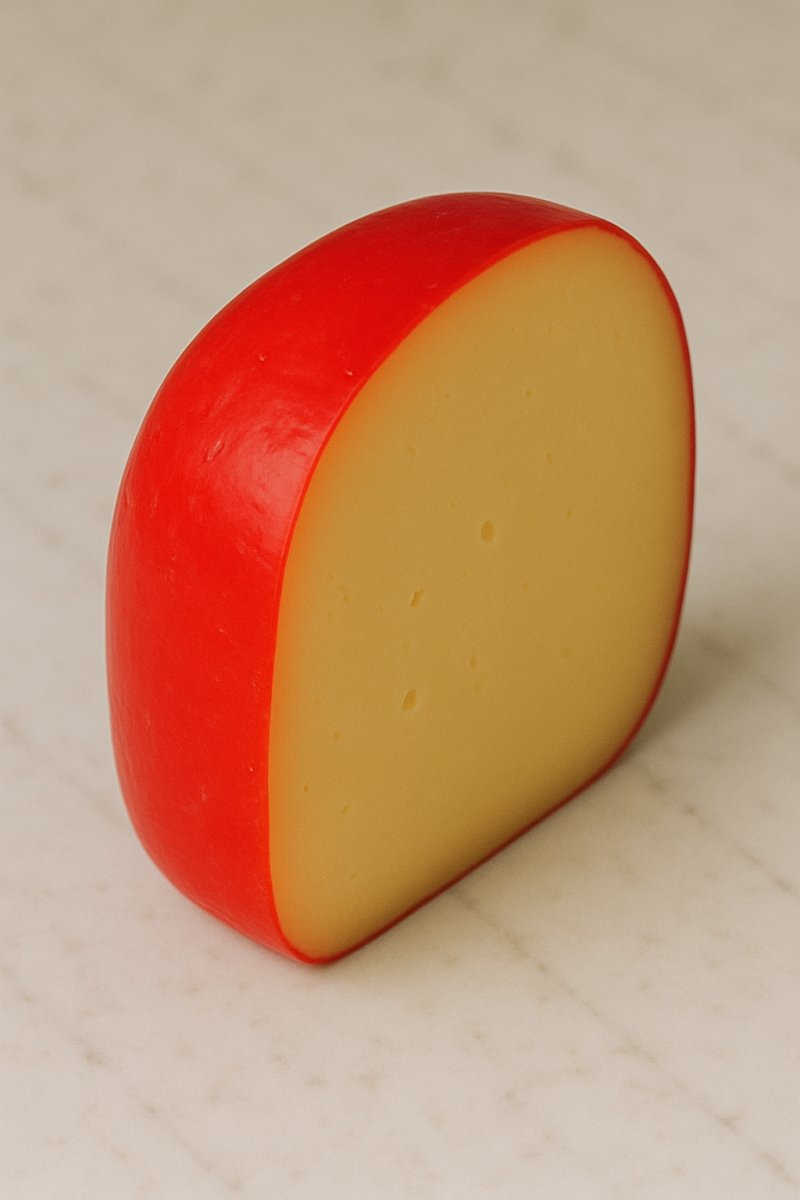
Edam cheese 45% fat in dry matter

Mild semi-hard cheese with a balanced fat content

Wiki about Edam cheese Nutri-Score D Vegan No Gluten-free Yes Lactose-free No Nut-free Yes
NUTRITION / 100 g
305 kcal 25 g Protein 0 g Kohlenhydrate 23 g Fett

Introduction

Edam cheese in slices
Edam cheese 45% fat in dry matter is one of the best-known and most popular cheeses in Europe. As an editor with a weakness for honest, versatile ingredients, I have encountered this semi-firm cheese in many different contexts over the past years: from uncomplicated family breakfasts to elegant cheese platters and creative recipes that convince even skeptics. What makes Edam special is its balanced combination of a mild, slightly nutty aroma, a pleasantly smooth texture and excellent melting properties. That very combination opens up an impressive range of uses in both everyday and refined cooking.

The term 45% fat in dry matter describes the fat content relative to the water-free portion of the cheese. In practice this means: Edam with 45% fat in dry matter is creamy enough to melt nicely while not being too heavy. This balance makes it ideal for hot dishes without feeling greasy, and equally perfect for cold applications where it retains structure. A colleague of mine who worked in a bistro in Amsterdam swears by serving Edam at room temperature: this way the aromas and flavors develop best, and the texture becomes velvety without being sticky.

Historically Edam originates from the Netherlands, more precisely from the region around the town of Edam. Traditionally the cheese was traded as a round wheel with a red or yellow rind – an image that many immediately think of when they imagine classic European cheese culture. Today Edam is produced in many European countries, with varying quality standards and ripening times. Ripening in particular plays an important role: younger Edam is especially mild and soft, while a slightly longer-aged Edam develops more intense, nuttier notes and a firmer bite.

In everyday cooking Edam cheese 45% fat in dry matter is a reliable partner: it can be grated, sliced or shaved excellently and fits seamlessly into sandwiches, gratins or casseroles. A colleague from the food desk bakes a golden-brown crust with Edam on a vegetable lasagna – she mixes it with a pinch of nutmeg and some coarsely ground pepper. The result is

Availability & types

Availability and types of Edam cheese 45% fat in dry matter

Edam is a semi-firm cheese originally from the town of Edam in the Netherlands. The designation “45% fat in dry matter” means “45 percent fat in the dry matter.” It sounds complicated, but it is simple: if all the water were removed from the cheese, the solid components would contain 45% fat. In practice Edam with 45% fat in dry matter feels mild, pleasantly creamy and not too heavy. It is therefore a popular everyday cheese – good on bread, for gratinating and for both cold and hot dishes.

Origin and development
Edam comes from the Netherlands, where it has been produced for centuries. It was often sold in the past as small round balls with a distinctive red rind. This rind is usually wax, which protects the cheese from drying out during transport. Today Edam is not only produced in the Netherlands. Many European countries – for example Germany, Poland or the Czech Republic – produce Edam or Edam-like cheeses. The basic idea remains the same: a mild, durable cheese that fits many kitchens.

Availability in trade
Edam 45% fat in dry matter is easy to find in most supermarkets. You can get it:

  • as a whole piece in a cheese block (versatile, stays juicier),
  • as slices for bread and sandwiches,
  • as grated for pizza, casseroles or gratins,
  • as snack cubes for in-between or for colorful cheese platters.
At cheese counters you can have Edam freshly cut for you. There you often also find different maturity levels. In the refrigerated section you will find branded products and private labels. In delicatessens international variants also appear, for example Edam from traditional production with a natural rind.

Main types and varieties
Although Edam is generally made according to a similar recipe, there are different variants. Here are the main ones

Details & nutrition

Property Value
Unit g
Average weight per piece 30
Calories per 100 305
Protein per 100 25
Carbohydrates per 100 0
Sugar per 100 0
Fat per 100 23
Saturated fat per 100 15
Monounsaturated fat 6
Polyunsaturated fat 1
Fiber per 100 0
Vitamin C (mg) per 100 0
Vitamin D (IU) per 100 20
Calcium (mg) per 100 700
Iron (mg) per 100 0.2
Nutri-Score D
CO₂ footprint 5.8 kg CO2e/kg
Origin EU
Gluten-free Yes
Lactose-free No
Nut-free Yes
Vegan No
Note Traditionally made from cow's milk; naturally very low in carbohydrates. Lactose content may be reduced depending on degree of maturation.

Technical & scientific information

Edam cheese 45% fat in dry matter is a semi-firm cheese of Dutch origin, technologically characterized by combined acid and rennet coagulation, thermal treatment of the curd and controlled maturation. The indication “45% fat in dry matter” refers to the fat content in the dry matter and serves as a standardized quality and typification class. Edam is traditionally made from pasteurized cow's milk, has an even, closed to slightly irregular eye formation and an elastic-smooth texture. Sensorially it shows a mild to slightly nutty aroma with subtle buttery notes that intensify with ripening, yet remain elegantly restrained compared to more strongly matured cheeses.

Production and technology: Production of Edam begins with the selection of standardized milk, whose fat and protein content are precisely adjusted to achieve the desired dry matter and fat percentage in dry matter. After pasteurization, inoculation with starter cultures follows, usually mixed cultures of Lactococcus lactis subsp. lactis and cremoris, sometimes supplemented by Leuconostoc species for finely tuned gas formation. Addition of rennet (chymosin) coagulates the casein micelle system, whereupon cutting the curd breaks the coagulum into uniform particles. The subsequent heating (scalding) at moderate temperature promotes syneresis and adjustment of moisture, which are essential for Edam's semi-firm consistency.

After molding and pressing, the cheese is matured in brine or dry-salted. Salt uptake controls water activity, microbial balance and rind formation. A characteristic wax coating or plastic rind protects against drying and contamination, stabilizes the ripening microbiome and enables even moisture distribution. Ripening time typically varies between 4 and 12 weeks; longer ripening leads to more complex aroma profiles, increased proteolysis and a slightly firmer texture.

Physicochemical properties: The water content lies in the range typical for semi-firm cheeses so that water activity is adjusted to control the activity of lactic acid bacteria

Wiki entry for: Edam cheese
Active now: 20 visitors of which 2 logged-in members in the last 5 minutes