Menu & categories

Dry yeast

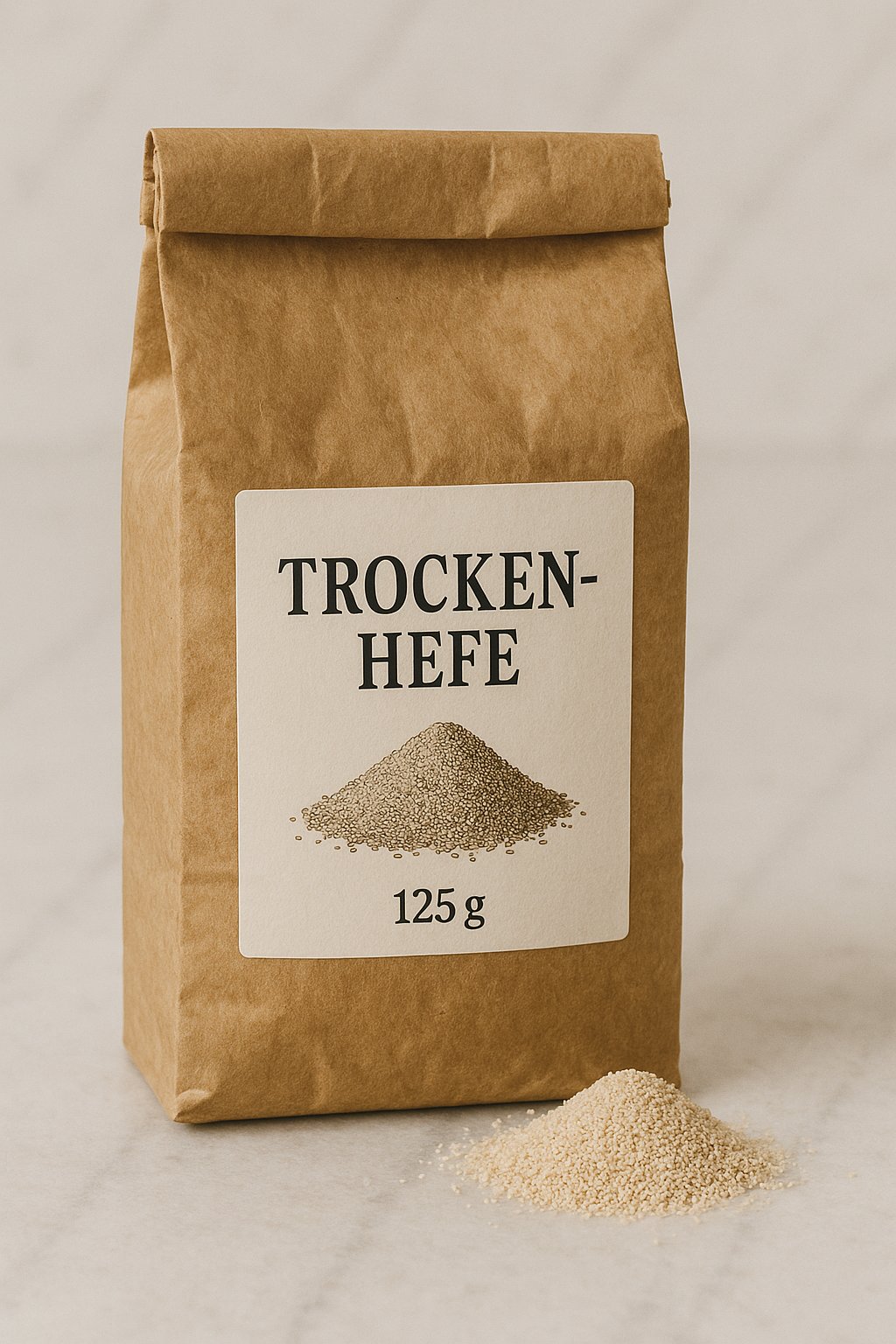
Dried baker's yeast used as a leavening agent for dough

Wiki about dry yeast Nutri-Score B Vegan Yes Gluten-free Yes Lactose-free Yes Nut-free Yes
NUTRITION / 100 g
350 kcal 40 g Protein 40 g Kohlenhydrate 6 g Fett

Introduction

Granulated dry yeast in a small bowl
I still remember exactly the first packet of dry yeast I consciously bought: the small, inconspicuous sachet lay between flour and sugar on the supermarket shelf, and I held it like a good-luck charm in my hand. Back then I knew little more than that dry yeast makes bread airy. By now it has become for me a reliable kitchen heroine that repeatedly provides surprises — from quick pizza dough on a Friday night to experimental focaccias flavored with herbs.

Dry yeast is dried, inactivated baker's yeast that comes in granular form and therefore has a long shelf life. Its advantage lies in easy handling: it does not need to be constantly refrigerated and can be mixed directly with flour or activated in warm water. I have gotten into the habit of keeping the package instructions in mind, but also improvising — a colleague of mine swears by dissolving the yeast first in a small amount of lukewarm milk when he makes sweet doughs for brioche.

What I particularly appreciate about dry yeast is its versatility:

  • Quick doughs: for simple breads and pizzas a short proofing time is often sufficient.
  • Longer proofing times: with less yeast and cooler water slower fermentations can be achieved that bring more aroma.
  • Portion-friendly: the small sachets are practical if you bake only occasionally.
Technically, yeast works by converting sugars and starch into carbon dioxide and alcohol — the carbon dioxide makes the dough rise. I have learned that temperature and time are decisive: water that is too hot kills the yeast cells, water that is too cold delays the process. Once I was baking with guests and accidentally put the bowl on a balcony that was too cold; the yeast was so slow that we calmly had an aperitif before the bread finally rose wonderfully anyway.

Tips that have helped me over the years: store dry yeast in a cool, dry place, pay attention to the best-before date, and try small variations with new recipes — less yeast, longer proofing, or part wholemeal flour. These small experiments often bring the biggest aha moments. Dry yeast is for me more than an ingredient; it is an invitation to try things out, a reliable partner in the kitchen and sometimes the quiet reason for satisfied faces at the table.

Availability & types

Availability and types

Dry yeast is an ingredient you can buy in many stores. It is practical because it has a long shelf life and does not need to be kept in the fridge until opened. You will usually find dry yeast in small sachets or in jars with granules that look like little colorful grains of sand. The yeast itself comes from a tiny living cell called a yeast organism (most often the species Saccharomyces cerevisiae), which diligently converts sugars into gas bubbles — exactly what makes dough light.

Origin and production areas
Yeast does not grow in fields like vegetables. Instead it is "cultivated" in factories, i.e. in large vessels with sugar, water and nutrients where yeast cells can multiply quickly. These factories are located around the world, especially in countries with large baking and beverage industries such as in Europe, North America or parts of Asia. You can imagine it as a kind of large aquarium for tiny organisms: the conditions (temperature, food) are precisely adjusted so that the yeast grows well.

Available types and variants
Dry yeast is available in several forms. The main variants are:

  • Instant dry yeast: this type is very popular because it can be mixed directly with flour without being dissolved in water beforehand. You can compare it to a quick smile: it is ready to use immediately and works fast.
  • Active dry yeast: this yeast works a little more slowly and prefers to be dissolved first in warm water so it can "wake up." It's like waking someone up and giving them a moment to become alert.
  • Organic/"bio" dry yeast: this yeast is produced according to specific rules that avoid certain chemicals. For people who prefer natural or more ecological products, this is an option.
  • Specialty yeasts: there are also specific yeast strains for particular purposes, for example for breads with distinctive flavor or for doughs that should ferment for longer. Sometimes they are processed with additional ingredients such as enzymes or malt to give the dough special properties.
Where to find dry yeast
You can buy dry yeast in supermarkets, health food stores, bakery supply shops or online. The small sachets are convenient if you rarely bake because one sachet is often exactly right for a recipe. The larger jars or tins make sense if you bake frequently. Pay attention to the best-before date: unopened dry yeast keeps for a long time, but once opened it loses strength after a while.

Simple example
Imagine you have two friends for a race: Instant is the friend who sprints off immediately, and Active is the friend you first have to wake up. Both reach the finish, just in different ways. So it is with yeast types: both make the dough airy, but they are handled slightly differently.

In summary: dry yeast is widely available worldwide, cultivated in specialized production facilities and comes in variants such as instant, active, organic and specialty strains. You can choose the variety that best suits your recipe and baking style.
Details & nutrition

Property Value
Unit g
Calories per 100 350
Protein per 100 40
Carbohydrates per 100 40
Sugar per 100 8
Fat per 100 6
Saturated fat per 100 1
Monounsaturated fat 2
Polyunsaturated fat 3
Fiber per 100 25
Vitamin C (mg) per 100 0
Vitamin D (IU) per 100 0
Calcium (mg) per 100 60
Iron (mg) per 100 4
Nutri-Score B
CO₂ footprint 2.5
Origin Worldwide, predominantly industrial fermentation
Gluten-free Yes
Lactose-free Yes
Nut-free Yes
Vegan Yes
Note Nutritional values may vary by manufacturer; information refers to commercially available active dry yeast without additives.

Technical & scientific information

Dry yeast is a dried leavening agent based on microorganisms of the genus Saccharomyces, typically Saccharomyces cerevisiae. It is produced by controlled cultivation, separation of the biomass and subsequent drying to a storable, granular product. Dry yeast contains living yeast cells that, after rehydration, become active again and ferment sugars to carbon dioxide and ethanol, which in baked goods provides volume and porous structure.

Composition and ingredients. Dry yeast consists predominantly of yeast cells (proteins, cell wall polysaccharides such as mannans and glucans, lipids, nucleic acids), water residues and small amounts of excipients or carrier substances. The cell wall components make up a large portion of the dry mass and are nutritionally relevant because they provide dietary fiber. Typical nutritional values per 100 g are about 300–350 kcal, with 40–50 g protein, 30–40 g carbohydrates and 3–10 g fat, depending on the manufacturing process and additives. Dry yeast is also rich in B vitamins, particularly vitamin B1, B2, B3, B6 and folate, as well as various minerals such as potassium, phosphorus and iron.

Manufacturing process. Production begins with fermentation in nutrient solutions that contain sugars, nitrogen sources and mineral salts. After sufficient cell multiplication, cells are separated from the culture fluid (centrifugation or filtration), washed and, if necessary, concentrated. Drying then takes place, usually by spray drying or fluidized-bed drying, with temperature profiles chosen so that yeast cells retain high survival rates. Occasionally stabilizers or anti-caking agents are added to improve flowability and storage stability.

Physicochemical properties. Dry yeast appears as granules or powder with low water activity, which enables long shelf life. Cell membranes and enzyme systems remain intact to a certain degree so that metabolic processes resume after rehydration. Activity parameters such as leavening power and viability are influenced by storage conditions (temperature, humidity) and packaging effects. Modern packages are typically gas-tight and light-protected to minimize oxidation and moisture uptake.

Application in food and industry. In baking, dry yeast is used for dough leavening and flavor formation; it can be used in both direct and indirect production systems. Industrially it also serves as a starting material for the production of yeast extracts, flavorings or as a dietary supplement. Dosage is based on recipes and desired fermentation speed; typical values are in the range of 0.5–3 % of the flour mass.

Health aspects and tolerance. For most people, dry yeast is harmless and provides valuable nutrients. However, people with a pronounced yeast allergy or a Candida hypersensitivity should exercise caution. In addition, yeast contains purines, which may be relevant for people with gout and elevated uric acid levels. In rare cases, taking large amounts of yeast preparations can cause gastrointestinal discomfort. In a therapeutic context, yeast is sometimes discussed as a support for B-vitamin intake or as a component of probiotic-containing products, although conventional baker's yeasts do not have typical probiotic properties.

Safety and storage instructions. Dry yeast should be stored in a cool, dry and light-protected place to maintain viability and leavening strength. Packaging is generally resealable or portioned. Long-term exposure to moisture reduces viability due to germination and residual fermentation in the product. In production handling, hygienic measures are required to prevent contamination and ensure the desired purity of the yeast strain.

In summary, dry yeast is a technically versatile, microbiologically based leavening agent with high nutrient density and practical handling. Its properties depend on strain selection, manufacturing process and storage conditions, which makes different products available for baking, the food industry and nutritional applications. Knowledge of chemical composition and physicochemical stability is important to ensure optimal baking results and safe, nutritionally appropriate use.

Wiki entry for: dry yeast
Active now: 20 visitors of which 2 logged-in members in the last 5 minutes