backecke.com
Recipes from South Tyrol and beyond
Discover over 2000 recipes
Find your new favourite recipe – from quick & easy to fine dining.
Dried apple
Fruity-sweet snack made from gently dried apples.
Introduction
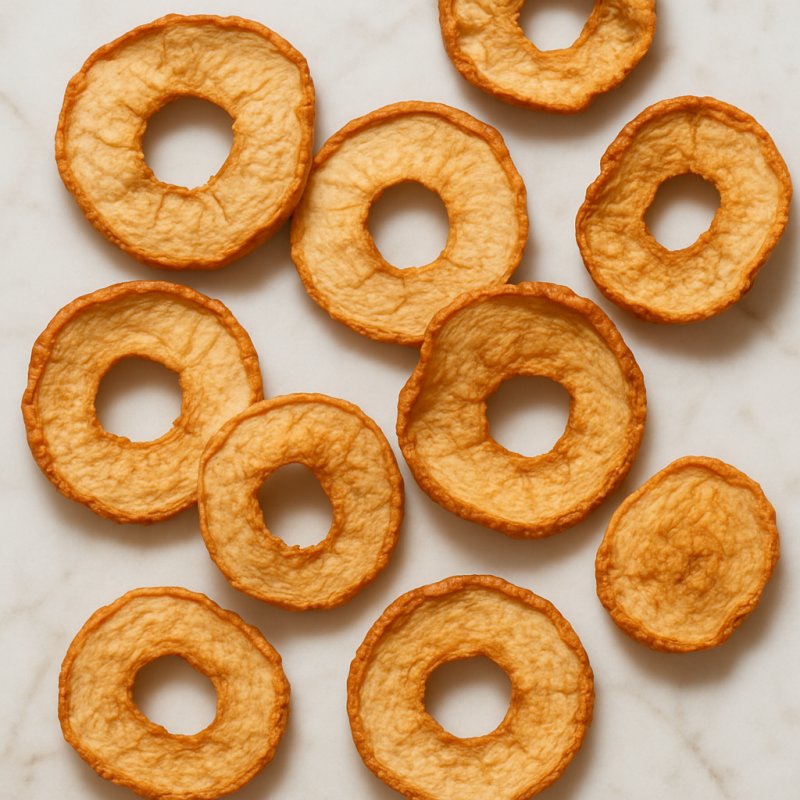
Availability & types
Availability and types of dried apples – it sounds technical at first, but it's simple to understand. Dried apples are fresh apples that have had their water removed so they last longer and become a small, practical snack. Today you can find them almost everywhere: in supermarkets, health-food stores, local markets and online. In many regions they are available year-round because drying prevents them from spoiling as quickly as fresh apples.
Origin and growing areas: Apples originally come from Central Asia (for example from the area of present-day Kazakhstan), but today they grow almost everywhere in the world where the climate is not too hot and not too cold. Important growing regions for apples that are later dried include:
- Europe: countries such as Poland, Germany, France and Italy
- North America: especially the US states of Washington and New York and parts of Canada
- China: one of the largest growing regions worldwide
- Turkey and parts of South America: depending on variety and climate
So when you buy dried apples, the fruit can come from many different countries. Often the pack states where the apples were grown. Organic apples are also widely available if you want to avoid many pesticides.
Available varieties and formats: Dried apples come in many forms and with various flavors. Here's an overview, simply explained:
- Apple rings: Thinly sliced, round pieces with the core hole visible. They are soft to chewy depending on how much they were dried.
- Apple slices / pieces: Small cubes or slices, good for muesli or baking.
- Apple chips: Very thin, crispy slices that crack like potato chips. They are often produced by baking or frying after drying.
- Freeze-dried apples: Water is removed from the frozen state. The result is very light, almost like an apple biscuit, and retains much flavor and nutrients.
- Sweetened or natural: Some dried apples are flavored with sugar or honey; others are dried with apple juice or completely natural.
- With additives: Sometimes they are briefly treated with a small amount of sulfite (sulfur) to keep them light. Sulfite sounds complicated but is just a preservative; sulfite-free variants are also available for sensitive people.
Popular apple varieties often used for drying include Golden Delicious, Gala, Granny Smith, Jonagold and Elstar. Each variety has its own taste: some are sweet, others more tart. For children you can explain it like this: it's like chips – there are different flavors depending on which “apple tree” produced the fruit.
In summary: Dried apples are easy to find and come in many forms – from soft rings to crispy chips. They can originate from different countries and be made from many apple varieties. The packaging usually states the variety and origin so you can find the product you like best.
Details & nutrition
| Property | Value |
|---|---|
| Unit | g |
| Average weight per piece | 5 |
| Calories per 100 | 243 |
| Protein per 100 | 1.3 |
| Carbohydrates per 100 | 65.0 |
| Sugar per 100 | 57.0 |
| Fat per 100 | 0.3 |
| Saturated fat per 100 | 0.1 |
| Monounsaturated fat | 0.1 |
| Polyunsaturated fat | 0.1 |
| Fiber per 100 | 8.0 |
| Vitamin C (mg) per 100 | 2.0 |
| Vitamin D (IU) per 100 | 0 |
| Calcium (mg) per 100 | 20 |
| Iron (mg) per 100 | 1.0 |
| Nutri-Score | C |
| CO₂ footprint | 1.8 kg CO2e/kg |
| Origin | EU/Germany (depending on batch) |
| Gluten-free | Yes |
| Lactose-free | Yes |
| Nut-free | Yes |
| Vegan | Yes |
| Note | Nutritional values may vary depending on apple variety and drying degree; assumed without added sugar. |
Technical & scientific information
Apple, dried refers to fruit pieces or slices of the cultivated apple (Malus domestica) from which most of the free moisture has been removed by water extraction. The drying process changes the physical structure, nutrient density and sensory properties of the fruit and makes it more durable, easier to store and more energy-dense than fresh apples.
Physical and microbiological properties
Drying typically reduces the moisture content to about 8–20%, which lowers water activity (aw). At aw < 0.6 most bacterial and yeast spoilage organisms are inactive, though molds and heat-resistant spores are not completely excluded. Cell walls partially collapse, producing a leathery to crispy texture depending on the process. Glass transition temperature and residual moisture content determine shelf life and crispness.
Chemical composition and nutritional values (typical ranges)
Dried apples are nutrient-concentrated; exact values vary by variety and processing. Typical values per 100 g are:
- Energy: approx. 200–320 kcal, depending on residual water and added sugar.
- Carbohydrates: 60–75 g, of which sugars (fructose, glucose, sucrose) 40–60 g.
- Fiber: 4–10 g, mainly pectin, cellulose and hemicelluloses.
- Proteins and Fats: very low, usually <1–2 g protein and <1 g fat.
- Minerals: potassium is most concentrated (several hundred mg/100 g), with traces of magnesium, calcium and iron.
- Vitamins: heat- and oxygen-sensitive vitamins like vitamin C are greatly reduced; lipophilic vitamins are low anyway.
Bioactive compounds
Dried apples contain concentrated polyphenols such as flavonoids (e.g. quercetin), flavanols (catechins) and apple-specific glycosides like phloridzin. These compounds have antioxidant effects; their amounts depend strongly on the drying method, with gentle methods preserving more polyphenols.
Processing methods
Common techniques are hot-air drying, freeze-drying (lyophilization), vacuum drying, osmotic drying and sun drying. Important technical aspects:
- Hot-air drying: economical, but causes shrinkage, Maillard reactions and aroma losses.
- Freeze-drying: best retention of structure, aroma and heat-sensitive compounds, but costly.
- Osmotic pretreatment: immersion in sugar solution reduces drying time but increases sugar content.
- Blanching and antioxidant treatments: use of sulfur dioxide, ascorbic acid or citric acid prevents enzymatic browning by polyphenol oxidase.
Health aspects
Dried apples provide fiber, which can positively influence bowel function and blood sugar control. However, concentration of sugars increases energy density, so portion sizes should be considered. The sticky consistency can increase caries risk. People with sulfite sensitivity should avoid products with sulfur dioxide. Birch-pollen allergic individuals may experience cross-reactions (PR‑10 proteins) with raw apple; drying and heating partially reduce these proteins.
Applications and storage
Dried apples are used as a snack, in muesli, baked goods, cereals and the food industry. To extend shelf life, dry, cool storage conditions and packaging that limit light and oxygen are advisable. Sensitive aromas and vitamins are best protected by freezing or vacuum packaging.
Overall, dried apple is a versatile, nutrient-concentrated product with technological potential and nutritional benefits, whose properties strongly depend on variety and drying method.
Wiki entry for: dried apple
Active now: 184
visitors
of which 2
logged-in members
in the last 5 minutes