Menu & categories

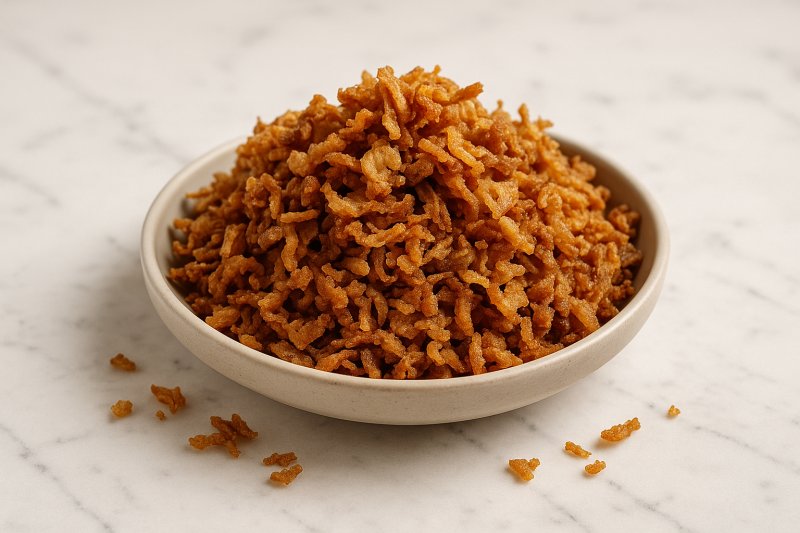
Crispy fried onions

Crispy fried onions as a savory garnish

Wiki about fried onion Nutri-Score D Vegan Yes Gluten-free No Lactose-free Yes Nut-free Yes
NUTRITION / 100 g
550 kcal 8 g Protein 40 g Kohlenhydrate 38 g Fett

Introduction

Crispy golden-brown fried onions
Crispy fried onions are for me one of those small culinary pleasures that elevate dishes from “good” to “irresistible.” When I think of the scent of freshly toasted onions, I immediately picture the golden, crunchy rings on a plate, quietly crackling. I still remember a rainy Sunday when I made a simple soup and, out of desperation, pulled a pack of crispy fried onions from the cupboard — the result was so convincing that a colleague asked the next day if I had tried a new recipe.

What makes crispy fried onions so fascinating is their versatility. They work as a garnish, a texture element and a carrier of flavor. On a sandwich they provide the crunch, in a casserole they bring a caramelized counterpoint, and in salads they add a salty, slightly smoky kick. It's these nuances that round out a dish without overpowering it.

Once I tried crispy fried onions to give depth to a simple potato gratin. I layered them between the potatoes and scattered a few more on top. The combination of a creamy interior and a crispy surface was such a hit that the host picked up the bag and said, 'The secret is in the onions.' Moments like that remind me how small ingredients can have big effects.

  • Taste: savory, slightly sweet, with smoky and caramel notes
  • Texture: crispy on the outside, sometimes still tender on the inside, depending on preparation
  • Use: as a topping for soups, salads and gratins, as an ingredient in fillings or as a snack
For me crispy fried onions are also an example of how practical solutions in the kitchen can inspire creative uses. I have amazed guests with a bowl of simple crispy fried onions sprinkled over a plain stew. It's not magic, but the play of heat, sugar and time that turns the onion into a golden delight.

So when I walk past the spice and snack aisle while shopping, I occasionally grab a bag of crispy fried onions because they let me shine improvisationally. They are not a loud ingredient, they don't demand attention, but they know exactly how to present a dish lovingly. And that is what makes them indispensable to me.

Availability & types

Availability and types of crispy fried onions

Crispy fried onions are small, crunchy pieces of onion often used as a topping on fries, soups or salads. They are available in many supermarkets, discount stores and delicatessens. You typically find them in jars, cans or bags as a ready product. Because they are already fried and seasoned, they can be used immediately — which is convenient when time is short.

Origin and cultivation areas

The onions used to make crispy fried onions are grown in many countries. Typical cultivation areas in Europe include countries such as Spain, the Netherlands and Poland. Onions are also grown in Germany. In warmer countries like Spain onions often grow faster and become large and juicy. In cooler regions, for example in northern Germany or the Netherlands, they grow more slowly, which can make them somewhat milder in flavor.

You can think of it like apples: different places give apples different characteristics. Likewise, climate, soil and rainfall change how onions later taste and look.

Available varieties and variants

  • Yellow onions: This is the most common variety for crispy fried onions. It has a robust, slightly sweet flavor and browns nicely when fried. Many ready products use yellow onions because they become very crispy.
  • White onions: This variety is a bit milder than the yellow onion. Crispy fried onions made from white onions taste somewhat more delicate and pair well with lighter dishes.
  • Red onions: Red onions are colorful and often have a sweet-sharp taste. As crispy fried onions they provide a pretty splash of color and a more intense flavor.
  • Sweet onions: Some manufacturers use particularly mild onion types that are naturally sweeter. These crispy fried onions are good when you don't want the flavor to be too sharp.
In addition to the pure onion varieties there are different preparation variants:

  • Classically fried: The onions are fried in fat until they are golden brown and crispy. This is the most common form found in jars.
  • Breaded or floured: Some crispy fried onions are lightly coated in flour or breadcrumbs before frying. This makes them extra crispy and gives them a firmer coating.
  • Spiced variants: There are crispy fried onions with added salt, paprika, pepper or herbs. This is practical when you want an immediate specific flavor profile, for example for grilled dishes.
  • Oil-free or reduced-fat: For people who want to eat less fat, some manufacturers offer reduced-fat versions. These are often prepared differently or made with less oil.
  • Organic and local: Those who value the environment and sustainable cultivation can also find organic crispy fried onions or ones from regional agriculture. Organic production uses fewer synthetic inputs.
For children it's like chips: some are simply salted, others are flavored like paprika or cheese. With crispy fried onions there are similar differences — except they are made from onions and are often crunchy and savory.

In summary: crispy fried onions come from different onion types and many countries. In the store you can find them in several styles — fried, breaded, seasoned, reduced-fat or organic. That way everyone can choose the variant that best suits their taste or a particular dish.
Details & nutrition

Property Value
Unit g
Calories per 100 550
Protein per 100 8
Carbohydrates per 100 40
Sugar per 100 8
Fat per 100 38
Saturated fat per 100 5
Monounsaturated fat 24
Polyunsaturated fat 9
Fiber per 100 6
Vitamin C (mg) per 100 5
Vitamin D (IU) per 100 0
Calcium (mg) per 100 80
Iron (mg) per 100 1.5
Nutri-Score D
CO₂ footprint 2.0
Origin Depending on the manufacturer, usually Europe or Asia; onions and vegetable oil processed industrially
Gluten-free No
Lactose-free Yes
Nut-free Yes
Vegan Yes
Note Nutritional values refer to industrially produced onions fried in vegetable oil with flour or breading. Composition may vary by manufacturer; if intolerant to gluten, check the ingredient list.

Technical & scientific information

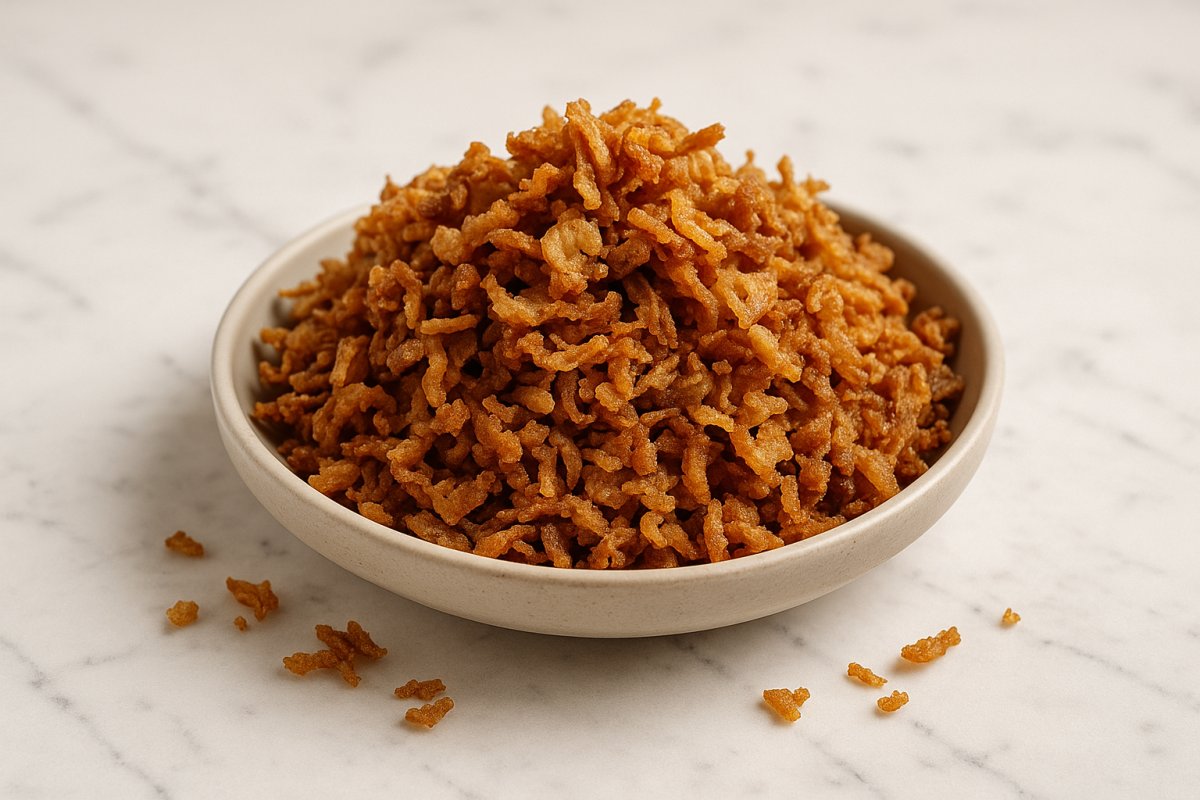
Crispy fried onions are thinly sliced or chopped pieces of onion browned in fat or fried until they are golden and crispy. They are used as an ingredient, garnish or snack and are characterized by an intense, caramelized flavor resulting from the thermal breakdown of sugars and Maillard reactions. Industrially produced crispy fried onions are often offered packaged as dried or dehydrated, while homemade variants are freshly fried in oil. The texture-defining attributes and the aroma are closely related to the onion varieties used, cut thickness, temperature control and the type of fat employed.

Chemical and physical fundamentals
When onions are heated several chemical processes run in parallel. Enzymatic breakdown of cell walls releases free sugars and amino acids. At temperatures above about 120 °C Maillard reactions between reducing sugars and amino acids are triggered, leading to brown pigments (melanoidins) and a complex aroma profile made up of hundreds of volatile compounds. At the same time caramelization occurs, where sugars thermally decompose producing sweet, nutty notes. As water is lost, the firmness of the cell structure increases, which together with the formation of a fat-impregnated, porous crust explains the crispy texture.

Ingredients and nutritional values
Fundamentally crispy fried onions consist mainly of carbohydrates (primarily sucrose, glucose, fructose and fiber), small amounts of protein and fat from the frying or cooking medium. Typical nutritional values vary widely depending on the production method: freshly oil-fried crispy onions have a high fat content (often 30–50 g/100 g), while air-dried or freeze-dried variants contain significantly less fat but more concentrated carbohydrates. Onions also supply minerals like potassium, small amounts of vitamin C and secondary plant compounds, including sulfur compounds (e.g. thiosulfinates) and flavonoids such as quercetin, whose content is reduced by heating but partly transformed into other bioactive metabolites.

Processing methods
The most common procedures include:

  • Direct frying: Thin onion slices are fried in oil at 160–190 °C until browned; this leads to rapid Maillard reactions and high fat uptake.
  • Gentle roasting: At lower temperatures and longer times a more even aroma develops with fewer burnt notes.
  • Dehydration/air drying: After pre-cooking or blanching onion pieces are dried to improve shelf stability; this enables easier rehydration and lower fat content.
  • Freeze-drying: Preserves full aroma and texture with minimal nutrient loss, but is costly.
Health aspects
Crispy fried onions provide flavor enrichment but also nutritional consequences. Fried variants are energy-dense and can contain high amounts of saturated and undesirable fatty acids, depending on the oil used and repeated reuse of frying fat. Heat degradation reduces some heat-sensitive vitamins and certain sulfur compounds, yet new Maillard products may form with antioxidant or pro-oxidant effects; the health significance of these new compounds is complex and context-dependent. People with histamine or fructose intolerance as well as those sensitive to fried foods should moderate their consumption. From a microbiological perspective dry, airtight packaging is stable, whereas improper storage of fresh crispy fried onions can lead to fat oxidation and rancid off-flavors.

Sensory properties and culinary use
Sensorily browned onions shape flavor through a combination of sweet, bitter and umami-like notes. They are employed as a topping for salads, soups, gratins and sandwiches and serve as a flavor source in roast fillings and sauces. Industrial products are often seasoned or contain additives such as antioxidants to stabilize color and flavor.

In summary, crispy fried onions are a chemically complex product whose aroma and texture result from thermal processes like Maillard reactions and caramelization. Nutritionally they provide flavor and some secondary plant compounds but may be energy-dense depending on production method. For quality and shelf life cut thickness, temperature control, fat quality and storage conditions are decisive, which is why both artisanal and industrial production processes should be carefully managed.

Wiki entry for: fried onion
Active now: 18 visitors of which 2 logged-in members in the last 5 minutes