Menu & categories

Cognac

French brandy with a distinctive aroma

Wiki about cognac Nutri-Score E Vegan Yes Gluten-free Yes Lactose-free Yes Nut-free Yes
NUTRITION / 100 ml
239 kcal 0 g Protein 0 g Kohlenhydrate 0 g Fett

Introduction

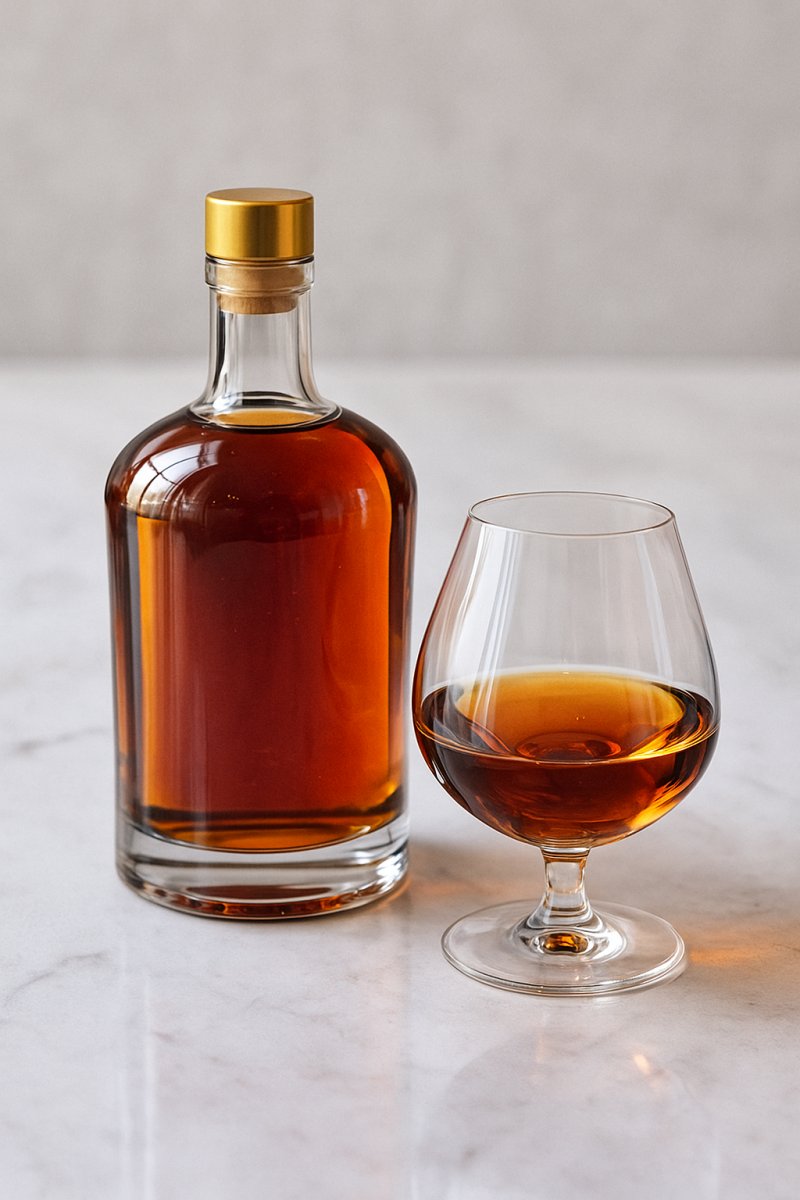
A glass of cognac with amber-colored liquid
I still clearly remember my first conscious moment with Cognac: a colleague handed me a small glass after a long evening, and the aroma was like a secret letter from another time. At first I thought of warm spices and dried fruit, then came the velvety warmth that takes the cold out of your fingers. For me Cognac is not simply a brandy; it is a small library of stories in every bottle.

What I love about Cognac is its complexity. Made from white wine grapes, distilled and aged in oak barrels, each vintage tells of climate, soil and craftsmanship. When I smell aromas of vanilla, toffee, plum or nut while tasting, I think of the careful decisions of the house and cellar masters. A friend once joked you could read the handwriting of a whole village in a good bottle of Cognac — and that's how it feels.

In the kitchen I use Cognac just as gladly as I do for drinking afterwards. A splash for flambéing peaches or in a cream sauce for mussels lifts the flavors without being overpowering. I have learned that less is often more; a good Cognac complements rather than overwhelms. At a dinner with friends I saw how a simple risotto with a spoonful of Cognac at the end suddenly sparked a whole conversation about travels and French cellars.

A few things I like to explain to audiences and colleagues:

  • Region: Cognac comes from the eponymous region, and origin influences character.
  • Maturation: Oak gives color and tannins; the aromas develop over years.
  • Assemblage: Many Cognacs are blends where experience decides which casks belong together.
For me Cognac is the drink that invites pause — a glass you don't throw away but fill with stories. At the last family gathering a bottle suddenly appeared on the table, and within minutes memories, laughter and new recipes were born. Thus Cognac connects tradition with company, taste with narrative, and that is exactly what makes it so irresistible to me.

Availability & types

Availability and types of Cognac

Cognac is a special brandy from France. You can think of it like a very fine grape juice that was first fermented and then distilled multiple times and aged for a long time. It comes only from a specific area in France, similar to how only Champagne may come from the Champagne region. That makes Cognac known and popular worldwide.

Origin and growing areas
Cognac is produced exclusively in the Cognac region in the southwest of France. This region is divided into several zones called Crus. The best known are:

  • Grande Champagne – considered the best zone; very fine and aromatic Cognacs are born here.
  • Petite Champagne – similarly good to Grande Champagne; Cognacs from both zones are often blended.
  • Borderies – a smaller zone with its own, floral aromas.
  • Fins Bois, Bons Bois and Bois Ordinaires – these zones lie further out and often produce fruitier or more rustic notes.
You can imagine the Crus like different schoolyards: on each yard the grapes grow somewhat differently because soil and weather differ. That later influences the taste of the Cognac.

Available varieties and types
Cognac is available in different kinds, often named after the ageing period. This is like shoes that come in short, medium and long sizes — only here "longer" in a wooden cask often means "riper" and stronger in taste.

  • VS (Very Special) – the youngest Cognac on the shelves. It has been aged at least two years in oak barrels. It is fresh and relatively light in taste.
  • VSOP (Very Superior Old Pale) – aged at least four years. It is rounder and has more aromas like vanilla or fruit.
  • XO (Extra Old) – aged significantly longer, at least ten years (current rule). Such Cognacs are very smooth, complex and often have notes of chocolate, nuts or dried fruits.
  • Hors d'Age / Extra / Antique – terms for very old and particularly precious Cognacs that often age for a very long time and are expensive.
There are also flavored or mixed variants that are combined with other drinks, as well as special bottlings from single vintages or cellars. Sometimes the bottle also indicates from which Cru the grapes come, or whether the Cognac comes from a producer's personal collection.

Availability in trade
You can find Cognac in many supermarkets, liquor stores and online. The inexpensive types like VS are easy to obtain, while very old XO or special bottlings are rarer and more expensive. Small producers or special vintage Cognacs are often available only in specialist stores or directly from the producer.

If you want to give Cognac as a gift or try it, it's good to know whether the recipient prefers fruity, light or very complex and old aromas. A comparison: a young VS Cognac is like a crisp apple, while a very old XO tastes more like a piece of dark chocolate with nuts. That way you can more easily choose what fits best.
Details & nutrition

Property Value
Unit ml
Calories per 100 239
Protein per 100 0
Carbohydrates per 100 0
Sugar per 100 0
Fat per 100 0
Saturated fat per 100 0
Monounsaturated fat 0
Polyunsaturated fat 0
Fiber per 100 0
Vitamin C (mg) per 100 0
Vitamin D (IU) per 100 0
Calcium (mg) per 100 2
Iron (mg) per 100 0
Nutri-Score E
CO₂ footprint 1.5 kg CO2e pro 0,7l Flasche
Origin France, Cognac region
Gluten-free Yes
Lactose-free Yes
Nut-free Yes
Vegan Yes
Note Alcoholic beverage (approx. 40 % vol.). Not suitable for children, pregnant women and people with alcohol intolerance.

Technical & scientific information

Cognac is an aged brandy produced exclusively in the French Cognac region under strict legal regulations. Chemically, it is a distillate of fermented grape must whose main constituent is ethanol. Besides ethanol, Cognac contains a complex mixture of organic compounds, including alcohols, esters, aldehydes, acids, phenols and terpenes, which together determine aroma, taste and mouthfeel.

Raw materials and basic chemistry: For Cognac production primarily white grape varieties are used, above all Ugni Blanc (Trebbiano). These varieties provide a must with relatively high acidity and low sugar content, which is converted to ethanol during fermentation. Alcoholic fermentation (yeasts of the Saccharomyces species) converts monosaccharides into ethanol and carbon dioxide; alongside ethanol, by-products such as higher alcohols (fusel oils) and organic acids are formed.

Distillation: Cognac is distilled twice in copper Charentais stills. Distillation is a fractionating process: by heating, more volatile components evaporate earlier and are concentrated in the distillates. Copper acts catalytically and removes undesirable sulfur-containing compounds, improves the purity of the distillate and influences the formation of esters. The distillate destined for ageing typically has an alcohol strength of around 70% vol.

Aging and chemical development: Aging takes place in oak barrels, mostly from French Limousin or Tronçais oak. During storage numerous chemical reactions occur:

  • Extraction of wood components such as lignin degradation products (vanillin), tannins and hemicelluloses.
  • Oxidation of small aldehydes and alcohols to acids or other derivatives.
  • Ester formation between alcohols and acids, producing fruity and floral aromas.
  • Micro-oxygenation via exchange through the wood pores, which promotes softer flavor profiles.
Ingredients and nutritional values: The main components are water and ethanol. Cognac contains practically no significant amounts of macronutrients such as carbohydrates, proteins or fats. Nutritional values vary with alcohol content; 100 ml at 40% vol. provide approximately 250–270 kcal, primarily from ethanol (≈7 kcal/g). Trace elements and organic aroma compounds are present in milligram to microgram amounts and contribute to sensory complexity.

Sensory and analytical characterization: Typical sensory features are produced by an interplay of ester and phenol compounds; gas chromatography coupled with mass spectrometry (GC–MS) is routinely used to identify and quantify these volatile compounds. Older Cognacs show higher concentrations of less volatile polymers and oxidation products, while younger distillates contain more fruity esters.

Health aspects: Like all alcoholic beverages, Cognac is primarily relevant for health because of its ethanol content. In the short term ethanol acts as a central nervous system depressant and can be toxic in larger amounts; long-term consumption increases the risk of liver disease, certain cancers and dependence. On the other hand, secondary plant substances and aroma components are discussed in popular media and partly in scientific literature as having antioxidant or anti-inflammatory effects; however, robust health benefits from moderate Cognac consumption are not conclusively established.

Legal and quality criteria: The designation Cognac is protected by an Appellation d'Origine Contrôlée (AOC). Legal requirements regulate harvest area, grape varieties, distillation method, minimum alcohol content of the distillate, barrel types and age designations (e.g. VS, VSOP, XO). These regulations ensure defined product quality and promote traceability of production steps.

In summary, Cognac is a complex alcoholic product shaped by distillation and cellulose- and lignin-mediated aging processes. Its chemical complexity and sensory finesse result from the combination of grape variety choice, microbial fermentation, the catalytic influence of copper in distillation and enzymatic and chemical transformations during oak barrel aging. From a health perspective ethanol content is the decisive factor; aromatic accompanying substances, despite their small mass fraction, decisively shape the taste experience.

Wiki entry for: cognac
Active now: 18 visitors of which 2 logged-in members in the last 5 minutes