Menu & categories

Coconut fat

Vegetable fat with high heat stability

Wiki about coconut oil Nutri-Score D Vegan Yes Gluten-free Yes Lactose-free Yes Nut-free Yes
NUTRITION / 100 g
892 kcal 0 g Protein 0 g Kohlenhydrate 100 g Fett

Introduction

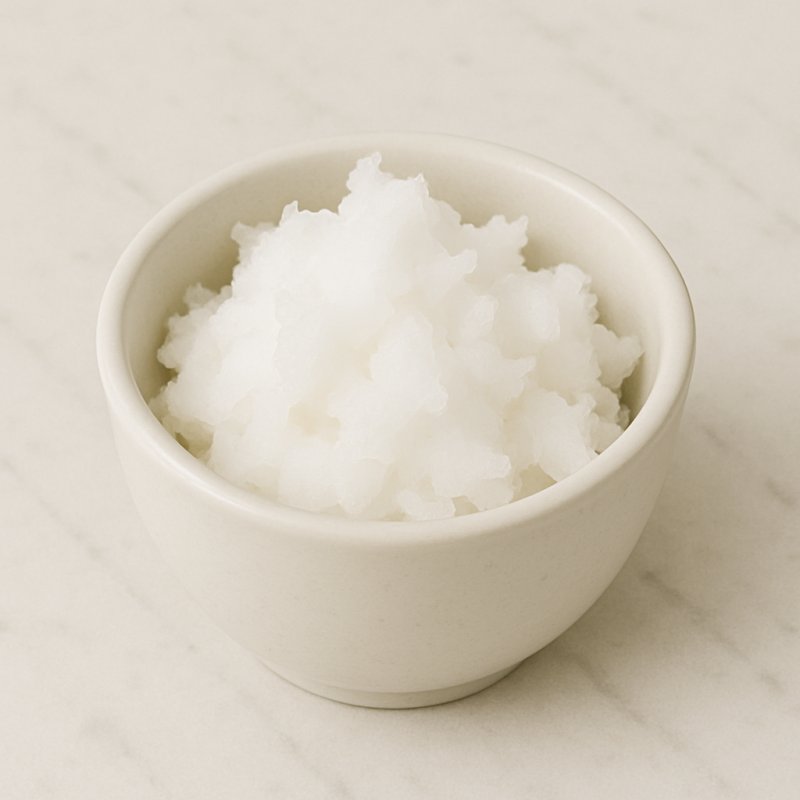
Coconut fat in a glass container
Coconut fat has accompanied me professionally and privately for years: as an editor in my mid-thirties from Europe I regularly research ingredients that have a place both in modern cooking and in traditional recipes. Hardly any ingredient polarizes as charmingly as coconut fat. It is versatile, long-lasting, aromatic – and in some kitchens the quiet star. At the same time it raises questions: Is it healthy? How does it differ from coconut oil? And what is it best used for? In this introductory text I examine origin, production, characteristics, uses, storage and small anecdotes that show why coconut fat is more than just an exotic ingredient.

When we talk about coconut fat, in Europe we often mean a refined product that is solid at room temperature and has a high proportion of saturated fatty acids. Technically it is usually refined, deodorized coconut oil, which due to its fatty acid composition solidifies already at about 24 to 26 degrees Celsius. In everyday life this leads to pleasant handling: it hardly splatters in the pan, has a high smoke point and can be portioned sharply with a knife. A colleague of mine who helps out in a small bakery swears by it, because his pastries made with coconut fat get an even, crispy structure without an intrusive inherent taste dominating.

Originally coconut fat comes from the tropics, especially from countries like the Philippines, Indonesia, Sri Lanka or India. Oil is extracted from the whitish flesh of the coconut, which is then cleaned and, if necessary, deodorized. The result is a neutral-tasting fat that convinces in international kitchens as well as in the home pan. I remember a trip to Lisbon: in a small café I was served pastéis with a filling whose delicate texture the pastry chef, winking, attributed to his “secret fat” – it was coconut fat, as he later revealed.

In terms of composition coconut fat is rich in saturated fatty acids, particularly lauric acid. This structure gives it stability at heat. However, it makes sense to seek balance in

Availability & types

Availability and types of coconut fat

Coconut fat is a fat obtained from the flesh of the coconut. It is easy to obtain in many countries, especially where a lot of baking or frying is done. In supermarkets you often find coconut fat on the shelf with oils and fats or in the baking section. Health food stores and Asian shops often have even more selection. Online shops also offer special variants, for example particularly mild or extra virgin coconut fat.
Important: the term “coconut fat” is sometimes used differently. Many mean a solid, neutral-tasting fat (often “coconut fat, hydrogenated” or “Palmin” in Germany). Others understand coconut fat simply as coconut oil, which also becomes solid at cooler temperatures due to its fatty acids. Both come from the coconut but have different production methods and properties.

Origin

The coconut palm grows in tropical regions. Main growing areas include, among others:

  • Southeast Asia: Indonesia, Philippines, Thailand
  • South Asia: India, Sri Lanka
  • Pacific and Oceania: Papua New Guinea, Fiji
  • Latin America and Africa: Brazil, Ivory Coast
There coconuts are harvested, the white flesh (copra or fresh grated coconut) is dried or processed directly. Pressing produces the oil which, depending on processing, becomes soft coconut oil or the solid, particularly neutral coconut fat.

What is coconut fat made of?

Coconut fat is composed mainly of saturated fatty acids. For this reason it is often solid at room temperature, especially when cool. It melts roughly between 20 and 26 degrees Celsius. That is practical for baking and frying because it is heat-stable and less likely to burn quickly.

Important types and varieties

  • Virgin

Details & nutrition

Property Value
Unit g
Calories per 100 892
Protein per 100 0
Carbohydrates per 100 0
Sugar per 100 0
Fat per 100 100
Saturated fat per 100 86
Monounsaturated fat 6
Polyunsaturated fat 2
Fiber per 100 0
Vitamin C (mg) per 100 0
Vitamin D (IU) per 100 0
Calcium (mg) per 100 0
Iron (mg) per 100 0
Nutri-Score D
CO₂ footprint 2.6 kg CO2e/kg
Origin Tropical regions (e.g. Southeast Asia)
Gluten-free Yes
Lactose-free Yes
Nut-free Yes
Vegan Yes
Note Smoke point approx. 200–230 °C; ideal for frying and sautéing. Neutral to slightly coconut-like, depending on refinement.

Technical & scientific information

Coconut fat (also called coconut oil or coconut kernel oil) is a vegetable fat obtained from the dried flesh of the coconut (Cocos nucifera). At temperatures below about 24–26 °C it is solid to semi-solid, above this it becomes liquid-oily. Characteristic are the high oxidation stability, the high content of medium-chain saturated fatty acids and pronounced heat resistance. In food technology, cosmetics, pharmaceuticals and industrial applications coconut fat serves as a structuring, flavoring and technologically robust raw material.

Origin and extraction: Coconut fat is obtained primarily from copra (dried coconut kernel pieces) or from fresh coconut flesh. The processes include mechanical pressing (cold-pressed/virgin), wet processing by centrifugation and hot pressing with subsequent refining. Refined, bleached and deodorized qualities (RBD) are neutral in taste and show low levels of free fatty acids. Unrefined qualities retain volatile aroma components, including lactones, which impart the characteristic coconut aroma.

Chemical composition: Coconut fat consists of about 99% triglycerides. The fatty acid content is strongly saturated; typical profiles (mass percentages) are: lauric acid (C12:0) about 45–53%, myristic acid (C14:0) 16–21%, palmitic acid (C16:0) 7–11%, caprylic acid (C8:0) 5–9%, capric acid (C10:0) 4–8%, stearic acid (C18:0) 2–4%, oleic acid (C18:1) 5–8%, linoleic acid (C18:2) 1–2%. The proportion of medium-chain triglycerides (MCT; C8–C12) is high, which entails particular metabolic and technological properties. Accompanying substances include tocopherols/tocotrienols in small amounts, phytosterols, polyphenols (especially in unrefined oils).

Wiki entry for: coconut oil
Active now: 17 visitors of which 2 logged-in members in the last 5 minutes