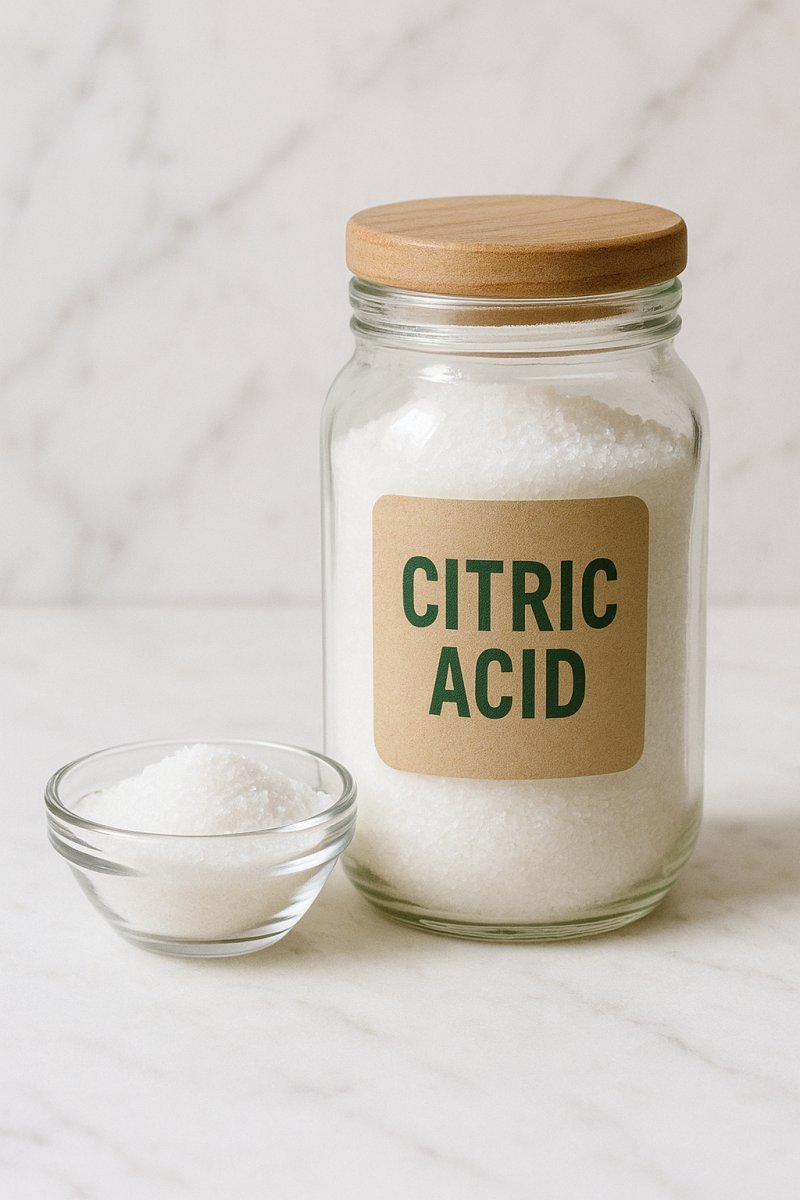
Availability and types
Citric acid is a very common ingredient found in many households. It occurs naturally in many fruits, especially lemons and other citrus. You can imagine it like this: when you bite into a lemon and it tastes sour, that is the citric acid you taste. Today, however, citric acid is usually not produced from whole fruits because it is simpler and cheaper to manufacture it industrially.
Origin and production
There are two ways citric acid is produced:
- Naturally in fruits: Small amounts come directly from lemons, oranges and other fruits.
- Industrial production: It is usually produced by fermentation. That means: a special fungus – not a dangerous mold, but a useful microorganism – “eats” sugar (for example from corn or sugar beet) and produces citric acid. It is similar to yogurt production, where bacteria turn milk into yogurt.
Growing regions and producing countries
Because industrial production often needs sugar as a raw material, citric acid comes from countries that grow a lot of corn, sugar beet or sugarcane and have large factories. Important producers include:
Because industrial production often needs sugar as a raw material, citric acid comes from countries that grow a lot of corn, sugar beet or sugarcane and have large factories. Important producers include:
- China – the largest producer worldwide
- India, Brazil and the USA – also significant producers
- In Europe it is also produced, for example from sugar beet sugar
Available types and variants
Citric acid comes in different forms – similar to sugar: there are sugar cubes, granulated sugar and powdered sugar. The main types are:
Citric acid comes in different forms – similar to sugar: there are sugar cubes, granulated sugar and powdered sugar. The main types are:
- Food grade: This is the most commonly sold variant for cooking, baking or beverages. It is very pure and safe to eat.
- Pharmaceutical grade: Even purer than food grade, used in medicines or certain laboratory applications.
- Technical or cleaning grade: Cheaper but not suitable for consumption. It is used for descaling, cleaning or in industrial plants.
- Anhydrous and monohydrate: These are two forms that differ by whether a small amount of water is bound in the crystal or not. For most household uses this is not important.
- Powder, crystals or solutions: You can buy it as a fine powder, coarse crystals, or already dissolved in liquid.
- Organic/bio: Some manufacturers offer citric acid from organic sugar sources or without genetically modified raw materials.
Where to get citric acid?
It is easy to find:
It is easy to find:
- Supermarkets: small packets for the kitchen
- Drugstores: often as an additive for cleaning or preservation
- Online shops: many varieties and larger quantities
- Specialist dealers and chemical suppliers: for specific qualities
When you buy citric acid, pay attention to the quality: food grade is for consumption, cleaning grade is not. Just as you wouldn't use baking sugar for car care, you should choose the right type. Overall, citric acid is readily available, comes either naturally from fruits or industrially from sugar, and there are different variants depending on the intended use.
