Menu & categories

Chocolate chips

Small chocolate pieces for baking and decorating

Wiki about chocolate chip Nutri-Score E Vegan No Gluten-free Yes Lactose-free No Nut-free No
NUTRITION / 100 g
500 kcal 5.0 g Protein 60.0 g Kohlenhydrate 27.0 g Fett

Introduction

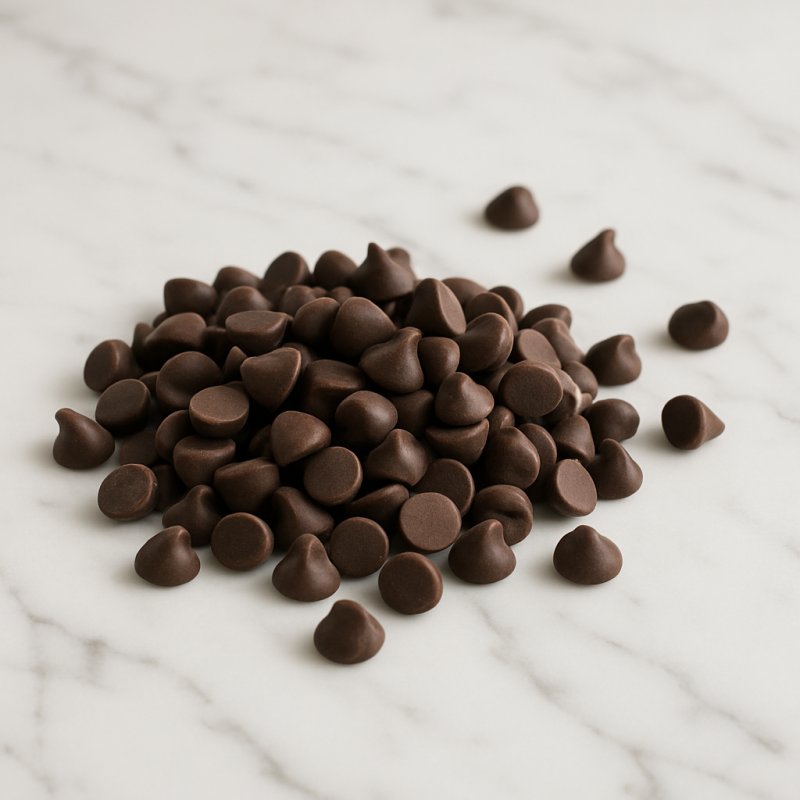
Close-up of chocolate chips
I have a small weakness: chocolate chips. They are more than just an ingredient to me; they are a kind of culinary comfort patch that has a place in every kitchen. When I think of warm cookies fresh from the oven, I see those shiny, half-melting spots in front of me and remember Sunday afternoons when the house smelled of vanilla and caramel. A friend once brought a bag to the office, and within minutes the bowl was empty — small pleasures can disappear that quickly.

Chocolate chips are practical, versatile and incredibly patient. You throw them into the dough and they preserve their shape, yet melt in the oven just enough so that every bite contains a small, liquid offering of happiness. In my notes there are also a few surprising uses: muesli gets a chocolatey kick, savory sauces can be finished with a pinch of dark chocolate, and I even once tried chocolate chips in a crunchy salad dressing — an experiment that worked oddly well.

It's not only the taste and texture that fascinate me, but also the simple rituals around them. I still remember how, as a young baking novice, I first struggled with the question of whether to melt the chips or leave them whole. A colleague advised me to melt half and leave the other half whole — the result was a visually and tastefully successful recipe. Since then I do that more often: liquid comforters and crunchy bites in one.

For me chocolate chips also stand for accessibility. They are found in almost every supermarket, in different cocoa percentages, with vegan or reduced-sugar variants. I like to experiment and find the balance between sweetness and intensity. Small tips I like to pass on:

  • Watch the temperature: At too high a heat they can melt completely, at moderate heat they remain spottily creamy.
  • Vary the mix: Dark and light chips together give depth of flavor.
  • Texture play: Combining whole and melted chips creates excitement in the mouth.
In the end chocolate chips are one of those ingredients that make baking easier and the result more tempting. They remind me that small things often provide the greatest joys — and that sometimes it's enough to add a handful of chocolate chips to a simple dough to conjure a smile.

Availability & types

Availability and types

Chocolate chips are small pieces of chocolate found in many baked goods and sweets. They are usually easy to obtain because they are sold in supermarkets, health food stores, bakeries and online. Some sellers package them in large bags for home use, others offer special varieties in small packets for bakers or cafés. If you're looking for chocolate chips you'll often find them in the baking aisle next to flour and sugar or with the confectionery.

The main ingredient of chocolate chips is chocolate, and the chocolate itself comes from the cocoa tree. Cocoa beans grow in warm and humid areas, mostly in countries near the equator. Well-known growing regions include West Africa (for example Ghana and the Ivory Coast), South America (like Ecuador and Brazil) and parts of Asia (for example Indonesia). You can think of it as a large, warm greenhouse where many trees grow and farmers harvest the beans.

There are different types and variants of chocolate chips. Here are the main ones, explained simply:

  • Dark chocolate chips: These chips have less sugar and taste somewhat more bitter. They are good if you like an intense chocolate flavor, similar to dark chocolate.
  • Milk chocolate chips: These are sweeter and creamier because they contain milk components. Many children particularly like this variety because it tastes soft and mild.
  • White chocolate chips: Technically they are not "real" chocolate because they contain no cocoa mass but cocoa butter. They are very sweet and have a light color, almost like vanilla.
  • Semi-sweet chocolate: This is a middle ground between dark and milk chocolate — less sweet than milk chocolate but milder than dark.
  • Sugar-free or with sweeteners: For people who need or want to eat less sugar, there are chocolate chips without normal sugar. Instead, sugar substitutes are used. They often taste a bit different, but serve the same purpose in baking.
  • Vegan or lactose-free variants: These chips contain no milk components and are intended for people who do not eat dairy. Instead of milk, plant-based milk or no milk at all is often used.
  • With add-ins: Some varieties have extra things like caramel, nuts, mint or cookie pieces in them. It's like a surprise effect that gives the baked goods additional flavor.
The shape and size can also vary: often they are small round drops, sometimes cut as chips or pieces. For certain recipes there are also larger chunks or very fine sprinkles. When baking it is important to know which chocolate you are using — for example milk chocolate melts differently than dark — but for cookies most varieties are suitable.

If you want to buy chocolate chips you can consider different things: the label states the chocolate type, the sugar and fat content, and sometimes where the cocoa comes from. Those who like to try can experiment with different varieties to see which tastes best — like trying different ice cream flavors until you find your favorite.

Overall chocolate chips are very versatile and available in many variants so there is something for every taste — whether you prefer it sweet and mild, strong and bitter or completely without milk.

Details & nutrition

Property Value
Unit g
Calories per 100 500
Protein per 100 5.0
Carbohydrates per 100 60.0
Sugar per 100 55.0
Fat per 100 27.0
Saturated fat per 100 16.0
Monounsaturated fat 8.0
Polyunsaturated fat 1.0
Fiber per 100 4.0
Vitamin C (mg) per 100 0
Vitamin D (IU) per 100 0
Calcium (mg) per 100 60
Iron (mg) per 100 2.5
Nutri-Score E
CO₂ footprint 3.5 kg CO2e/kg
Origin Depending on the manufacturer, often EU
Gluten-free Yes
Lactose-free No
Nut-free No
Vegan No
Note Nutritional values for typical milk chocolate chips for baking; exact values may vary depending on manufacturer and cocoa and sugar content.

Technical & scientific information

Chocolate chips are small, usually conical or round confectionery pieces made of chocolate or chocolate-like masses that are used as an ingredient in the food industry and in private baking applications. Typically they consist of a cocoa-containing mass that is shaped into drop-shaped particles by molding or extrusion. Chocolate chips are offered in various types, including dark, milk and white chocolate, and may contain different proportions of cocoa solids, milk components, sugar and additives depending on the recipe.

Chemical composition and ingredients
The basic components of chocolate chips are cocoa mass, cocoa butter, sugar and, if applicable, milk powder or milk components in milk chocolate. White chocolate chips contain no cocoa mass but exclusively cocoa butter, sugar and milk components. Emulsifiers such as lecithin (soy- or sunflower-based), which improve viscosity and processing properties, are often added, as well as flavors (e.g. vanillin). The exact composition varies by manufacturer; in vegan or reduced-sugar variants different cocoa mass proportions, sweeteners (e.g. isomalt, erythritol) or plant-based milk alternatives are used.

Nutritional values
Chocolate chips are energy-dense: 100 g typically contain 450–600 kcal depending on the type. Macronutrient-wise fat (mainly from cocoa butter) and sugar dominate. Typical ranges per 100 g are:

  • Fat: 25–40 g (of which saturated fatty acids from cocoa butter and milk fats)
  • Carbohydrates: 45–60 g (of which sugars: 40–55 g)
  • Protein: 4–8 g (higher in milk chocolate due to milk powder)
  • Fiber and minerals: variable depending on cocoa content; dark variants provide more polyphenols and some magnesium, iron and potassium
Processing methods
The manufacture of chocolate drops is similar to that of chocolate bars, with adjustments for shaping. After mixing the raw materials the particles are conched to develop texture and aroma, and subsequently tempered to produce stable crystal forms of cocoa butter. For the drop shape dosing is done into molds or by injection molding on conveyor belts; subsequent cooling and demoulding ensure mechanical stability. Industrial processes often use continuous extrusion and vibrating nozzles to ensure uniform size and shape. Small defects, such as sweating surfaces during baking, result from insufficient tempering or moisture uptake.

Sensory and functional properties
Chocolate chips are intended to keep their shape during baking, partially melt or form soft cores, depending on recipe and processing. A high cocoa butter content promotes a clear melting behavior and improved "melt-in-the-mouth" effect, while additives can improve shape stability under heat. The content of cocoa solids influences taste depth, bitterness and aromatic complexity; dark chips deliver more intense polyphenols and roast flavors.

Health aspects
From a nutritional perspective, chocolate chips should be considered a calorie-dense ingredient with limited nutritional value when consumed in larger quantities due to their high sugar and fat content. Dark chocolate chips with higher cocoa content, however, contain flavonoids and other polyphenols that are attributed antioxidant effects and potentially beneficial effects on endothelial function and blood pressure when consumed in moderation. Allergens can include milk components, soy lecithin or traces of nuts; manufacturer labeling is therefore important for allergy sufferers. Sugar-free variants may contain sweeteners or sugar substitutes that need to be tolerated gastrointestinally.

Storage and quality
Chocolate chips are sensitive to light and heat: storage in cool, dry conditions (ideally 12–20 °C, low humidity) preserves shine and prevents blooming (fat or sugar bloom). Bloom occurs through recrystallization of fats or sugars on the surface and affects only appearance, not necessarily food safety. Quality control includes organoleptic tests, moisture and fat analyses and microbiological tests for products with milk content.

Overall chocolate chips are a versatile ingredient with specific physico-chemical and nutritional properties, whose characteristics strongly depend on cocoa content, milk components and the manufacturing process. Consumers should pay attention to ingredient lists and storage instructions, while food technologists should design formulations and tempering so that desired baking properties and stability are achieved.

Wiki entry for: chocolate chip
Active now: 17 visitors of which 2 logged-in members in the last 5 minutes