Menu & categories

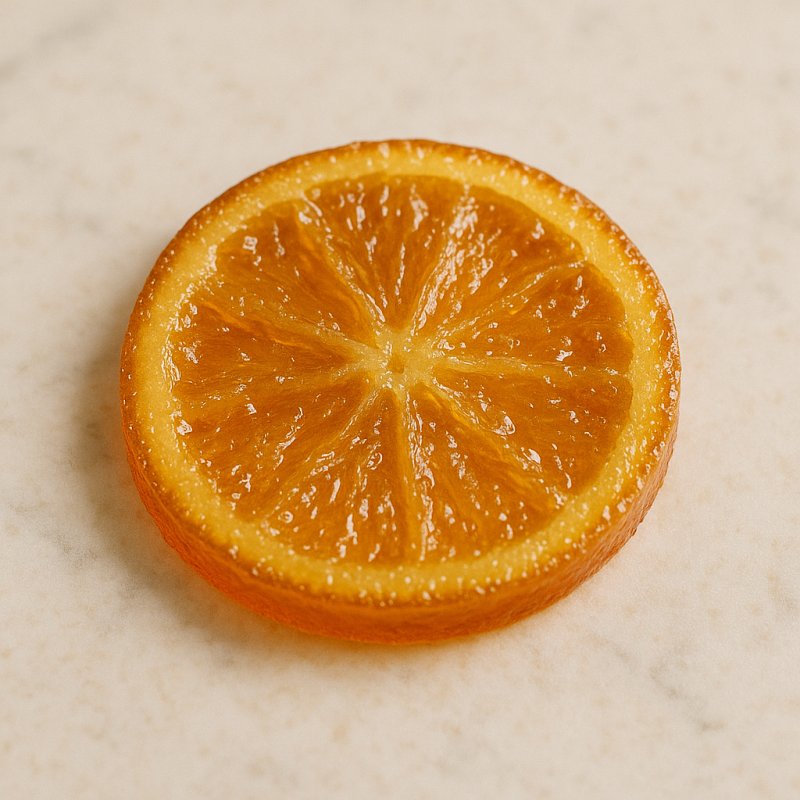
Candied orange slice

Sweet-aromatic orange slice, candied in sugar.

Wiki about candied orange slice Nutri-Score E Vegan Yes Gluten-free Yes Lactose-free Yes Nut-free Yes
NUTRITION / 100 g
320 kcal 0.5 g Protein 80 g Kohlenhydrate 0.2 g Fett

Introduction

Candied orange slices on a plate
Candied orange slice is, for me, one of those small culinary pleasures that feel both nostalgic and surprisingly modern. I still clearly remember a rainy Sunday afternoon when I first tried a crisp, glossy slice on a piece of chocolate and thought: Why hadn't I discovered this sooner?

The candied orange slice is made when thin slices of oranges are slowly candied in sugar syrup and then dried. The result is a perfect balance of tangy freshness and sweet caramel, with a slightly chewy texture at the edge and a silky core. I often keep small jars at home because they are so versatile.

When I want to offer guests something special, I artfully arrange a few slices on cheese boards or crumble them over yogurt. A colleague once brought a box to the Christmas party, and suddenly all desserts were garnished with an orange slice before they were even photographed. That showed me how much such small details can set the mood.

  • Culinary use: Perfect with dark chocolate, in desserts or on bread.
  • Culinary tips: Thinly sliced pieces candy faster and more evenly.
  • Storage: Kept dry and airtight, the flavor stays for several weeks.
I have also tried candying orange slices myself, and yes, it takes patience. The syrup must simmer gently, and turning the slices requires a delicate touch. But when the scent of caramelized orange fills the kitchen, it makes every minute worthwhile. Sometimes I refine the syrup with a clove or a cardamom pod to add a warm, spicy note.

For me the candied orange slice is more than just an ingredient; it is a small stylistic device that can elevate everyday dishes to a new level. Whether wrapped as a gift in cellophane, used as a topping or enjoyed as a standalone snack — it brings light and flavor to the simplest moments.

Availability & types


Availability and types of candied orange slices

A candied orange slice is an orange slice that has been preserved in sugar and dried so that it keeps for a long time and tastes sweet. You can think of it like jam: the fruit is protected by sugar, except that with candied slices it remains whole or in large pieces. This treat exists in many variants and can be found almost everywhere.

Origin and growing regions
Oranges grow mainly where it is warm and sunny. Typical countries that supply oranges for candied slices are:

  • Spain – many oranges and often good quality for confectionery.
  • Italy – known for aromatic varieties and traditional production.
  • Turkey – large producer of candied fruits.
  • Morocco and Tunisia – also important suppliers.
  • USA (California, Florida) and South Africa – supply fresh fruit seasonally.
Sometimes oranges also come from China, Brazil or other warm regions. Producers choose the region depending on taste and price.

Available orange varieties
There are different types of oranges used for candied slices. The most important are:

  • Valencia – juicy and sweet, often for juice, but also good for candying.
  • Navel – thick-skinned and easy to peel, sweet and mild.
  • Blood orange – has a red coloration and a slight berry aroma; yields pretty reddish slices.
  • Bitter orange (Seville) – very aromatic, often used for marmalade and special candyings.
Variants and shapes
Candied orange slices come in several variants. Here are some easily recognized examples:

  • Whole slices – round "wheels" from the orange, nice for decorating cakes.
  • Half slices or strips – practical shape for baking or snacking.
  • With peel or without – some like the bitter peel, others prefer only the flesh.
  • Chocolate-coated – dipped halfway or fully in chocolate, a popular combination.
  • Organic variants – made without artificial additives, sometimes more expensive.
  • Glacé fruits – very glossy and soft, often confectionery quality.
Availability in trade
You can find candied orange slices in supermarkets, delicatessens, bakeries, and online. Because sugar preserves them, they are available year-round. However, quality can vary: there is inexpensive mass-produced product and handcrafted, high-quality slices. If you want fruity flavor and good color, pay attention to producer information such as country of origin or organic certification.

In summary: Candied orange slices come from warm growing regions around the Mediterranean, southern Europe, Turkey and sometimes further afield. There are different orange varieties and many shapes — from the simple sugared wheel to the chocolatey treat. Because sugar preserves well, they are practically available year-round and in many price ranges.
Details & nutrition

Property Value
Unit g
Average weight per piece 10
Calories per 100 320
Protein per 100 0.5
Carbohydrates per 100 80
Sugar per 100 70
Fat per 100 0.2
Saturated fat per 100 0.0
Monounsaturated fat 0.0
Polyunsaturated fat 0.1
Fiber per 100 2.0
Vitamin C (mg) per 100 2
Vitamin D (IU) per 100 0
Calcium (mg) per 100 30
Iron (mg) per 100 0.3
Nutri-Score E
CO₂ footprint 1.6
Origin EU (e.g. Spain/Italy; depending on the manufacturer)
Gluten-free Yes
Lactose-free Yes
Nut-free Yes
Vegan Yes
Note Candied orange slices typically contain added sugar; nutritional values may vary depending on sugar content and manufacturing process.

Technical & scientific information


Definition and description
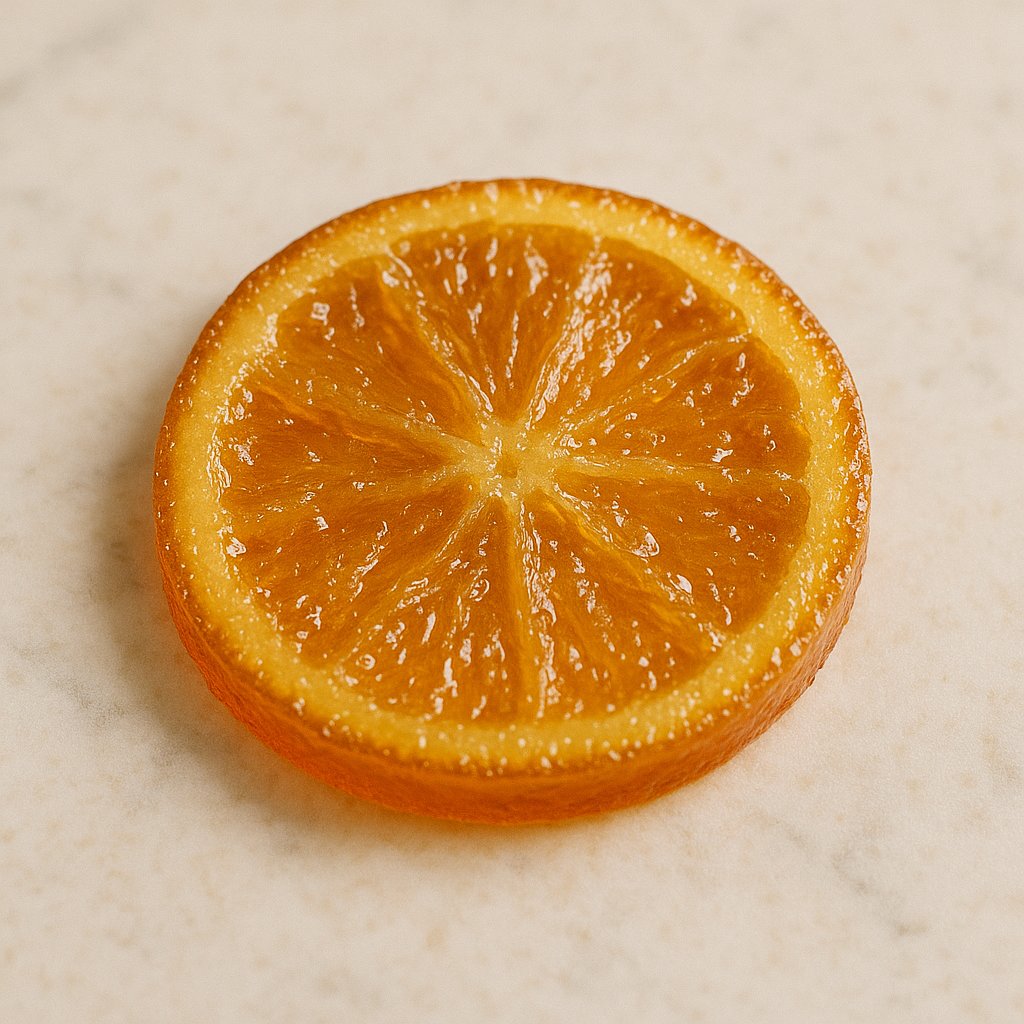
A candied orange slice is a slice of the peel and flesh of an orange that has been preserved and flavored by a controlled sugar treatment process. Candied orange slices have a translucent, glossy surface and a soft to chewy texture, depending on drying level. They are produced industrially or artisanally and are used as an ingredient in baked goods, confections and as a garnish.

Chemical composition and constituents
The composition of a candied orange slice differs from fresh orange mainly due to the high sugar content. Important components are:

  • Monosaccharides and disaccharides: Mainly sucrose, as well as glucose and fructose from the sugar syrup used.
  • Organic acids: Primarily citric acid and to a lesser extent ascorbic acid (vitamin C), whose content is reduced by heating.
  • Flavonoids and polyphenols: Hesperidin, narirutin and other bioflavonoids remain largely in the peel and have antioxidant properties, although partially degraded.
  • Essential oils: limonene and other terpenes in the peel contribute to the characteristic aroma; some may evaporate or change during processing.
  • Dietary fiber and pectins: structure-forming polysaccharides from the peel remain and influence texture and gel formation.
Nutritional values (typical values per 100 g)
Candied orange slices are energy-dense due to the high sugar content. Typical nutritional values fall in the following range:

  • Energy: 300–360 kcal
  • Carbohydrates: 70–85 g (of which sugars 60–80 g)
  • Protein: 0.5–1.5 g
  • Fat: <1 g
  • Dietary fiber: 1–4 g
  • Water content: 10–30 % (depending on drying level)
Processing methods and physico-chemical processes
Production is based on osmosis and heat application: after cutting, orange slices are briefly blanched to reduce bitter compounds and then immersed in multistage sugar syrups. Through osmotic water loss and sugar uptake, the concentration of dissolved solids in the fruit peel changes. Subsequent cooking and controlled drying cause tissue thickening. Technical aspects include:

  • Osmotic dehydration: water diffuses out of the tissue, sugar diffuses in.
  • Glass transition and crystallization: avoiding unwanted crystal formation by correct syrup concentration and drying temperatures.
  • Water activity (aw): reduced aw lowers microbial growth; typical values are below 0.7.
  • Preservation: sulfites or antioxidants may be used to stabilize color and aroma; their use is subject to labeling requirements.
Health aspects
Candied orange slices are high in energy and sugar and should therefore be consumed in moderation. Positive aspects include the presence of flavonoids and pectin, which may have antioxidant and gelling properties. Drawbacks are the high sugar content with risk of dental caries and increased caloric intake. Sensitivities to sulfites should be considered. Heat-sensitive vitamins such as vitamin C are greatly reduced during processing, so candied fruits are no longer a reliable source of vitamin C.

Storage and culinary use
Properly stored, candied orange slices are long-lasting; kept dry, protected from light and cool and shielded from moisture, they retain aroma and texture. They are used as a baking ingredient, in chocolates, as decoration and in traditional recipes because they bind moisture, concentrate flavor and provide decorative accents.

Overall, the candied orange slice combines the natural chemical components of the orange with physico-chemical transformations due to osmosis, heat and drying, with the main nutritional consideration being the high sugar content and the altered vitamin profile to take into account.

Wiki entry for: candied orange slice
Active now: 20 visitors of which 2 logged-in members in the last 5 minutes