Menu & categories

Candied bitter orange peel

Candied peel of bitter oranges, aromatic-sweet and fruity

Wiki about candied orange peel Nutri-Score D Vegan Yes Gluten-free Yes Lactose-free Yes Nut-free Yes
NUTRITION / 100 g
320 kcal 0.5 g Protein 80 g Kohlenhydrate 0.2 g Fett

Introduction

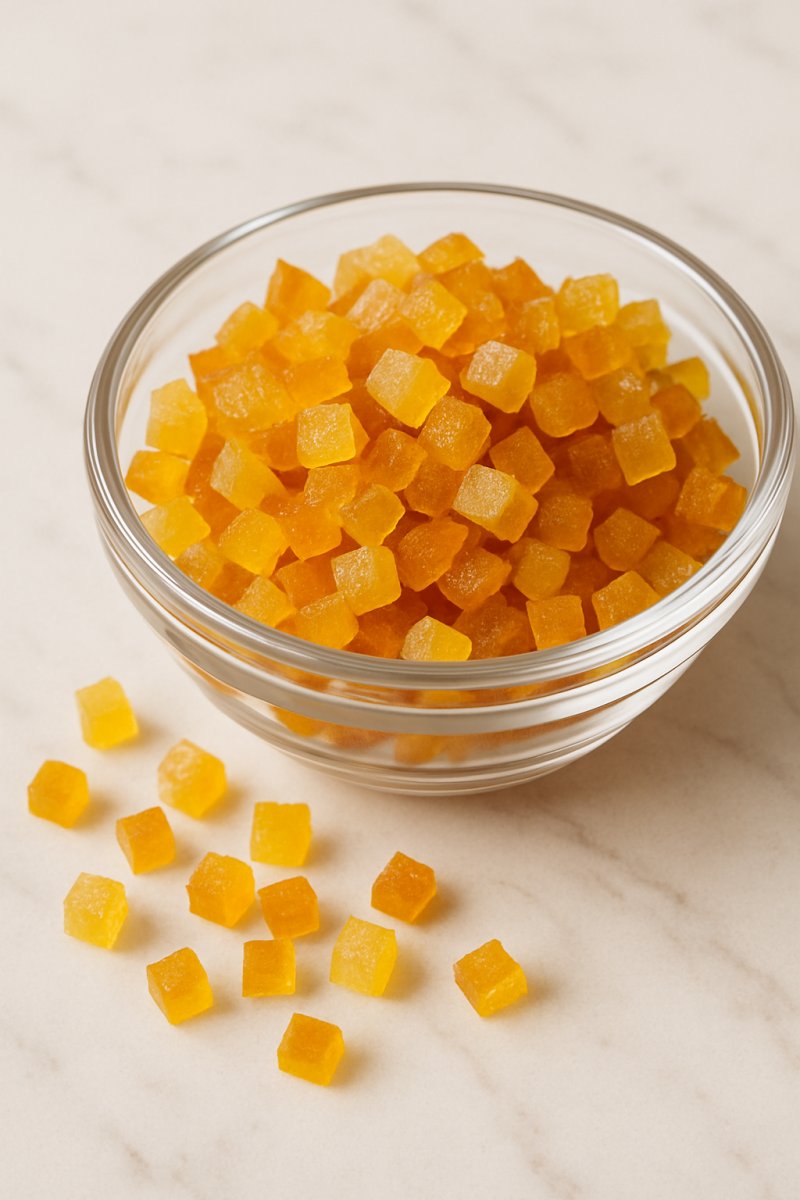
Cubes of candied bitter orange peel on a wooden board
I still remember the first scent of candied orange peel that greeted me when I opened a tin: concentrated, sun-warmed bitter-orange peel, sweet but with a surprising, astringent depth. Since then candied orange peel has held a steady place in my kitchen, not only as an ingredient for classic holiday cakes but as a small flavour miracle that subtly enlivens baked goods and desserts. When I smell it, I immediately feel the anticipation for rich stollen, gingerbread or those old-fashioned sponge cakes that taste like childhood.

My relationship with candied orange peel is pragmatic and a little sentimental. A colleague once brought a piece of orange cake to the office in which gold-orange streaks were hidden. I asked what it was, and he mentioned the word so casually, as if it were obvious. After that I began to study the baking shelf more closely and experimented with different brands and textures.

What is candied orange peel? Candied orange peel is the candied rind of bitter or sweet oranges, cut into thin strips or cubes. The peel is first blanched, then cooked in sugar syrup and usually dried. The result is a firm, aromatic ingredient that combines sweetness and bitterness and delivers big impact in small amounts.

Typical uses:

  • In classic Christmas bakes like stollen or panettone
  • As an aromatic kick in fruit bread, cookies and sponge cakes
  • Chopped as a surprise element in chocolate desserts or glazes
  • Sometimes in savory sauces or paired with cheese as a contrast
I like how candied orange peel feels both down-to-earth and exotic. Once I opened a packet and forgot to seal it airtight; the flat smelled for days of orange marmalade and old Christmas markets. When I tell guests about candied orange peel I often get surprised looks — many only know freshly grated lemon or orange zest. Yet a teaspoon of candied peel can transform a recipe without dominating it.

When shopping I pay attention to colour and texture: natural amber tones and a slightly tacky, not glassy surface are, to me, signs of good quality. I store candied orange peel cool and airtight to preserve the aroma. For bakers and lovers of small bursts of flavour, candied orange peel is a loyal, often underrated pantry companion.

Availability & types

Availability and types of candied orange peel

Candied orange peel is peeled, cut into small pieces and candied orange rind. You will often find it in traditional baking recipes such as stollen, fruit bread or panettone. Availability here means where you can buy candied orange peel and how easy it is to find. In supermarkets candied orange peel is usually in the baking aisle next to raisins and citron. In well-stocked food shops or delicatessens there are often different brands. If you can't find it in store, you can easily order candied orange peel online — many online shops offer small and large packs. During the Christmas season candied orange peel is especially easy to obtain, because it is often used for cookies and festive baking.

Origin and growing regions

Candied orange peel comes from the peel of the orange. Orange trees prefer warm summers and milder winters. Important growing regions include:

  • Mediterranean region – Countries like Spain, Italy and Greece grow many oranges. The climate there is sunny and warm, which makes the oranges very juicy.
  • Brazil – Brazil is a huge producer of oranges and supplies a lot for juice and processing.
  • USA (Florida) – Florida is known for oranges, especially for orange juice, but also for fruit whose peels can be further processed.
  • Other warmer regions – for example South Africa or Australia, which also grow oranges.
The exact origin may be indicated on the packaging. Sometimes candied orange peel is also made from oranges that are specifically destined for processing or whose juice has been used for other purposes.

Available varieties and forms

Candied orange peel does not come in a single form. Here are the main variants you may find when shopping:

  • Coarsely chopped candied orange peel – The pieces are larger and feel a bit more “chewy.” This is good if you want the little piece to be noticeable in a cake.
  • Finely chopped candied orange peel – Very small pieces, almost like crumbs. It distributes more evenly in the dough and you taste the orange everywhere.
  • Dried candied orange peel – A bit drier, but longer lasting. Sometimes it is not so “juicy,” but useful if you want to store it a long time.
  • Candied orange peel (classic) – This is the classic form: the peel is cooked with sugar, giving it a sweet, glazed surface. This is the candied peel most people know.
  • Organic candied orange peel – Made from oranges grown organically without synthetic pesticides. For people who prefer organic products.
  • Flavour-enhanced variants – Sometimes candied orange peel is enhanced with extra orange juice or oil to make it smell and taste even more strongly of orange.
When choosing candied orange peel you can consider whether you want larger or finer pieces, whether you need extra shelf life or prefer organic. A simple tip: if the candied peel is nicely glossy and smells sweet, it has most likely been freshly processed.

In summary: candied orange peel is readily available, especially in the baking season, typically comes from warm growing regions like the Mediterranean or Brazil, and is sold in coarse or fine pieces, candied or dried, and in organic quality. This lets you pick the right type for your recipe and taste.

Details & nutrition

Property Value
Unit g
Calories per 100 320
Protein per 100 0.5
Carbohydrates per 100 80
Sugar per 100 78
Fat per 100 0.2
Saturated fat per 100 0.05
Monounsaturated fat 0.05
Polyunsaturated fat 0.05
Fiber per 100 2
Vitamin C (mg) per 100 5
Vitamin D (IU) per 100 0
Calcium (mg) per 100 40
Iron (mg) per 100 0.3
Nutri-Score D
CO₂ footprint 1.8
Origin Mostly from the Mediterranean region, processed in Europe
Gluten-free Yes
Lactose-free Yes
Nut-free Yes
Vegan Yes
Note Made by candying the peel of bitter oranges; high sugar content, commonly used in baked goods such as stollen and fruit cakes.

Technical & scientific information

Candied orange peel denotes the candied rinds of bitter or sweet oranges used in food production as an aromatic ingredient. Traditionally candied orange peel is made from the outer peel (zest) and often also from the white mesocarp (the so-called albedo), which is preserved in sugar syrup and subsequently dried or further processed. The characteristic combination of bitter, aromatic compounds and sugar makes candied orange peel a staple of baked goods, confectionery and traditional festive recipes.

Composition and constituents
Chemically, candied orange peel consists primarily of sucrose with smaller amounts of glucose and fructose that are deposited into the peels during the candying process. The plant constituents contain essential oils with main components such as limonene, myrcene, citral and linalool, which are responsible for the typical orange aroma. Additionally, the peel contains flavonoids (e.g. hesperidin, narirutin), carotenoids and small amounts of vitamin C. The concentration of these secondary plant compounds varies depending on orange variety, harvest time and processing method.

Manufacturing process
The production of candied orange peel involves several steps that decisively influence organoleptic properties and shelf life:

  • Selection and cleaning of the fruit: intact, untreated peels are preferred, since pesticide residues on the outer peel can be problematic.
  • Peeling and, if necessary, removal of the most bitter inner part: depending on the recipe, only the outer zest or also the albedo is processed.
  • Blanching: brief boiling in water reduces bitter compounds and softens cell walls, facilitating uptake of the sugar syrup.
  • Candying: repeated immersion in increasingly concentrated sugar syrup solutions until the solids are largely impregnated with sucrose.
  • Drying and preservation: drying to defined moisture levels and, if necessary, treatment with further sugar or alcohol solutions for microbial stabilization.
Nutritional values
Nutritionally, candied orange peel is energy-dense due to its high sugar content. Per 100 g of candied peel there are typically around 300–350 kcal, almost entirely from carbohydrates (sugars). The content of fiber, vitamins and minerals is reduced compared with the fruit flesh, since the bulk is predominantly sugar. Nevertheless, relevant amounts of secondary plant compounds, particularly flavonoids and essential oils, may be retained.

Sensory properties and applications
Sensorially, candied orange peel provides a combination of intense orange aroma, sweetness and a subtle residual bitterness. Textural properties range from soft to slightly chewy depending on water content after candying. Common applications include:

  • Baked goods such as stollen, panettone, cookies and cakes
  • Chocolate, pralines and nougat
  • Confectionery and decoration
  • Use in beverages or liqueur infusions as a flavoring agent
Food safety and health aspects
Important food safety aspects include control of microbial contamination prior to candying and minimization of pesticide residues on the peel. The high sugar content inhibits growth of most microorganisms, but hygienic measures during production are still necessary. Sensitive individuals should be aware of the high sugar content; candied orange peel contributes significantly to calorie intake and excessive consumption can contribute to dental problems. Allergic reactions to citrus oils are rare but can occur in sensitive persons. Due to its essential oils, candied orange peel can cause gastrointestinal discomfort in some people at high doses.

Quality criteria and storage
High-quality candied orange peel is characterised by an intense, natural orange aroma, an even candying without excessive crystallisation and a clean, clear colour. For storage, dry, cool, light-protected conditions in airtight containers are recommended to prevent aroma loss and oxidation of the essential oils. When stored properly, candied orange peel remains stable for months.

Overall, candied orange peel is a versatile, aroma-intense ingredient with a clearly defined chemical and sensory signature that is primarily a source of sugar nutritionally, but—thanks to the essential oils and secondary plant compounds in the peel—makes an important flavour and functional contribution to traditional and modern recipes.

Wiki entry for: candied orange peel
Active now: 20 visitors of which 2 logged-in members in the last 5 minutes