Menu & categories

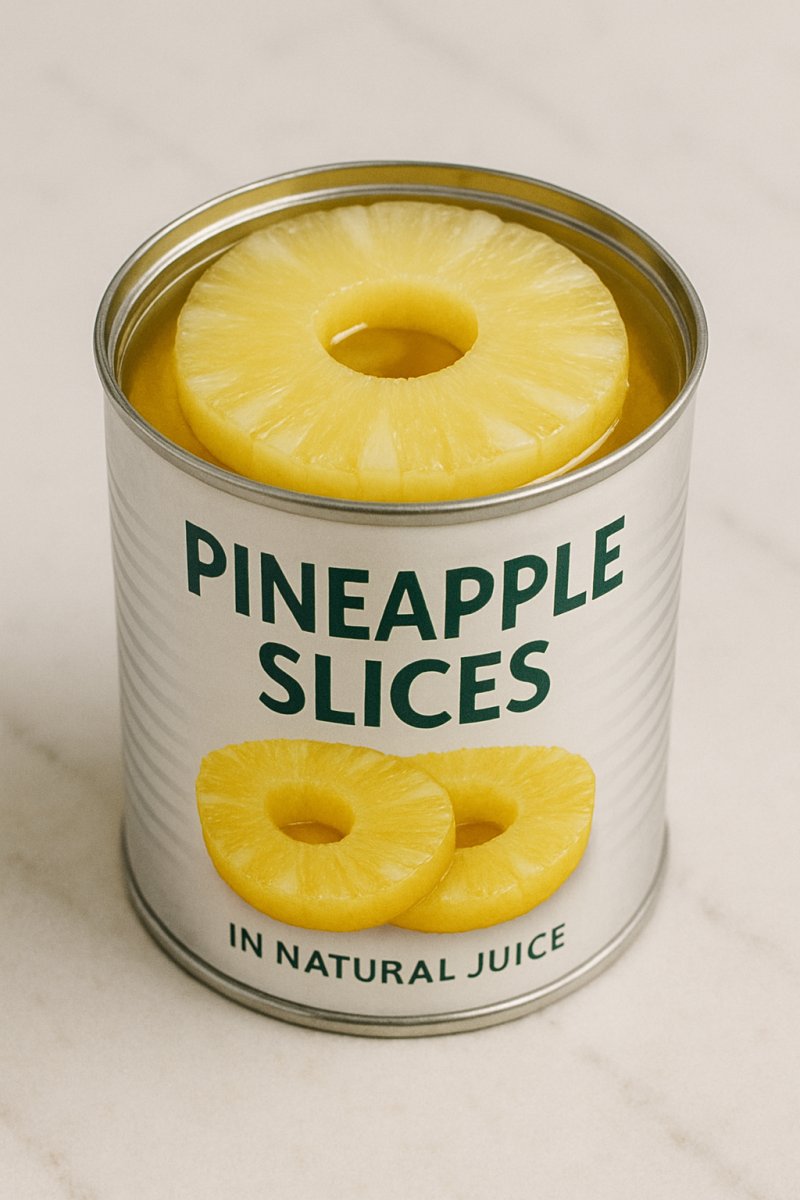
Canned pineapple

Sweet, preserved pineapple pieces in their own juice or syrup

Wiki about can of pineapple Nutri-Score B Vegan Yes Gluten-free Yes Lactose-free Yes Nut-free Yes
NUTRITION / 100 g
68 kcal 0.4 g Protein 16.5 g Kohlenhydrate 0.1 g Fett

Introduction

Canned pineapple pieces in a bowl
I still clearly remember the first can of pineapple I placed in my kitchen after a rainy weekend market shopping trip: the bright yellow shimmered almost like a little sunrise among the canned goods, and suddenly my fridge felt less pragmatic and more full of possibility. A can of pineapple is for me more than a pantry item; it is a small culinary journey into a moment where time pressure meets flavor. I love how uncomplicated it is when the fresh fruit is not available or is too expensive.

In my pantry the can has taken on many roles. It provides quick desserts when guests bring surprises, and it rescues spontaneous salads when I forgot to shop. A colleague of mine swears that pineapple slices from a can are the cherry on a simple but foolproof pizza. I tried it and had to admit: surprisingly delicious. The preserved sweetness and the mildly tart note often balance salty ingredients better than I expected.

Of course I don't use canned pineapple only plain. It is ideal for:

  • refreshing fruit salads that can be mixed quickly;
  • marinated meat dishes where the fruit's acidity tenderizes;
  • light desserts like trifle or combined with coconut cream.
When buying I look for simple ingredient lists without unnecessary added sugar and for more sustainable packaging options, because I care about the environment. Sometimes I open a can while reading an old cookbook and let myself be inspired by recipes that use pineapple as a surprising counterpoint to spicy flavors. Once I organized an improvised grill night with friends where pineapple slices caramelized directly on the grate — the aroma was unmistakable and became the little sensation of the evening.

In summary the can of pineapple for me is a practical, versatile and often unexpectedly refined ingredient. It brings color, sweetness and structure to dishes and ensures that cooking ideas do not fail because fresh fruit is unavailable. Especially in current everyday life it is a reliable companion that brightens the kitchen and the mood in an instant.

Availability & types

Availability and types

A can of pineapple is a practical way to have pineapple year-round. Fresh pineapple grows in warm countries, but it is not available everywhere all year. That is why many pineapples are harvested, processed and canned so they can be bought in supermarkets at any time.

Origin
Pineapples originally come from South America, specifically areas like Brazil and Paraguay. Today they grow in many tropical countries, where it is warm and sunny. Known growing regions include:

  • Thailand – a large country that produces a lot of pineapple and ships many cans around the world.
  • Philippines – also an important producer of pineapple products.
  • Brazil – where the fruit originally comes from and where a lot is still grown.
  • Kenya and some countries in Central America – they also grow pineapple for international supply.
You can imagine it like this: farmers grow pineapples in rows in fields, harvest them, cut them into pieces, cook or briefly preserve them and then pack them into cans. This way the pineapple stays fresh enough to be sold in supermarkets around the world.

Available varieties and variants
There are different varieties and variants of pineapple in cans so there is something for every taste. The main differences are:

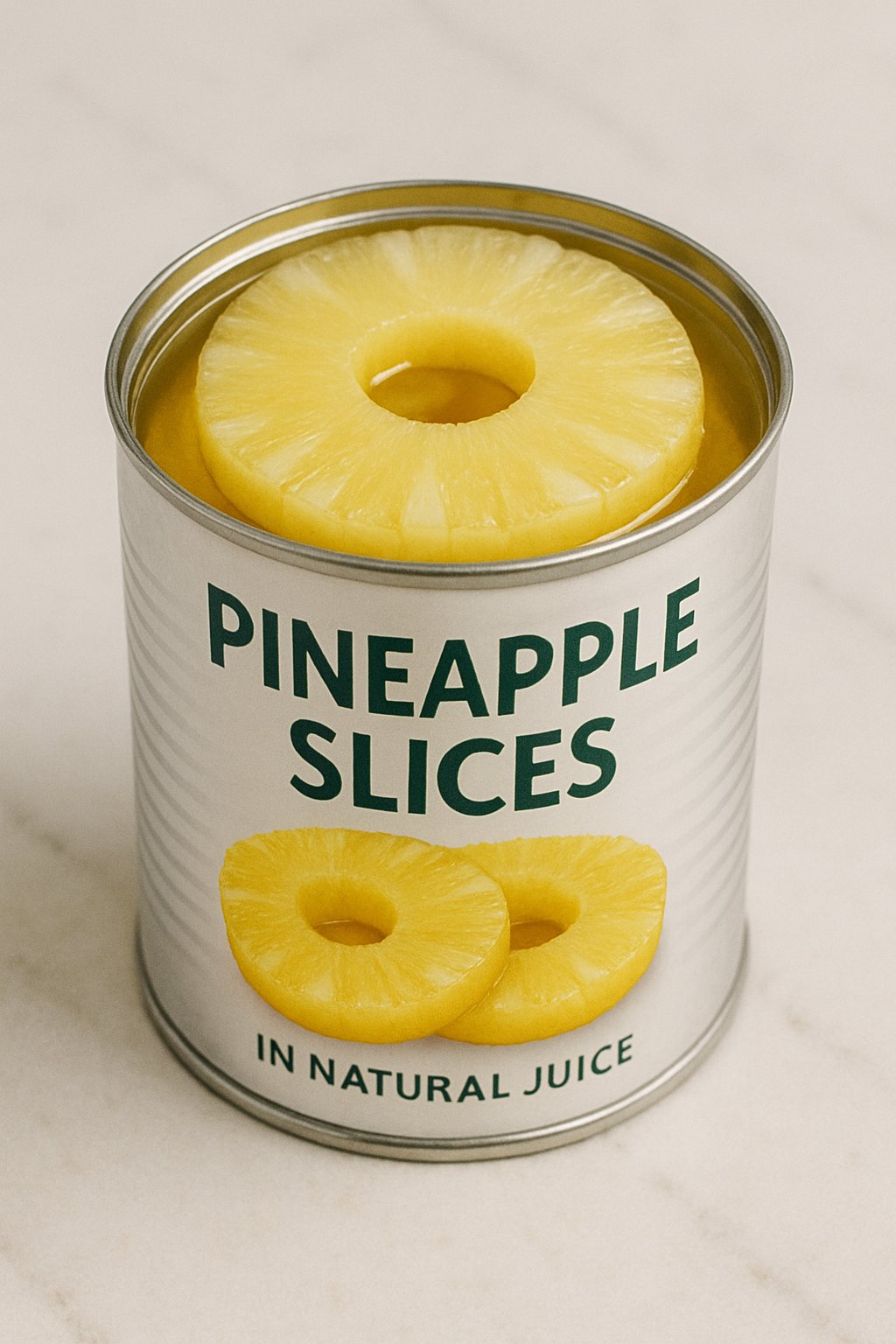
  • Forms: Pineapple pieces can come as slices (rings), cubes or chunks. Rings are good for decoration or on pizzas, cubes are practical for fruit salad and chunks are versatile for many recipes.
  • Can contents: Some cans contain only pineapple and juice, others have pineapple in syrup. Juice is usually lighter and less sweet because it is just the fruit's juice. Syrup is sweeter because sugar has been added — it's like making a lemonade extra sweet.
  • Sugar content: There are light or reduced-sugar variants for people who want less sugar. These cans are like a lighter version.
  • Flavors: Sometimes pineapple is also packaged together with other fruits in a can, e.g. fruit salad with mandarins or peaches.
  • Organic or conventional: Organic pineapple is grown without certain chemical pesticides. This is important for some people who care about the environment and natural farming methods.

A simple comparison: imagine pineapple cans are like a pack of different pens. Some are colorful (different fruits), some are particularly light (juice instead of syrup), and others are intended as a light version. All serve the same purpose – tasty pineapple ready at any time – just with small differences depending on what you like.
In most supermarkets you will find several brands and variants, especially in the canned goods section. When you shop you can check the label to see whether the pineapple is in its own juice, in syrup or reduced sugar. That way you know exactly what you are buying and can choose the can that best suits your taste.
Details & nutrition

Property Value
Unit g
Calories per 100 68
Protein per 100 0.4
Carbohydrates per 100 16.5
Sugar per 100 15.5
Fat per 100 0.1
Saturated fat per 100 0.01
Monounsaturated fat 0.01
Polyunsaturated fat 0.02
Fiber per 100 1.0
Vitamin C (mg) per 100 8
Vitamin D (IU) per 100 0
Calcium (mg) per 100 13
Iron (mg) per 100 0.3
Nutri-Score B
CO₂ footprint 0.7
Origin Tropical growing countries, processed and preserved in cans
Gluten-free Yes
Lactose-free Yes
Nut-free Yes
Vegan Yes
Note Nutritional values for drained canned pineapple pieces in their own juice; values may vary slightly depending on brand and sugar content.

Technical & scientific information

Can of pineapple refers to peeled, cored and usually cut into pieces, rings or wedges pineapple fruit that has been preserved in cans under vacuum or in sterilization containers. Canned pineapple is industrially processed to ensure shelf life and sensory properties. Preservation is usually in syrup (sugar solution) or a water-based beverage liquid; some products also have natural fruit juice filling or reduced-sugar variants.

Composition and ingredients

  • Fruit components: The main components of pineapple are water (≈85–90 %), carbohydrates (mainly fructose, glucose and sucrose), fiber (especially pectin and cellulose) as well as small amounts of protein and fat.
  • Vitamins and minerals: Fresh pineapple contains mainly vitamin C (ascorbic acid) and smaller amounts of B vitamins as well as minerals such as manganese, potassium, magnesium and calcium. During processing some of the heat-sensitive vitamin C may be reduced, but it often remains in appreciable amounts.
  • Enzymes: A characteristic enzyme is Bromelain, a proteolytic enzyme complex found in the flesh and stem that shows enzymatic activity in some applications (e.g. meat tenderizing). Bromelain is partially heat-sensitive and is inactivated or reduced by can sterilization, but may remain to a small extent in some products.
  • Additives: Depending on the product, sugar, citric acid, ascorbic acid (as an antioxidant) or preservatives may be added. Some cans contain gelling agents or acidulants for stabilization.
Nutritional values (typical per 100 g, vary by syrup type)

  • Calories: approx. 60–120 kcal (lower in water/fruit juice, higher in heavy syrup)
  • Carbohydrates: approx. 15–30 g (of which sugars depending on the sugar content of the filling medium)
  • Fiber: approx. 1–2 g
  • Protein: low, ≈ 0.5–1 g
  • Fat: very low, < 0.5 g
Processing methods

  • Harvest and selection: Ripe fruits are sorted by size, ripeness and quality.
  • Peeling and cutting: Machines remove the peel and eyes, then cut into rings, pieces or wedges.
  • Blanching and pasteurization: Short heat treatment can inactivate enzymes and reduce microorganisms; the subsequent filling into cans or jars usually takes place under vacuum.
  • Sterilization: A thermal sterilization process is applied in cans (high temperatures under pressure) to ensure shelf life of months to years. This treatment affects texture, flavor and heat-sensitive nutrients.
  • Filling medium: Choice between heavy or light syrup, fruit juice or water, which has a significant influence on calorie content and flavor.
Health aspects

  • Nutrient supply: Canned pineapple provides vitamins (in particular vitamin C) and minerals as well as fiber, although exact amounts depend on the filling medium and heat treatment.
  • Sugar content: Variants preserved in syrup can contain high amounts of added sugar, which increases energy content and is relevant for people with sugar restrictions.
  • Bromelain effects: Fresh pineapple can have proteolytic effects; after sterilization bromelain is usually reduced, but products filled with juice may still have slight activity. Bromelain is pharmacologically studied, for example for inflammation and digestion, but it should be considered in cases of allergies or certain drug interactions.
  • Food safety: Industrial sterilization minimizes microbiological risks. Opened cans should be stored refrigerated and consumed within a few days to avoid spoilage.
Applications

Canned pineapple is used in many ways in the kitchen: as a dessert component, in baked goods, in savory dishes (e.g. pizza, wok dishes), in cocktails or as an ingredient in sauces and marinades. The choice of filling (syrup vs. juice) affects culinary use and nutritional profile. Overall the can combines long shelf life with the characteristic aroma of pineapple, while processing steps change the composition compared to fresh fruit.

Wiki entry for: can of pineapple
Active now: 21 visitors of which 2 logged-in members in the last 5 minutes