Menu & categories

Calvados

French apple brandy from Normandy

Wiki about calvados Nutri-Score E Vegan Yes Gluten-free Yes Lactose-free Yes Nut-free Yes
NUTRITION / 100 ml
240 kcal 0 g Protein 0 g Kohlenhydrate 0 g Fett

Introduction

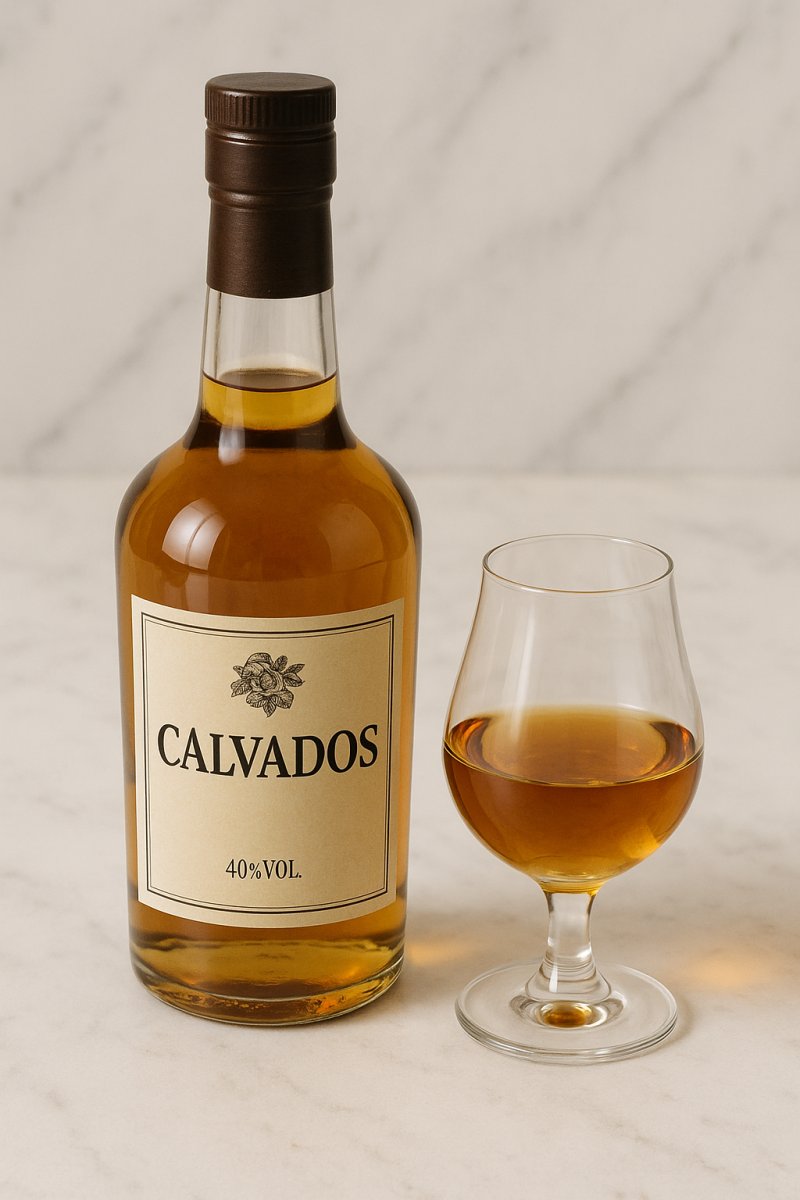
A glass of Calvados next to fresh apples
I still remember the first evening when I truly understood why Calvados has won so many hearts and glasses. A friend had brought a bottle from the back room of a small Normandy shop, deep amber and heavy like a secret. We sat in his kitchen, the light was warm, and already the first scent – a mixture of freshly picked apples, baked cake and a delicate wood note – made me pause. It was as if someone had distilled Normandy into a glass.

Calvados is an apple brandy from the French region of Normandy and is made by distilling fermented apple must. What particularly fascinates me is the combination of rural down‑to‑earth character and artisanal refinement. Producers often work with old apple varieties, some orchards are generations old, and each cuvée tells its own story of climate, soil and patience. The result can range from lively‑fresh to deep, complex and wood‑spiced.

For special evenings I like Calvados neat, at room temperature, so the aromas can fully open. At the same time, a visit to a small bistro reminds me of the versatility of this drink: a splash of Calvados in apple pie makes the sweetness more elegant, a dash in a sauce rounds off a roast, and I have even seen a bartender incorporate it into an autumnal cocktail that recalled warm punch.

A colleague of mine swears by serving Calvados alongside desserts. He briefly reduces it with a little sugar and orange zest, pours the sweet, aromatic liquid over vanilla ice cream and watches his guests' amazement. I'm also interested in ageing: in younger expressions I find the fruitiness clear and exciting, while aged bottlings offer notes of dried fruit, caramel and cedarwood that tell stories of decades in cask.

When I talk about Calvados, I also talk about regional culture: festivals in Normandy, apple harvest in autumn, and handcraft passed down from generation to generation. For the curious I recommend starting with small tastings, looking for differences between vintages and casks, and taking your time. That way you discover how a seemingly simple distillate can elevate cuisine, enrich conversations and preserve memories.

Availability & types

Availability and types of Calvados

Calvados is a French apple brandy made from apples (sometimes blended with pears). You can compare it to apple juice that has been given oxygen, time and heat until it becomes a robust spirit. Although Calvados is less known in some countries than wine or beer, it can be found in many well‑stocked supermarkets, liquor shops and online. In smaller towns it is rarer, but in cities or near French speciality stores the selection is usually larger.

Origin
Calvados originates from Normandy, a region in northern France. Many fruit trees grow there, especially apple trees, because the climate is often mild and humid – ideal for apples. The name "Calvados" comes from the area and is protected: only brandy produced in this region according to specific rules may truly be called that. This is similar to "Champagne": only sparkling wine from a particular region in France may bear that name.

Growing areas
The main growing areas for Calvados are in Normandy and are often named as follows:

  • Calvados (Pays d'Auge) – This is a particularly esteemed area. Many apple varieties for Calvados come from here.
  • Calvados AOC – This is the somewhat larger region that covers a bit more area than Pays d'Auge alone.
  • Calvados Domfrontais – This area in the west of Normandy also allows many pears, which is why Calvados from this region often tastes fruitier.
These zones are like different neighbourhoods where soil and weather create small differences – you can notice them in the flavour.

Available types and variants
Calvados comes in several variants that differ by age, flavour and production method. Here are the most common types, explained simply:

  • Jeune (jung) – This Calvados has been aged only briefly. It is fresh and fruity, similar to apple juice with more "warmth".
  • Vieux / Réserve (alt) – These variants have been aged longer in wooden casks. As a result they gain more aromas – for example vanilla or caramel – and a softer, rounder taste.
  • VSOP / XO – These letters indicate how long the Calvados has been aged at minimum. VSOP denotes an intermediate maturation time, XO a longer one. Older varieties are darker and often have more complex aromas.
  • Single Cask (Einzelfass) – This is Calvados from a single cask. Every drop can taste slightly different – like tasting apples from a specific tree.
  • Blend (Verschnitt) – Here the producer blends spirits from different casks or vintages to achieve a consistent flavour. It's like mixing colours to always get the same shade.
  • Calvados with pears – Especially from Domfrontais come variants that also include pears. These often taste sweeter and rounder.
When you buy Calvados, two things help you choose: the age (the older, the softer and more aromatic) and the origin (Pays d'Auge, Domfrontais or Calvados AOC). For beginners young or VSOP variants are often a good choice because they are fresh but not too sharp. Older varieties are well suited to enjoying in small amounts because they have a lot of flavour.

In summary: Calvados is a regional spirit with many variants – fresh or aged, made from apples alone or blended with pears. Its availability depends on where you shop, but in well‑stocked stores and online you will usually find a nice selection. Try different types to discover which you prefer – just like apples, which can taste very different.
Details & nutrition

Property Value
Unit ml
Calories per 100 240
Protein per 100 0
Carbohydrates per 100 0
Sugar per 100 0
Fat per 100 0
Saturated fat per 100 0
Monounsaturated fat 0
Polyunsaturated fat 0
Fiber per 100 0
Vitamin C (mg) per 100 0
Vitamin D (IU) per 100 0
Calcium (mg) per 100 0
Iron (mg) per 100 0
Nutri-Score E
CO₂ footprint 1.5
Origin France, Normandy
Gluten-free Yes
Lactose-free Yes
Nut-free Yes
Vegan Yes
Note Calvados is a distilled apple brandy with a typical alcohol content of about 40% vol.; it contains no significant amounts of macro- or micronutrients, but does provide calories from alcohol.

Technical & scientific information

Calvados is a French apple brandy (eau‑de‑vie) from Normandy, produced by distilling fermented apple must and subsequently ageing in oak casks. Legally protected, the designation Calvados refers only to spirits from certain production areas in Normandy made according to defined production methods. The base is a must from specific cider apple varieties, often with a share of pears, which after alcoholic fermentation is distilled and then matured for several years in wooden casks.

Raw materials and composition
Calvados is made from apple must, whose composition depends strongly on the apple varieties used. Typical constituents of the fresh must are sugars (mainly fructose and sucrose), fruit acids (especially malic acid), tannins (polyphenols such as procyanidins), free amino acids and aroma precursors like terpenes and esters. After fermentation the mash contains ethanol, methanol in small amounts (mostly from pectin breakdown), organic acids and fermentative by‑products such as higher alcohols (fusel oils), which are partially separated during distillation.

Distillation and technical parameters
Distillation is carried out either in continuous columns (typical for Calvados AOC Pays d’Auge, where often double discontinuous stills are prescribed) or in pot‑still units, depending on the appellation and desired aroma profile. During distillation volatile components are separated: head fractions (contain e.g. methanol, acetaldehyde) are discarded or used only in limited amounts, heart fractions supply the qualitatively relevant spirit, and tail fractions contain less desired higher boiling point components. The alcohol content of the raw spirit typically lies between 60 and 72 % vol. before cask ageing.

Ageing and chemical development
Ageing in oak casks induces several chemical processes that shape the final aroma. Wood extracts supply lignin and hemicellulose breakdown products (e.g. vanillin), tannins and lactones (e.g. whisky lactone) that are transferred to the distillate. At the same time slow oxidation and esterification reactions occur: ethanol reacts with organic acids to form esters that contribute fruity and floral notes. Maturation time varies, and legal age indications (e.g. VSOP, XO) serve as minimum durations, while complex aromas develop over several years of storage. Evaporative losses (the so‑called angel's share) lead to a slight increase in aroma concentration per unit volume and a decrease in volume alcohol content, unless diluted afterwards.

Nutritional values and health aspects
Calvados is an alcoholic beverage with a typical alcohol content between 40 and 45 % vol. The caloric content arises mainly from ethanol: 1 g of alcohol provides about 7 kcal. A standard portion (25–40 ml) therefore supplies roughly 70–140 kcal. From a nutritional perspective Calvados contains virtually no significant amounts of protein, carbohydrates, vitamins or minerals. Ethanol has known acute and chronic health effects: acutely it acts as a central nervous system depressant and impairs motor skills and judgement; chronically, regular high consumption promotes liver disease, cardiovascular problems and an increased cancer risk. Some studies report moderate cardioprotective effects at low intake, but these findings are controversial and strongly dependent on consumption patterns.

Safety and sensory aspects
Food safety relevant aspects concern in particular methanol content, volatile sulfides or fusel oils, which may be elevated with improper distillation. Legal limits and technical practices in fractionation minimise these risks. Sensorially Calvados is characterised by a wide aroma spectrum: from fresh apple notes to dried fruit, spices, vanilla and oak, up to roasted and caramel notes with longer ageing. This aromatic profile results from the interplay of the base fruit, microbial fermentation, distillation technique and wood‑related maturation processes.

Calvados is thus a technically complex product in which agricultural raw material quality, microbiological fermentation management, distillation precision and controlled cask ageing jointly shape the chemical composition and the sensory profile. Its production follows clearly defined regional and artisanal rules that integrate both traditional methods and scientifically derived quality controls.

Wiki entry for: calvados
Active now: 20 visitors of which 2 logged-in members in the last 5 minutes