Menu & categories

Buttermilk

Mildly tangy dairy product for drinking, baking and cooking.

Wiki about buttermilk Nutri-Score B Vegan No Gluten-free Yes Lactose-free No Nut-free Yes
NUTRITION / 100 ml
40 kcal 3.4 g Protein 4.8 g Kohlenhydrate 0.9 g Fett

Introduction

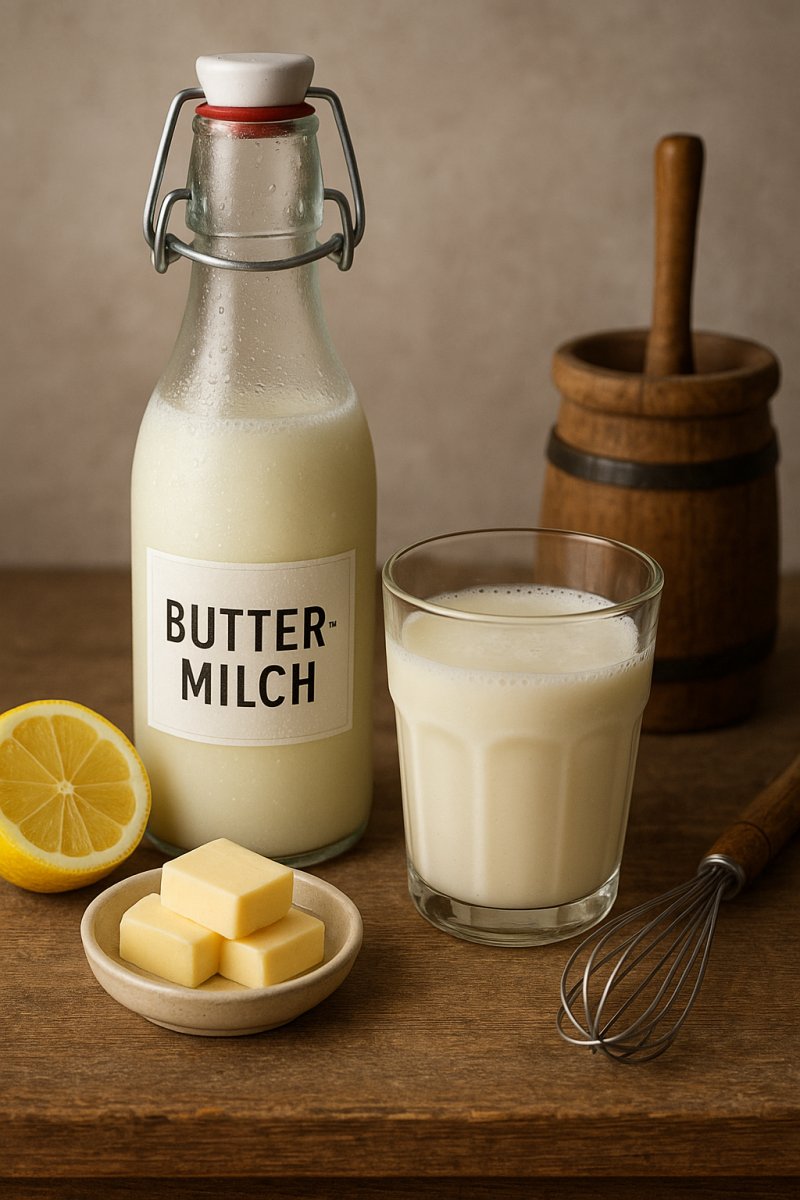
Fresh buttermilk in a glass
I have a secret weakness for buttermilk. Even the smell takes me back to warm kitchens where someone is stirring a bowl of pancake batter and a mysterious, slightly tangy aroma fills the air. A colleague once affectionately called it “kitchen yogurt for lazy bakers,” and I laughed because there's a lot of truth in that: buttermilk is uncomplicated, versatile and incredibly forgiving.

What I especially like is its texture and the way it reacts to heat. In savory sauces it provides creaminess without heaviness, in baking it makes cakes incredibly light, and in batter for fried potatoes it creates a perfect crust. I still remember a Sunday when I accidentally put too much baking powder into a cake — the buttermilk saved it and in the end we had a recipe that is now in my notebook.

A few practical things I always keep in mind:

  • Substitute: No buttermilk at home? One tablespoon of lemon juice or vinegar in 250 ml of milk replaces it well.
  • Baking: It reacts with baking powder and baking soda to provide airiness.
  • Marinades: Acid plus enzymes — perfect for tenderizing chicken pieces.
  • Storage: Well chilled it keeps for a few days; smell and taste are the best indicators.
I love experimenting with buttermilk: from cool summer drinks with cucumber and dill to warm, spicy stews where a splash of buttermilk added just before serving rounds the dish. Some time ago I was at a market, tasted a producer's homemade version and was delighted by how lively and fresh it tasted. Discoveries like that drive my small culinary adventures.

In the end buttermilk is for me an unobtrusive everyday hero: down-to-earth, versatile and full of surprising possibilities. I can only recommend using it more consciously — in sweet as well as savory recipes, because it brings just the right balance of acidity and creaminess to the kitchen.

Availability & types


Availability and types

What is buttermilk and where does it come from?
Buttermilk sounds like something that only comes from the kitchen. Historically that was the case: when people churned butter from cream, a thin milky liquid remained — that was the traditional buttermilk. Today the name is often used for a similar, slightly sour milk produced intentionally. In many supermarkets you won't find the “residual liquid,” but the modern variant made from milk with specific bacteria.

In which regions is buttermilk common?
Buttermilk is widespread in Europe and North America. In countries like Germany, the Netherlands, the United Kingdom and the USA you can easily find it in supermarkets. On small farms or traditional markets you sometimes still encounter the real, freshly churned variant. In some parts of the world buttermilk is less known and other types of fermented milk products are used.

Important varieties and types
Buttermilk today exists in different forms. Here are the main ones, simply explained:

  • Cultured buttermilk: This type is made from regular milk to which specific “good” bacteria are added. These bacteria make the milk slightly sour and thicker. This is the variety you usually find in the supermarket and that works well for baking.
  • Traditional buttermilk: This is the liquid left over when churning butter. It is somewhat thinner and can have regional flavor differences because farmers use different methods.
  • Low-fat or full-fat: Buttermilk is sometimes available with less fat (low-fat) or more fat (full-fat). Low-fat is like skimmed milk, only sour; full-fat feels creamier.
  • UHT (shelf-stable) vs fresh: Some buttermilk is long-life because it has been treated at high temperature (UHT). Other buttermilk is fresh and should be consumed more quickly in the refrigerator. Fresh buttermilk often tastes more vibrant.
  • Powdered form: There is also dried buttermilk in powder form. You mix it with water when needed — practical for baking or when fresh buttermilk is hard to obtain.
  • Lactose-free / for allergens: For people who have problems with milk sugar (lactose) there are lactose-free variants. There are also often similar plant-based products that mimic buttermilk.
  • Plant-based alternatives: For vegans or in case of milk allergy there are “buttermilk-like” products made from soy, oat, almond or coconut. They are not real buttermilk but are often used in the same way, e.g. in baking or as a dip.
  • Organic and regional products: In organic shops or farmers' markets you often find buttermilk from organic farming or directly from the farm. It sometimes tastes stronger and is less processed.
In summary: buttermilk is available as the traditional residual liquid, as intentionally cultured milk, low-fat or full-fat, fresh or shelf-stable, in powder form, lactose-free and as plant-based alternatives. The cultured variant is the most common in supermarkets, while on markets and small farms you can still find the traditional form. Everyone can choose depending on whether they want it for baking, as a drink or for cooking.
Details & nutrition

Property Value
Unit ml
Calories per 100 40
Protein per 100 3.4
Carbohydrates per 100 4.8
Sugar per 100 4.8
Fat per 100 0.9
Saturated fat per 100 0.6
Monounsaturated fat 0.2
Polyunsaturated fat 0.1
Fiber per 100 0.0
Vitamin C (mg) per 100 1.0
Vitamin D (IU) per 100 0
Calcium (mg) per 100 120
Iron (mg) per 100 0.1
Nutri-Score B
CO₂ footprint 0.11 kg CO2e/100 ml
Origin EU (often Germany)
Gluten-free Yes
Lactose-free No
Nut-free Yes
Vegan No
Note Nutritional values may vary slightly depending on fat content and manufacturer.

Technical & scientific information

Buttermilk is a fermented dairy product produced both as a traditional by-product of butter-making and intentionally by lactic acid fermentation of skimmed or partially skimmed milk. Chemically and microbiologically buttermilk differs from fresh milk mainly by an increased content of lactic acid, altered protein structures and characteristic aroma compounds such as diacetyl, which give it the slightly tangy and buttery taste.

Chemical composition and typical nutritional values

  • Energy content: approximately 25–60 kcal per 100 g, depending on fat content (skimmed buttermilk considerably lower).
  • Macronutrients: protein about 3–3.5 g/100 g, carbohydrates (mainly lactose) about 4–5 g/100 g, fat typically 0.5–1.5 g/100 g in commercial buttermilk.
  • Minerals and vitamins: calcium about 100–130 mg/100 g, phosphorus, potassium and fat-soluble vitamins in reduced amounts compared to whole milk; B vitamins such as riboflavin and B12 are present.
  • Acidity and pH: pH values are usually between 4.2 and 4.6; titratable acidity around roughly 0.5–1.0 % lactate equivalent.
Manufacturing process

Historically buttermilk arose as a liquid residue after skimming and churning cream to make butter. In modern food production, cultured buttermilk is mostly produced: pasteurized skimmed milk is inoculated with starter cultures, typically Lactococcus and Leuconostoc strains, and incubated at controlled temperature. During fermentation these lactic acid bacteria convert lactose to lactic acid and also produce aroma compounds (e.g. diacetyl) and sometimes exopolysaccharides that affect texture. After reaching the desired acidity the product is cooled and packaged. Homogenization and standardization of fat content are optional steps.

Microbiology and food technology

Fermentation lowers the pH and thereby inhibits the growth of many pathogenic organisms, which is why fermented products have a longer shelf life than fresh milk. Pasteurization before fermentation reduces the risk of pathogens; however, live cultures can remain after fermentation. Exopolysaccharides from certain cultures improve mouthfeel and viscosity without additional fat.

Functionality in cooking and food processing

Buttermilk has functional properties used in baked goods, marinades and dressings: the acidity reacts with baking soda to produce carbon dioxide, which lightens doughs; the acidity denatures proteins and promotes tenderness in marinated meat; proteins and fat help emulsify sauces.

Health aspects

Buttermilk provides energy, protein and calcium and can contribute to a lower-calorie diet if it is skimmed. Some fermented products contain live cultures that may support the gut flora; however not every buttermilk has probiotic properties in the strict sense. People with lactose intolerance tolerate it to varying degrees: some lactose is reduced by fermentation, but buttermilk is generally not completely lactose-free. It is unsuitable for milk protein allergy.

Storage and shelf life

Buttermilk should be stored refrigerated; unopened and properly cooled, shelf life is usually days to weeks depending on manufacturing and packaging. Sensory changes such as further souring, off-odors or strong phase separation indicate spoilage.

Overall buttermilk is a nutritionally interesting, technologically versatile and microbiologically stabilized component of milk processing with clearly defined chemical characteristics and established applications in gastronomy and industry.

Wiki entry for: buttermilk
Active now: 21 visitors of which 2 logged-in members in the last 5 minutes