Menu & categories

Bread roll

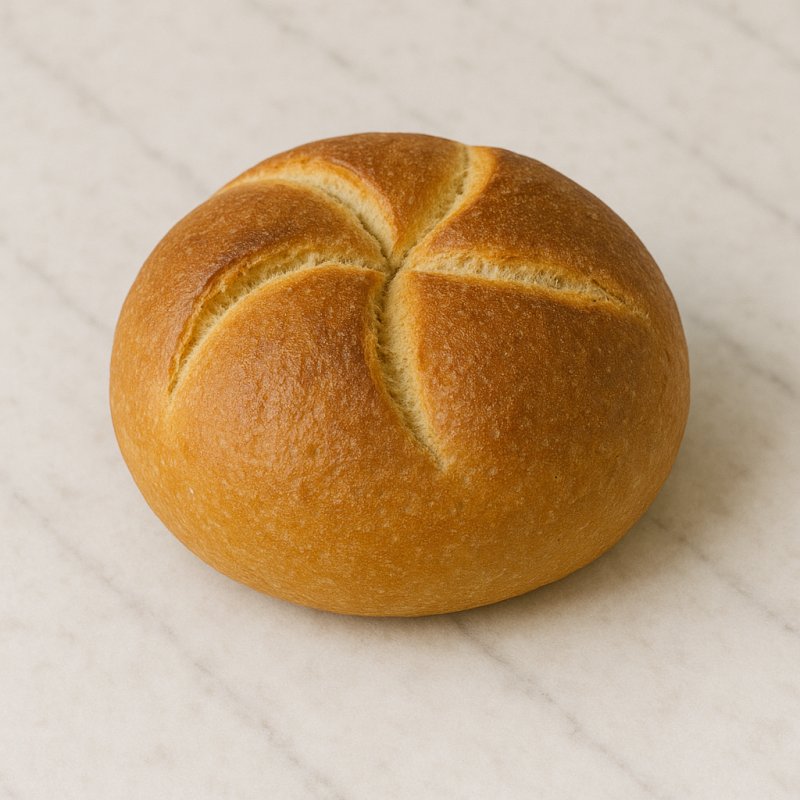
Classic wheat roll – crispy, mild and versatile.

Wiki about bread roll Nutri-Score C Vegan Yes Gluten-free No Lactose-free Yes Nut-free Yes
NUTRITION / 100 g
270 kcal 9.0 g Protein 52.0 g Kohlenhydrate 2.5 g Fett

Introduction

A simple roll with a golden-brown crust
I have a tender relationship with Brötchen, and I mean that quite literally: still warm, the crust slightly crisp, the fingers a bit dusted with flour — that is a small bit of happiness for me every morning. A colleague of mine once called them 'round problem solvers': bad mood? Brötchen. Unexpected guests? Brötchen. Not enough time? Brötchen. These little creations of flour, water, yeast and salt can do more than just fill you up; they tell stories of bakeries on street corners, Sunday brunches and the aroma that changes whole blocks.

What exactly a Brötchen is sounds simple, but regionally it becomes a small universe. There is the classic Schrippe, the airy Kaiserbrötchen variant, the rustic Vollkornbrötchen and the fine Laugenbrötchen. The basic ingredients remain surprisingly constant, yet kneading time, proofing and oven heat create countless nuances. I still remember a trip where every morning I tried a different roll and learned more about the city than in some guidebooks.

I have picked up practical tips over the years and am happy to share them:

  • Buy fresh: In the morning they are at their best, the crumb is airy and the crust crisp.
  • Storage: In a cotton bag they stay fresh longer; in the fridge they quickly lose their charm.
  • Reheating: Briefly in the oven at 160 °C or for ten seconds in the toaster — that revives the crust.
  • Use: As a sandwich, for dipping, as a side to soups or simply plain with butter and salt.
Sometimes small mishaps are what make a Brötchen story so endearing. Once I accidentally took six instead of three rolls on a hike; we shared them with strangers, and the group that formed became the highlight of the day. These bites act almost like an invitation: they crack, they smell, and they bring people together.

In the end: a good Brötchen is more than just an ingredient. It is a morning comfort, a culinary all-rounder and a piece of culture that charms in its simplicity and makes everyday life a little better.

Availability & types


Availability and types of Brötchen

A Brötchen is a small piece of bread eaten in many countries for breakfast or as a snack. Its origin lies in the long bread-baking tradition of Europe. In the past people baked at home or in small bakeries. Today rolls are available everywhere: at the bakery, in the supermarket or even at train stations. You can buy them fresh, frozen or prepackaged.

Growing regions – that is where the ingredients grow: the main ingredient for most rolls is cereal, especially wheat and rye. These cereals grow in large fields. In Europe they are widely grown in countries such as Germany, France, Poland and further afield in the USA, Canada or Russia. For special rolls other grains are sometimes used, such as spelt (an ancient wheat), oats or corn. If you imagine it like clothing: different plants are like different fabrics from which different things are sewn.

Available types and variants

  • Weizenbrötchen: The classic light roll with a crispy crust and soft interior. Many say this is the 'standard' roll.
  • Vollkornbrötchen: Baked from the whole grain. That means the fibrous parts of the plant are still present. As a result they are often a bit darker and keep you full longer.
  • Roggenbrötchen: Somewhat heartier in taste and darker. Rye often makes the roll denser.
  • Laugenbrötchen: These look like small pretzels and have a shiny, slightly salty crust.
  • Multigrain or seed rolls: With flaxseed, sesame, sunflower seeds or pumpkin seeds. They have a nice crunch and look colorful.
  • Sweet rolls (e.g. milk rolls): Softer and often a bit sweeter, good for children or as a sweet snack.
  • Regional variants: Depending on the area rolls are called and shaped differently – in southern Germany 'Semmel', in Berlin 'Schrippe', in Austria 'Weckerl'.
  • International variants: Ciabatta rolls (from Italy), pieces of baguette (from France) or brioche (French, buttery) – every culture has its own version.
So rolls are very versatile: some you prefer soft, others crispy or with seeds. Bakeries usually offer freshly baked rolls in the morning. Supermarkets often have a wider selection and also frozen or packaged rolls that last longer. Smaller bakeries often offer special varieties or regional recipes, while large manufacturers produce many similar rolls.

When choosing a roll, think briefly: do you want something healthy (e.g. whole grain), something quick (supermarket) or very fresh (bakery)? And feel free to try different types – that way you'll find your favorite. Rolls are practical, tasty and easy to obtain in many shapes and flavors.

Details & nutrition

Property Value
Unit g
Average weight per piece 60
Calories per 100 270
Protein per 100 9.0
Carbohydrates per 100 52.0
Sugar per 100 3.0
Fat per 100 2.5
Saturated fat per 100 0.4
Monounsaturated fat 0.6
Polyunsaturated fat 1.0
Fiber per 100 3.0
Vitamin C (mg) per 100 0
Vitamin D (IU) per 100 0
Calcium (mg) per 100 20
Iron (mg) per 100 3.0
Nutri-Score C
CO₂ footprint 0.07 kg CO2e/100 g
Origin Germany/Europe (typically made from wheat flour)
Gluten-free No
Lactose-free Yes
Nut-free Yes
Vegan Yes
Note Nutritional values can vary significantly depending on the recipe (e.g., with milk/butter or seeds).

Technical & scientific information


Brötchen in the German-speaking area denotes small, individually portioned baked goods based on wheat or mixed flour, produced by dough preparation, resting and baking. They differ in shape, crust, crumb and formulation, but technically viewed are a typical product of the small baked goods class with comparatively short baking time and high surface area relative to volume.

Composition and ingredients: The basic ingredients are flour, water, yeast or sourdough, salt and occasionally fat or sugar. Chemically dominated are:

  • Starch (approx. 50–70% of the flour dry matter): main carbohydrate source, consisting mainly of amylose and amylopectin.
  • Proteins (8–15% in wheat flour): mainly glutenin and gliadin, which together form the gluten network and enable dough elasticity and gas retention.
  • Lipids (1–3%): Present in small amounts, influence dough consistency and shelf life.
  • Minerals (ash content): significant especially in whole grain variants; include potassium, phosphorus, magnesium and iron.
  • Water: Determines dough viscosity and the activity of enzymatic processes.
Nutritional values (typical, per 100 g of a white roll): Energy 250–300 kcal, carbohydrates 45–55 g (mainly starch), protein 8–10 g, fat 2–5 g, fiber 2–4 g. Values vary depending on flour type, fat addition and recipe.

Manufacturing processes: Technically, production can be divided into several steps:

  • Mixing: Flour, water, salt and other ingredients are homogenized. Starch hydration and enzyme activation begin.
  • Kneading: Mechanical shear forces promote formation of the gluten film, which is important for gas retention and dough structure.
  • Fermentation/Primary proof: Yeast or sourdough produce CO2 and flavor compounds by fermenting sugars; at the same time pH and enzyme activity change.
  • Shaping and final proof: Portioning, shaping and the final rest period before baking.
  • Baking: Heat leads to starch gelatinization, protein denaturation and crust formation through Maillard reactions and caramelization. Crust formation influences flavor compounds, color and texture.
Technological additives: In industrial or artisanal recipes improvers, enzymes, emulsifiers or ascorbic acid are often used to improve volume, shelf life and dough stability.

Health aspects: Rolls are a quickly available energy source but mainly provide easily digestible carbohydrates, which can result in a medium to high glycemic index. Whole grain rolls contain significantly more fiber, B vitamins and minerals. For people with celiac disease or gluten intolerance standard wheat-based rolls are not suitable. Salt content can be nutritionally relevant; this should be considered with reduced salt intake. Excessive browning produces small amounts of acrylamide, a potential health-relevant by-product of the Maillard reaction.

Storage and microbiology: Fresh rolls are sensitive to drying out and mold growth. Cool, dry storage slows microbial spoilage. Freezing is commonly used to preserve freshness and delay starch retrogradation.

Overall, the roll is a technologically mature, nutritionally versatile staple food whose properties strongly depend on flour quality, dough management and the baking process.

Wiki entry for: bread roll
Active now: 20 visitors of which 2 logged-in members in the last 5 minutes