Menu & categories

Brandy

Aromatic distilled wine spirit with a high alcohol content.

Wiki about brandy Nutri-Score E Vegan Yes Gluten-free Yes Lactose-free Yes Nut-free Yes
NUTRITION / 100 ml
240 kcal 0.0 g Protein 0.0 g Kohlenhydrate 0.0 g Fett

Introduction

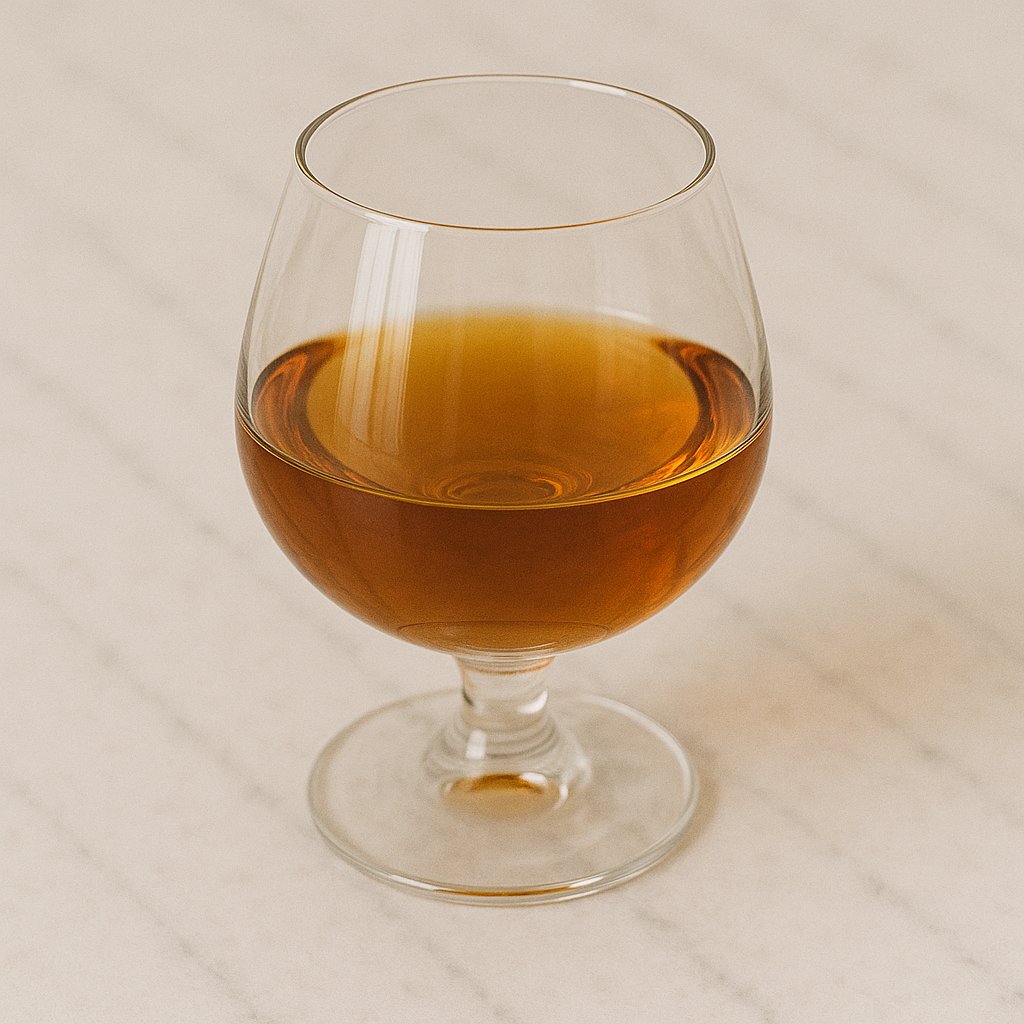
Bottle of brandy on a table

I have a small weakness for brandy, and not only because it warms you at the end of a nice meal, but because it tells stories in bottles. The first time I really noticed a glass of brandy was at a winter tasting, where the scent of vanilla, caramel and toasted wood immediately triggered a kind of time travel. Since then, at some family events I don't think of candles but of the soft clink of a cognac glass.

Brandy is made by distilling wine and traditionally ages in oak barrels. The result is complex aromas that can range from dried fruits to spice notes to chocolate. I still remember a colleague telling me that the art is in the barrel: the longer the aging, the silkier the texture, but a good brandy never loses its origin, that fine grapey undertone.

In everyday life I use brandy surprisingly versatilely. It is not only suited to the classic cognac glass, but it gives sauces depth, makes desserts shine and even livens up savory dishes like braised beef. A little splash in the roasting juices can turn a simple sauce into something elegant. I often keep a small bottle at hand in my kitchen because it rarely disappoints.

  • Tasting notes: Vanilla, caramel, nut, dried fruits, oak tones.
  • Use: Digestif, cocktail base, refinement of sauces and desserts.
  • Storage: Cool, dark and closed, brandy remains stable for a long time.
Once, at a small birthday gathering, I forgot to drizzle the traditional dash over the cake. The guests noticed immediately and asked why it tasted "so youthful." I learned from that that brandy not only creates aroma but also evokes memories. When I now recommend someone experiment with brandy, I advise small amounts and good taste: it is powerful, but never clumsy.

In conclusion, for me brandy remains a reliable companion between kitchen and hearth, a drink to be taken seriously but also enjoyed with a wink.

Availability & types


Brandy is a beverage made from wine that is then distilled. You can imagine it like grape juice that first becomes wine and then is concentrated and aged to get a warm, rounded flavor. In this section I explain where brandy comes from, in which regions it is produced, what varieties exist and how easy it is to buy — all so that a 12‑year‑old can understand it well.

Origin and short history
Brandy has a long history. Many hundreds of years ago people discovered that wine tastes even better if you distill it and then store it in wooden barrels. The wood gives the brandy special aromas. Some regions became famous for this and even received their own names for their brandy.

Important growing and production areas
Brandy itself does not grow on a tree — the grapes do. Important grape-growing regions are therefore also important places for brandy. Well-known regions include:

  • France: Particularly famous are Cognac and Armagnac. There specific grapes are used and special rules are followed so that the product may carry that special name.
  • Spain: There is Brandy de Jerez, often with a strong flavor due to aging in special sherry casks.
  • Italy, Portugal and Germany: Also produce brandy in various styles, often regionally different.
  • USA and many other countries: Make modern versions, sometimes with different grapes or production methods.
What types and variants exist?
Brandy comes in several variants that differ mainly by age, production method and origin. A few simple categories:

  • Age classes (VS, VSOP, XO): These abbreviations tell how long the brandy has aged in wooden casks. You can imagine it like shoes: new (VS) are fresh, medium (VSOP) have a somewhat worn aroma, and old (XO) are very aged and have many special aromas.
  • Geographical types: Cognac, Armagnac, Brandy de Jerez — each type has its own rules and tastes different. Cognac is often very refined, Armagnac more robust, Brandy de Jerez sometimes sweeter.
  • Simple brandy vs specialties: There are young, clear brandies, long-aged wood-aged brandies or flavored versions with spices or fruit.
  • Brandy vs fruit brandies: Brandy comes from wine (i.e. grapes). Fruit brandies (e.g. kirsch) come from other fruits.
Availability — where can you buy brandy?
Brandy is easy to find in many shops. You can buy it in supermarkets, well-stocked liquor stores, specialty shops and online. Prices range from inexpensive bottles for everyday use to very expensive collector bottles. Small bottles for trying are often available, and labels usually indicate whether it is VS, VSOP or XO or from which region the brandy originates.

In summary: brandy exists in many variants and from many countries. It can be young or very old, mild or strong, and it is easy to find in stores or online. Next time you see a bottle, pay attention to origin and age designation — that already reveals much about the taste.
Details & nutrition

Property Value
Unit ml
Calories per 100 240
Protein per 100 0.0
Carbohydrates per 100 0.0
Sugar per 100 0.0
Fat per 100 0.0
Saturated fat per 100 0.0
Monounsaturated fat 0.0
Polyunsaturated fat 0.0
Fiber per 100 0.0
Vitamin C (mg) per 100 0.0
Vitamin D (IU) per 100 0
Calcium (mg) per 100 0
Iron (mg) per 100 0.0
Nutri-Score E
CO₂ footprint 0.16 kg CO2e/100 ml
Origin EU (often France)
Gluten-free Yes
Lactose-free Yes
Nut-free Yes
Vegan Yes
Note Alcohol-containing ingredient (typically approx. 36–40% vol.); when cooking alcohol can partially evaporate, flavors remain.

Technical & scientific information


Brandy is a type of spirit distilled from wine; it concentrates, refines and often ages in wooden barrels the alcohol mixtures produced by fermentation of grape juice. Chemically, brandy consists primarily of ethanol (C2H5OH) and water, supplemented by a complex mixture of accompanying compounds (so‑called congeners) that determine aroma, taste and physiological effects.

Composition and ingredients:

  • Ethanol and water: Ethanol is the main component and provides the energetic basis; the alcohol content of common brandies typically lies around 36–40% vol.
  • Higher alcohols (fusel oils): Propanol, butanol, amyl alcohols and related compounds contribute to body and warming sensation.
  • Volatile esters: Ethyl acetate, ethyl butyrate and other esters form during fermentation and aging and give fruity and floral notes.
  • Aldehydes and ketones: Acetaldehyde and smaller ketones influence freshness and sometimes sharpness of the aroma.
  • Phenolic compounds and tannins: Vanillin, eugenol and tannins come mainly from barrel aging and shape color, vanilla and spice notes and mouthfeel.
  • Trace substances: Minerals, organic acids and very small amounts of residual sugars can vary depending on the base wine.
Manufacturing process: The base is fermented grape wine. It is usually distilled using methods such as skillful pot-still distillation or continuous column stills. During distillation heads and tails are separated to minimize unwanted components and to obtain the so‑called heart. This is often followed by aging in oak barrels, during which chemical processes such as oxidation, ester formation and extraction of wood-typical substances take place. The duration and type of barrel aging largely determine the color, aroma and texture of the final product.

Sensory and technological changes: Barrel aging leads to browning through extracted lignin and tannin components and to a softening of harsh alcohol tones. Ester formation between alcohols and acids provides fruity nuances. Continuous maturation and blending of different batches serve to achieve consistent quality profiles.

Nutritional values and calories: Brandy yields primarily energy from ethanol. In 100 ml of a 40% spirit roughly 200–250 kcal can be expected, depending on density and residual components. For a standard portion (about 20–30 ml) the calorie amounts are correspondingly lower. Macronutrients like carbohydrates, proteins or fats are practically absent.

Health aspects:

  • Ethanol is primarily oxidized in the liver by alcohol dehydrogenase to acetaldehyde and further to acetate; acetaldehyde is considered a reactive, toxic intermediate.
  • Regular or high consumption increases the risk of liver disease, certain cancers and cardiovascular problems. Moderate amounts can have short-term vasodilatory effects; long-term effects must be assessed on a risk basis.
  • Particular caution is advised during pregnancy, when taking medications and with genetic differences in alcohol‑metabolizing enzymes (e.g. ALDH2 variants).
  • Congeners, especially fusel oils and aldehydes, are associated with stronger hangover symptoms.
Use and storage: Brandy is consumed neat, as part of mixed drinks, in cooking (e.g. for flambéing or sauces) and to enhance desserts. After bottling it remains stable for years if protected from light and oxygen; opened bottles should be stored cool and dark as prolonged oxygen exposure can cause aroma loss.

In summary, brandy is a technologically and chemically multifaceted product whose character is determined by the base wine, distillation technique and barrel aging. The main chemical actors are ethanol, water and a bundle of congeners that together shape the sensory profile and metabolic effects. Responsible consumption and knowledge of the health effects are important when enjoying and using it in food.

Wiki entry for: brandy
Active now: 6 visitors of which 2 logged-in members in the last 5 minutes