Menu & categories

Black olives

Aromatic olives matured in brine with an intense flavor

Wiki about black olive Nutri-Score C Vegan Yes Gluten-free Yes Lactose-free Yes Nut-free Yes
NUTRITION / 100 g
235 kcal 1.5 g Protein 6.0 g Kohlenhydrate 22.0 g Fett

Introduction

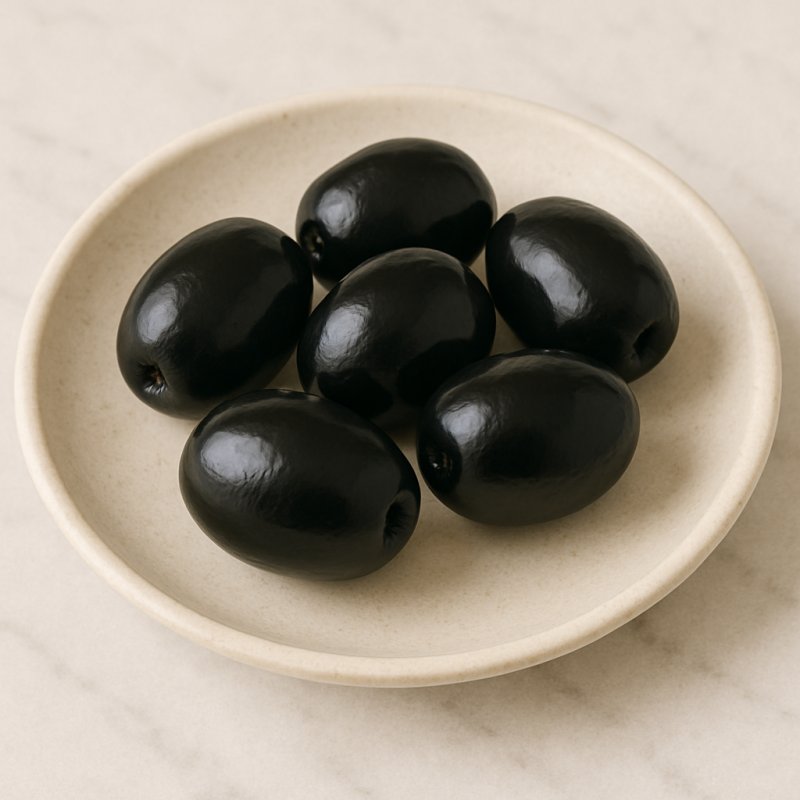
Black olives in a small bowl
I still clearly remember the first taste of black olives, which surprised me so much that I laughed out loud. A friend had simply brought them from a market stall, in a small oil-glossy bowl, and I expected the usual salty flavor. Instead I was hit by a mix of deep fruitiness and a subtle bitterness that immediately conjured images of sun-drenched groves, rugged stone terraces and long summer evenings.

Black olives are more than just a pretty garnish on pizza or a quick ingredient for a salad. They are the result of ripeness, handling and tradition. While green olives are harvested early, the fruit for black ones is allowed to fully ripen. This changes aroma, texture and sugar levels – that makes the difference between a flat and a complex taste experience.

When I think of dishes where black olives shine, a few classics come to mind right away.

  • Tapenade – purist and intense, perfect on crusty bread.
  • Pasta – with tomatoes, capers and olives it becomes a little Mediterranean getaway for the mouth.
  • Baked goods – olive bread or savory scones gain depth and character.
I once tried to make a simple bruschetta with the dark olives that still shimmered with their preserving oil. A colleague was skeptical until he took the first bite and immediately asked for the recipe. Moments like that show me how easily this ingredient can spark conversations and memories.

Beyond the taste I appreciate the versatility: they come pickled, as pasteurized variations or even as dried specialties. When I buy olives I pay attention to origin labels and preservation methods, because they influence texture and intensity. A small trick I like to share: rinse olives briefly in warm water if they seem too salty, it brings out more balanced flavors.

For me black olives are an invitation to play with colors, textures and stories. They are uncomplicated and yet strong-willed, ideal for quick dishes and for festive menus alike. In my kitchen they are often the quietly enthusiastic hero that holds dishes together and creates memories.

Availability & types

Availability and types

Black olives can be found in many supermarkets, delicatessens and weekly markets. Sometimes they are fresh, but often they are packaged in jars, cans or as pasteurized goods. Fresh olives straight from the tree are rarer, because they usually only become edible after treatment. When you buy olives you can check the label: it will state whether they are preserved, in brine, dried or conserved in oil. These different types affect flavor and shelf life.

Origin and growing regions

Black olives mainly come from countries around the Mediterranean. Important producing countries include:

  • Spain: One of the largest producing countries. Many varieties such as the well-known "Manzanilla" or "Arbequina" come from here.
  • Italy: Italian olives often come from regions like Apulia or Sicily. They are known for robust flavor.
  • Greece: Famous for varieties like the Kalamata olive, which is large and aromatic. It is often deep purple to black.
  • Turkey, Tunisia and Morocco: These countries also supply many olives, often for export in preserves or as table olives.
There are now also olive trees in other warmer parts of the world, for example in California, Australia or Chile. There the trees grow under a climate similar to the Mediterranean: lots of sun, warm summers and mild winters.

Available varieties and variants

Black olives are not all the same. There are many varieties and processed variants. Here are some you can easily understand:

  • Unripe vs. ripe olives: Olives on the tree are green at first. As they ripen they turn dark – purple or black. Some are artificially blackened, others ripen naturally, which changes the flavor.
  • Kalamata: These olives are pear-shaped, dark purple to black and very aromatic. They often appear in Greek salads.
  • Gaeta: Small, dark olives from Italy with a mild, slightly sweet taste.
  • Arbequina: Originally from Spain, small and round, often packed in oil and somewhat nutty in flavor.
  • Pitted: Many black olives can be bought without pits. This is practical if you want to eat them straight away or use them in dishes.
  • Stuffed: Some olives are filled with peppers, garlic, almonds or cheese. It's like a small surprise package inside.
  • Dried or semi-dried: These are more intense in flavor because part of the water has been removed, similar to sun-dried tomatoes.
  • In oil or brine: Olives in oil often taste richer, while olives in brine tend to preserve the natural flavor and last longer.
Simply put: black olives come in many forms – large or small, soft or firm, with or without pits, plain or stuffed. When you try olives you'll soon notice which variety you like best. Some are mild and almost sweet, others are spicier or saltier. It's like tasting different varieties of apples: each has its own character.

When buying it helps to check origin and method of preservation. That way you find the olives that suit your taste and the dish you plan to make. Whether in a salad, on pizza or plain as a snack – black olives are versatile and available in many variants.
Details & nutrition

Property Value
Unit g
Average weight per piece 3
Calories per 100 235
Protein per 100 1.5
Carbohydrates per 100 6.0
Sugar per 100 0.5
Fat per 100 22.0
Saturated fat per 100 3.0
Monounsaturated fat 16.0
Polyunsaturated fat 2.0
Fiber per 100 3.0
Vitamin C (mg) per 100 1.0
Vitamin D (IU) per 100 0
Calcium (mg) per 100 90
Iron (mg) per 100 3.0
Nutri-Score C
CO₂ footprint 1.5
Origin Mediterranean region (e.g. Spain, Greece, Italy)
Gluten-free Yes
Lactose-free Yes
Nut-free Yes
Vegan Yes
Note Nutritional values refer to pitted black olives preserved in brine; high fat content mainly from monounsaturated fatty acids.

Technical & scientific information

Olives, black are the ripe-harvested fruits of the oil- and table-olive tree (Olea europaea) and constitute a distinct ingredient with specific chemical, nutritional and technological properties. Botanically they are drupes (stone fruits), whose color during ripening changes from green through purple to dark purple or black. The black color results from a higher concentration of pigments such as anthocyanins and the breakdown of chlorophyll-containing compounds in ripe fruits.

Chemical composition and constituents

  • Fatty acids: Olives are largely composed of lipids, the main fraction being high-quality vegetable oil. The oil contains predominantly monounsaturated fatty acids, particularly oleic acid (C18:1), with palmitic acid (saturated) and linoleic acid (polyunsaturated) also present.
  • Polyphenols: Black olives contain phenolic compounds such as oleuropein (higher in unripe fruits), hydroxytyrosol, tyrosol and other flavonoids. These molecules contribute to antioxidant activity and the characteristic taste.
  • Pigments: Anthocyanins, melanin-like oxidation products and degradation products of chlorophyll are responsible for the dark coloration; pigment content varies by variety.
  • Other constituents: Olive pulp/pomace contains water, fiber, proteins, minerals (e.g. potassium, calcium, iron) and traces of vitamins, notably vitamin E (tocopherols) as a lipid-soluble antioxidant.
Nutritional values (typical per 100 g, preserved in brine)

  • Calories: approximately 100–145 kcal, depending on oil content and preservation method.
  • Fat: 8–15 g, predominantly monounsaturated (oleic acid).
  • Protein: 0.5–1.5 g.
  • Carbohydrates: 1–4 g, including fiber 2–4 g.
  • Salt: highly variable; pickled black olives can contain 1 g to over 3 g sodium per 100 g.
Processing methods

  • Natural ripening: Some varieties are harvested naturally black and dried, with no alkalization. This drying or sun technique reduces bitterness partly through enzymatic changes.
  • Lye treatment and preservation: Many black olives are treated after harvest with lye (sodium hydroxide) to remove bitter compounds like oleuropein, and then fermented or preserved in brine or oil. The duration and concentration of the lye influence aroma and texture.
  • Fermentation: Lactic acid fermentation by the natural microflora alters flavor and increases shelf life. Fermentation processes generate organic acids, change polyphenol profiles and influence microbial safety.
  • Blackening: Industrially blackened olives can be darkened by oxidation or by addition of E151 (Black); in high-quality products this, however, is rare and unnecessary.
Health aspects

  • The composition rich in monounsaturated fatty acids and polyphenols makes black olives a component that potentially supports cardioprotective effects, for example through beneficial effects on lipid profiles and oxidative stress markers.
  • Polyphenols such as hydroxytyrosol are considered strongly antioxidant and may have anti-inflammatory effects. Bioavailability depends on matrix and processing.
  • High salt content of preserved olives should be noted; people with hypertension or sodium restriction should limit consumption.
  • Allergies to olives are rare but can occur; olives also contain secondary plant compounds that in individual cases can cause intolerances.
Quality and storage aspects

Fresh black olives are sensitive to light, oxygen and temperature. Preserved products keep quality best in airtight containers under cool storage; oil or brine prevents microbial spoilage. Sensory quality is assessed by flesh firmness, a balanced fat-to-salt ratio and characteristic aroma.

Overall, black olives are a complex ingredient that varies greatly in chemical composition and nutritional properties due to genetic varietal differences, time of ripening and processing methods. Their combination of monounsaturated fatty acids, antioxidant polyphenols and a specific aroma profile makes them both culinarily valuable and interesting from a nutritional science perspective, while processing and salt content substantially affect the health balance.

Wiki entry for: black olive
Active now: 20 visitors of which 2 logged-in members in the last 5 minutes